
生长相关蛋白43(GAP - 43)在阿尔茨海默病痴呆连续体中预测脑淀粉样变性:一项[F] AV - 45研究。
Growth associated protein 43 (GAP-43) predicts brain amyloidosis in Alzheimer's dementia continuum: an [ F] AV-45 study.
作者信息
Nemati Rezvan, Sohrabi-Ashlaghi Ahmadreza, Saberian Parsa, Sadeghi Mohammad, Mardani Sajjad, Abadi Amir Sina Jafari Hossein, Yaghoobpoor Ali, Heydari Atefeh, Khoshroo Niloofar, Rahnama Yassin, Mayeli Mahsa, Nasiri Hamide
机构信息
Department of Psychology, Islamic Azad University Arak branch, Arak, Iran.
Department of Physiology, Faculty of Medicine, Tehran Medical Sciences, Islamic Azad University, Tehran, Iran.
出版信息
BMC Neurol. 2025 Apr 1;25(1):134. doi: 10.1186/s12883-025-04140-5.
BACKGROUND
Growth-associated protein 43 (GAP-43) is a key protein involved in neuronal growth and synaptic plasticity. Alterations in GAP-43 levels have been associated with Alzheimer's Disease (AD), potentially reflecting synaptic dysfunction. We evaluated the potential of GAP-43 as a biomarker for AD and explored its association with amyloid-beta (Aβ) levels, as well as its correlation with Aβ plaque burden in the brain.
METHODS
We screened 1,639 participants from the Alzheimer's Disease Neuroimaging Initiative (ADNI) cohort. A total of 226 individuals met the eligibility criteria and were enrolled. Participants were classified into three groups: 77 cognitively normal (CN) individuals, 111 with mild cognitive impairment (MCI), and 38 with a diagnosis of AD. The associations between cerebrospinal fluid (CSF) GAP-43 levels with other biomarkers as well as [¹⁸F] AV-45 (Florbetapir) PET Standardized Uptake Value Ratios (SUVR) were investigated.
RESULTS
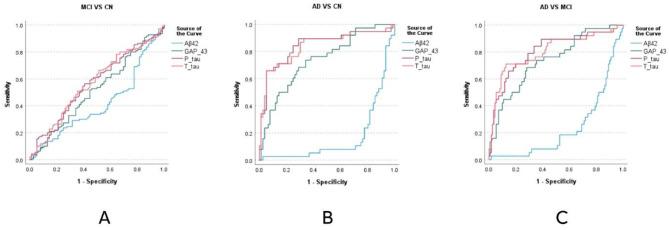
Our findings revealed significantly elevated CSF GAP-43 levels in individuals with AD compared to CN and MCI groups. Furthermore, GAP-43 levels showed a significant positive correlation with tau pathology. Notably, we observed a significant association between GAP-43 and [¹⁸F] Florbetapir PET SUVR in the MCI group, suggesting that GAP-43 may serve as a reliable biomarker in the early stages of AD.
CONCLUSION
This study provides evidence supporting the role of GAP-43 as a potential biomarker for AD, particularly in relation to predicting the amyloid pathology pattern in the brain in the MCI stage.
背景
生长相关蛋白43(GAP - 43)是一种参与神经元生长和突触可塑性的关键蛋白。GAP - 43水平的改变与阿尔茨海默病(AD)相关,可能反映突触功能障碍。我们评估了GAP - 43作为AD生物标志物的潜力,并探讨了其与β淀粉样蛋白(Aβ)水平的关联以及与大脑中Aβ斑块负荷的相关性。
方法
我们从阿尔茨海默病神经影像学倡议(ADNI)队列中筛选了1639名参与者。共有226人符合纳入标准并被纳入研究。参与者被分为三组:77名认知正常(CN)个体、111名轻度认知障碍(MCI)个体和38名被诊断为AD的个体。研究了脑脊液(CSF)中GAP - 43水平与其他生物标志物以及[¹⁸F] AV - 45(氟代贝他吡)PET标准化摄取值比率(SUVR)之间的关联。
结果
我们的研究结果显示,与CN组和MCI组相比,AD患者脑脊液中GAP - 43水平显著升高。此外,GAP - 43水平与tau病理呈显著正相关。值得注意的是,我们在MCI组中观察到GAP - 43与[¹⁸F]氟代贝他吡PET SUVR之间存在显著关联,这表明GAP - 43可能在AD早期阶段作为一种可靠的生物标志物。
结论
本研究提供了证据支持GAP - 43作为AD潜在生物标志物的作用,特别是在预测MCI阶段大脑中的淀粉样蛋白病理模式方面。
 Zotero 插件