
脂质蓄积产物与相对握力之间的关联:一项基于大规模人群的研究。
Association between lipid accumulation products and relative handgrip strength: a large population-based study.
作者信息
Wu Qian, Ling Yicheng, Yuan Guiqiang, La Rui, Xu Bin, Pang Erkai, Lin Chuan, Chen Zhanghuan, Zhang Zhigang, Jiang Dinghua, Huang Lixin, Xu Jiangnan, Mao Yubo
机构信息
Department of Orthopedic Surgery, Wuxi Ninth People's Hospital Affiliated to Soochow University, Jiangsu, China.
Department of Orthopedic Surgery and Sports Medicine, Institute of Orthopedics, The First Affiliated Hospital of Soochow University, Soochow University, Jiangsu, China.
出版信息
Sci Rep. 2025 Apr 4;15(1):11562. doi: 10.1038/s41598-025-96481-x.
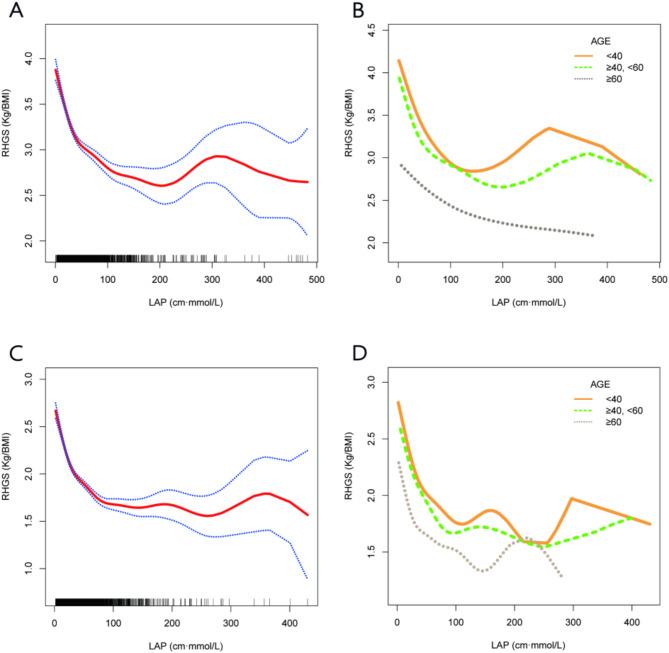
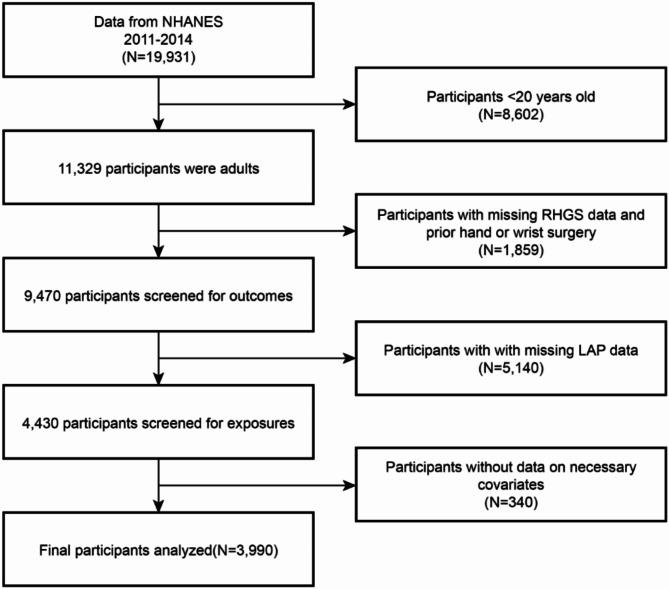
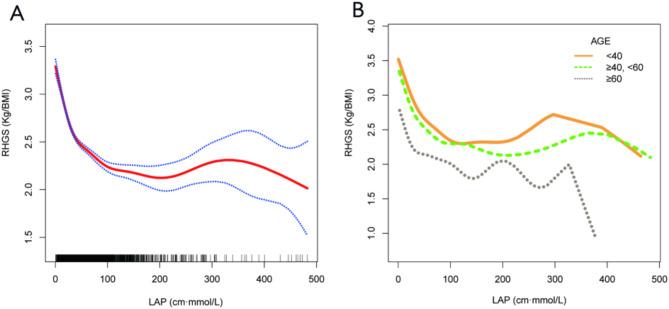
Given the increasing prevalence of chronic diseases in the aging population, it is of great importance to gain an understanding of how changes in body composition affect health outcomes. Handgrip strength (HGS) serves as a valuable proxy for overall muscle strength, while relative HGS (RHGS) adjusts for body size, providing a more accurate assessment of the relationship between muscle strength and metabolic disease. Lipid accumulation products (LAP) are an indicator that can reflect visceral lipid accumulation. Based on previous studies, the relationship between LAP and RHGS has not been explored. This study aims to address this gap in the literature and provide insights for public health recommendations. Data was collected and extracted from the 2011-2014 National Health and Nutrition Examination Survey (NHANES) database. LAP was calculated from the arithmetic product of waist circumference (WC) and fasting plasma triglyceride (TG), the calculation as following formulas: for females, [WC (cm) - 58] × [TG (mmol/l)], and for males, [WC (cm) - 65] × [TG (mmol/l)]; RHGS was derived from the HGS to BMI ratio. The correlation between the variables was initially explored using multivariate linear regression. Secondly, smoothed-fitted curves were used to investigate the non-linear relationship between the variables. The inflection point values were determined based on the results of the threshold effect analysis. Subgroup analyses were also conducted to assess the stability of the relationship between the variables in different populations. The study analyzed 3990 patients. After accounting for different covariates, multivariate linear regression analysis demonstrated a significant negative correlation between increased levels of LAP and increased levels of RHGS (beta coefficient = -0.0020; 95% confidence interval CI: -0.0023 to -0.0017; P < 0.0001). The interaction test did not have a statistically significant effect on this association. Furthermore, curve fit and threshold effect analysis demonstrated a non-linear relationship with a breakpoint at 49.8083 cm·mmol/L. The results of this study demonstrate an inverse relationship between LAP and RHGS in various populations in the United States. These findings provide compelling evidence of the clinical significance of LAP as a predictor of RHGS, offering valuable insights for developing early intervention strategies in high-risk populations.
鉴于慢性病在老年人群中的患病率不断上升,了解身体成分变化如何影响健康结果至关重要。握力(HGS)是整体肌肉力量的一个有价值的替代指标,而相对握力(RHGS)则根据身体大小进行调整,能更准确地评估肌肉力量与代谢疾病之间的关系。脂质积聚产物(LAP)是一种可反映内脏脂质积聚的指标。基于以往研究,尚未探讨LAP与RHGS之间的关系。本研究旨在填补这一文献空白,并为公共卫生建议提供见解。数据收集自2011 - 2014年国家健康与营养检查调查(NHANES)数据库并从中提取。LAP通过腰围(WC)与空腹血浆甘油三酯(TG)的算术乘积计算得出,计算公式如下:女性为[WC(厘米) - 58]×[TG(毫摩尔/升)],男性为[WC(厘米) - 65]×[TG(毫摩尔/升)];RHGS由HGS与BMI的比值得出。首先使用多元线性回归探索变量之间的相关性。其次,使用平滑拟合曲线研究变量之间的非线性关系。根据阈值效应分析结果确定拐点值。还进行了亚组分析以评估不同人群中变量之间关系的稳定性。该研究分析了3990名患者。在考虑不同协变量后,多元线性回归分析表明LAP水平升高与RHGS水平升高之间存在显著负相关(β系数 = -0.0020;95%置信区间CI:-0.0023至-0.0017;P < 0.0001)。交互作用检验对这种关联没有统计学上的显著影响。此外,曲线拟合和阈值效应分析表明存在非线性关系,断点为49.8083厘米·毫摩尔/升。本研究结果表明,在美国不同人群中,LAP与RHGS之间存在负相关关系。这些发现提供了令人信服的证据,证明LAP作为RHGS预测指标的临床意义,为制定高危人群的早期干预策略提供了有价值的见解。
 Zotero 插件