
线性规划方法在五岁以下儿童饮食优化中的应用:一项范围综述
The use of linear programming approach in diet optimization among children under five: a scoping review.
作者信息
Miow Yee Xuen, Mok Wilfred Kok Hoe, Gan Wan Ying, Lim Poh Ying, Appannah Geeta, Adznam Siti Nur 'Asyura
机构信息
Department of Nutrition, Faculty of Medicine and Health Sciences, Universiti Putra Malaysia, 43400, Serdang, Selangor, Malaysia.
Institute for Health Systems Research, National Institutes of Health, Ministry of Health Malaysia, 40170, Shah Alam, Selangor, Malaysia.
出版信息
BMC Public Health. 2025 Apr 4;25(1):1279. doi: 10.1186/s12889-025-22414-y.
BACKGROUND
Adequate nutrition is crucial for optimal child growth and development, especially for children under five. Over the years, the linear programming (LP) approach has been used to develop food-based recommendations (FBRs) for children under five.
OBJECTIVE
This scoping review aims to (i) summarize the use of LP in diet optimization to improve nutrient adequacy, (ii) evaluate nutrient requirements by using modelling techniques when the use of local foods is optimized, and (iii) identify and compare the problem nutrient(s).
METHODS
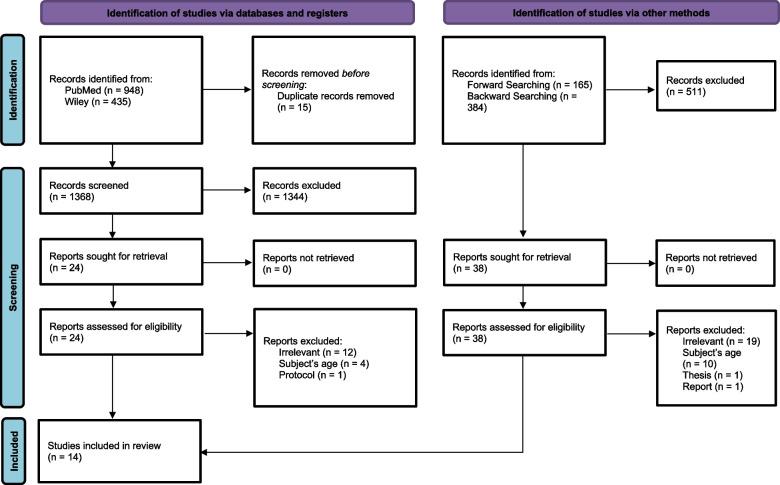
This scoping review was performed by searching PubMed and Wiley databases from 2012 to 2025, and also screened the reference lists of included publications to identify potentially eligible articles. Forward and backward citation searches were also performed to supplement the structured searches in the databases.
RESULTS
Fourteen studies were included after a systematic literature search. The objective functions and the final set of FBRs of the included studies were summarized. Moreover, the nutrient intakes in the optimized diets and the problem nutrients of the included studies were compared and discussed. When optimizing diets using the LP approach, most of the nutrient requirements can be achieved, except for iron and zinc and, in some studies, thiamine, niacin, folate, and calcium. Iron was identified as the problem nutrient in all studies involving infants aged 6 to 11 months old, followed by calcium and zinc. In children aged 12 to 23 months, iron and calcium were identified as the problem nutrients in almost all studies, followed by zinc and folate. In children aged 1 to 3 years, fat, calcium, iron, and zinc were recognized as the absolute problem nutrients, while fat, calcium, and zinc were the absolute problem nutrients for children aged 4 to 5 years. Findings on dietary inadequacy of nutrient intakes were remarkably consistent across studies conducted in different geographic and socioeconomic settings.
CONCLUSIONS
Modeled diets involving local foods are inadequate to meet the requirements for certain micronutrients, particularly iron and zinc. Cost-effective strategies are required to improve the dietary adequacy of young children.
背景
充足的营养对于儿童的最佳生长和发育至关重要,尤其是对五岁以下儿童。多年来,线性规划(LP)方法一直被用于制定五岁以下儿童基于食物的建议(FBRs)。
目的
本范围综述旨在(i)总结LP在饮食优化中用于提高营养充足性的应用,(ii)在优化当地食物使用时通过建模技术评估营养需求,以及(iii)识别和比较问题营养素。
方法
本范围综述通过检索2012年至2025年的PubMed和Wiley数据库进行,并筛选纳入出版物的参考文献列表以识别潜在符合条件的文章。还进行了向前和向后的引文搜索,以补充数据库中的结构化搜索。
结果
经过系统的文献检索,纳入了14项研究。总结了纳入研究的目标函数和最终的FBRs集。此外,还对优化饮食中的营养摄入量和纳入研究的问题营养素进行了比较和讨论。当使用LP方法优化饮食时,除了铁和锌,以及在一些研究中的硫胺素、烟酸、叶酸和钙外,大多数营养需求都可以得到满足。在所有涉及6至11个月大婴儿的研究中,铁被确定为问题营养素,其次是钙和锌。在12至2岁的儿童中,几乎所有研究都将铁和钙确定为问题营养素,其次是锌和叶酸。在1至3岁儿童中,脂肪、钙、铁和锌被认为是绝对的问题营养素,而脂肪、钙和锌是4至5岁儿童的绝对问题营养素。在不同地理和社会经济环境中进行的研究中,关于营养摄入饮食不足的研究结果非常一致。
结论
涉及当地食物的模拟饮食不足以满足某些微量营养素的需求,特别是铁和锌。需要具有成本效益的策略来提高幼儿的饮食充足性。
 Zotero 插件