
体内诱变性终点的基准反应(BMR)值。
Benchmark Response (BMR) Values for In Vivo Mutagenicity Endpoints.
作者信息
White Paul A, Chen Guangchao, Chepelev Nikolai, Bell Madison A, Gallant Lauren R, Johnson George E, Zeller Andreas, Beal Marc A, Long Alexandra S
机构信息
Environmental Health Science and Research Bureau, Environmental and Radiation Health Sciences Directorate, Health Canada, Ottawa, Canada.
Centre for Prevention, Lifestyle and Health, RIVM (National Institute for Public Health and the Environment), Bilthoven, the Netherlands.
出版信息
Environ Mol Mutagen. 2025 Apr;66(4):172-184. doi: 10.1002/em.70006. Epub 2025 Apr 4.
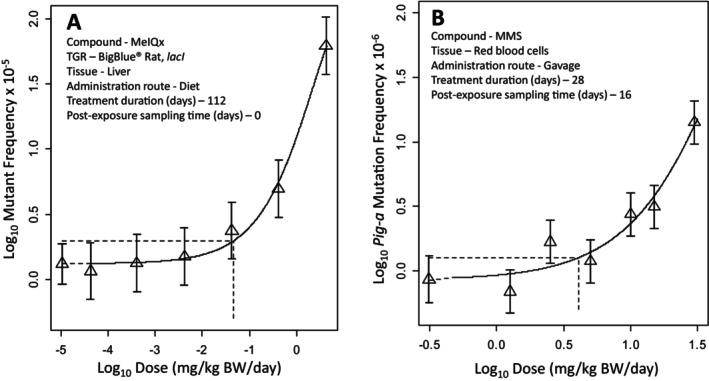
The benchmark dose (BMD) approach constitutes the most effective and pragmatic strategy for the derivation of a point of departure (PoD) for comparative potency analysis, risk assessment, and regulatory decision-making. There is considerable controversy regarding the most appropriate benchmark response (BMR) for genotoxicity endpoints. This work employed the Slob (2017) Effect Size (ES) theory to define robust BMR values for the in vivo transgenic rodent (TGR) and Pig-a mutagenicity endpoints. An extensive database of dose-response data was prepared and curated; BMD analyses were used to determine endpoint-specific maxima (i.e., parameter c) and within-group variance (i.e., var). Detailed analyses investigated the dependence of var on experimental factors such as tissue, administration route, treatment duration, and post-exposure tissue sampling time. The overall lack of influence of these experimental factors on var permitted the determination of typical values for the endpoints investigated. Typical var for the TGR endpoint is 0.19; the value for the Pig-a endpoint is 0.29. Endpoint-specific var values were used to calculate endpoint-specific BMR values; the values are 47% for TGR and 60% for Pig-a. Endpoint-specific BMR values were also calculated using the trimmed distribution of study-specific standard deviation (SD) values for concurrent controls. Those analyses yielded endpoint-specific BMR values for the TGR and Pig-a endpoints of 33% and 58%, respectively. Considering the results obtained, and the in vivo genetic toxicity BMR values noted in the literature, we recommend a BMR of 50% for in vivo mutagenicity endpoints. The value can be employed to interpret mutagenicity dose-response data in a risk assessment context.
基准剂量(BMD)方法是推导比较效力分析、风险评估和监管决策的起点(PoD)的最有效和务实的策略。关于遗传毒性终点最合适的基准反应(BMR)存在相当大的争议。这项工作采用了斯洛布(2017)效应大小(ES)理论来定义体内转基因啮齿动物(TGR)和Pig-a致突变性终点的稳健BMR值。准备并整理了一个广泛的剂量反应数据库;使用BMD分析来确定终点特异性最大值(即参数c)和组内方差(即var)。详细分析研究了var对组织、给药途径、治疗持续时间和暴露后组织采样时间等实验因素的依赖性。这些实验因素对var的总体缺乏影响使得能够确定所研究终点的典型值。TGR终点的典型var为0.19;Pig-a终点的值为0.29。使用终点特异性var值来计算终点特异性BMR值;TGR的值为47%,Pig-a的值为60%。还使用同期对照的研究特异性标准差(SD)值的截尾分布来计算终点特异性BMR值。这些分析得出TGR和Pig-a终点的终点特异性BMR值分别为33%和58%。考虑到所获得的结果以及文献中提到的体内遗传毒性BMR值,我们建议体内致突变性终点的BMR为50%。该值可用于在风险评估背景下解释致突变性剂量反应数据。


 Zotero 插件