
食品甜味剂:对人类健康而言是天使还是小丑?
Food sweeteners: Angels or clowns for human health?
作者信息
Hong Qiao-Yun, Huang Yan, Yang Jie, Su Long-Teng, Dai Zhao-Ri, Zhao Cheng-Fei
机构信息
School of Basic Medicine, Putian University, Putian, 351100, China.
School of Pharmacy and Medical Technology, Putian University, Putian, 351100, China.
出版信息
Curr Res Food Sci. 2025 Mar 12;10:101032. doi: 10.1016/j.crfs.2025.101032. eCollection 2025.
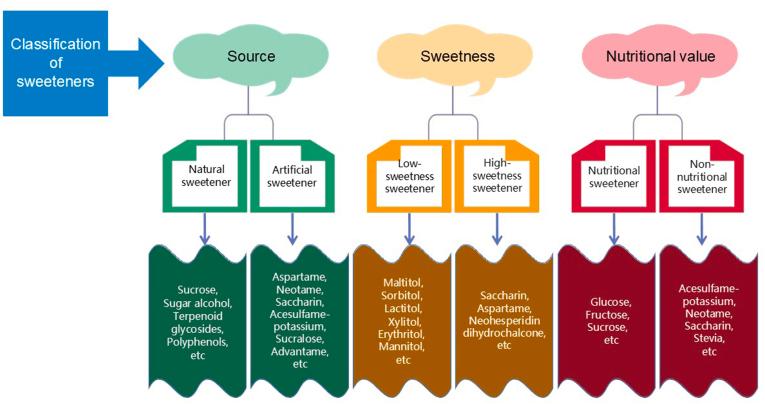
With the global prevalence of obesity and diabetes continuing to rise, metabolic diseases caused by excessive sugar intake have become a significant public health issue. In this context, various sweeteners as sugar substitutes have been widely used in the food industry. Sweeteners are highly favored for their good safety profile, cost-effectiveness, low-calorie properties, and potential blood sugar regulation effects, and their applications have extended to fields such as pharmaceuticals and daily chemicals. However, recent studies indicate that the impact mechanisms of sweeteners on human health are more complex than previously understood, and the long-term safety of their use has sparked widespread concern in both academia and the public. This review systematically examines relevant literature from the past three decades, employing evidence-based medicine methods for screening and meta-analysis, aiming to comprehensively assess the potential effects of sweeteners on human metabolic indicators (including blood glucose homeostasis and body fat composition) and cancer risk. The discussion will unfold in the following four sections: (1) Definition and classification of sweeteners; (2) Application areas of various sweeteners; (3) Beneficial effects of sweetener use on human health; (4) Adverse effects of sweetener use on health issues in different population groups. Current evidence suggests that the rational use of specific types of sweeteners within recommended dosage ranges can effectively improve blood glucose control, promote weight management, and play a positive role in maintaining oral health. However, excessive or long-term use of certain sweeteners may disrupt gut microbiota balance, affect glucose and lipid metabolism homeostasis, increase cardiovascular disease risk, and potentially be associated with the occurrence of certain malignant tumors. Notably, sweetener exposure during pregnancy may affect the fetus through mechanisms such as epigenetic modifications, necessitating special caution in sweetener selection for pregnant women. This review aims to provide clinicians, nutritionists, and food science professionals with the latest evidence-based medical evidence, guiding consumers to make informed sweetener choices by weighing health benefits against potential risks. It also offers scientific basis for formula optimization and product development in the food industry, thereby promoting public health.
随着全球肥胖和糖尿病患病率持续上升,因糖分摄入过多引发的代谢性疾病已成为重大的公共卫生问题。在此背景下,各种甜味剂作为糖替代品在食品工业中得到广泛应用。甜味剂因其良好的安全性、成本效益、低热量特性以及潜在的血糖调节作用而备受青睐,其应用已扩展到制药和日化等领域。然而,近期研究表明,甜味剂对人类健康的影响机制比之前所理解的更为复杂,其长期使用安全性引发了学术界和公众的广泛关注。本综述系统地梳理了过去三十年的相关文献,采用循证医学方法进行筛选和荟萃分析,旨在全面评估甜味剂对人类代谢指标(包括血糖稳态和体脂组成)以及癌症风险的潜在影响。讨论将在以下四个部分展开:(1)甜味剂的定义与分类;(2)各种甜味剂的应用领域;(3)使用甜味剂对人类健康的有益影响;(4)使用甜味剂对不同人群健康问题的不良影响。目前的证据表明,在推荐剂量范围内合理使用特定类型的甜味剂可有效改善血糖控制、促进体重管理,并对维持口腔健康发挥积极作用。然而,过量或长期使用某些甜味剂可能会破坏肠道微生物群平衡,影响葡萄糖和脂质代谢稳态,增加心血管疾病风险,并可能与某些恶性肿瘤的发生有关。值得注意的是,孕期接触甜味剂可能通过表观遗传修饰等机制影响胎儿,因此孕妇在选择甜味剂时需格外谨慎。本综述旨在为临床医生、营养学家和食品科学专业人员提供最新的循证医学证据,引导消费者在权衡健康益处与潜在风险的基础上做出明智的甜味剂选择。它还为食品工业中的配方优化和产品开发提供科学依据,从而促进公众健康。


 Zotero 插件