
金属元素与自闭症谱系障碍儿童端粒长度的关联
Association of metallic elements with telomere length in children with autism spectrum disorder.
作者信息
Zhu Qiuyan, Zhang Tong, Sun Yanan, Liu Jinming, Liu Zizi, Wei Fengxiang, Jin Yu
机构信息
Department of Maternal and Child Health, School of Public Health, Sun Yat-Sen University, Guangzhou, China.
Longgang District Maternity & Child Healthcare Hospital of Shenzhen City (Longgang Maternity and Child Institute of Shantou University Medical College), Shenzhen, China.
出版信息
PeerJ. 2025 Apr 1;13:e19174. doi: 10.7717/peerj.19174. eCollection 2025.
BACKGROUND
Imbalances in metal elements have been identified as a potential risk factor for autism spectrum disorder (ASD), and shortened telomere length (TL) is commonly observed in children with ASD. Metal elements may influence telomere homeostasis through oxidative stress, which could contribute to the pathogenesis of autism. However, studies examining the combined effects of metal elements on TL in children with ASD are limited. To fill the gaps in the current literature, this study aimed to investigate the relationship between six metallic elements: manganese (Mn), copper (Cu), zinc (Zn), calcium (Ca), magnesium (Mg), and iron (Fe), and TL in the whole blood of children with ASD.
METHODS
A total of 83 children with ASD and 95 typically developing children were recruited. TL was measured using digital PCR, while metal concentrations were assessed using inductively coupled plasma mass spectrometry (ICP-MS). Linear regression analysis was first conducted to explore the correlations between metal elements and TL in both groups. Additionally, Bayesian Kernel Machine Regression (BKMR) was used to further examine the combined effects and potential interactions of these metals on TL in the ASD group.
RESULTS
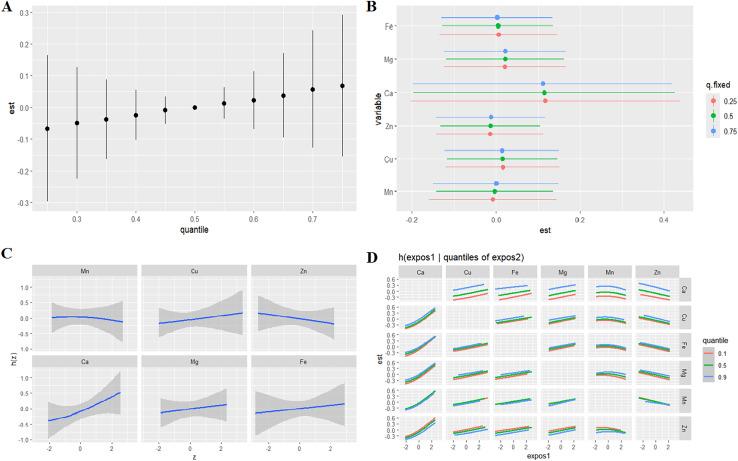
In the ASD group, Ca was found to have a protective effect on TL ( = 0.07, 95% CI [0.01-0.13], = 0.027). In contrast, Mg showed a protective effect on TL in the control group ( = 0.10, 95% CI [0.01-0.18], = 0.027). The BKMR model revealed a significant positive combined effect of the metal mixtures on TL in the ASD group, with Ca having the largest individual effect (PIP = 0.45). Further analysis indicated that increases in Zn and Mn concentrations from the 25th to the 75th percentile were negatively correlated with TL, while higher concentrations of Cu, Ca, Mg, and Fe were positively associated with TL. No significant interactions among the metals were observed.
CONCLUSIONS
This study suggests a potential link between metallic elements and TL in children with ASD, with Ca having the greatest effect. Our findings highlight the potential benefits of appropriate calcium supplementation as a protective strategy for lengthening telomeres in children with ASD, emphasizing the importance of early nutritional interventions to improve their overall health.
背景
金属元素失衡已被确定为自闭症谱系障碍(ASD)的潜在风险因素,并且在ASD儿童中普遍观察到端粒长度(TL)缩短。金属元素可能通过氧化应激影响端粒稳态,这可能导致自闭症的发病机制。然而,研究金属元素对ASD儿童TL的综合影响的研究有限。为了填补当前文献中的空白,本研究旨在调查六种金属元素:锰(Mn)、铜(Cu)、锌(Zn)、钙(Ca)、镁(Mg)和铁(Fe)与ASD儿童全血中TL的关系。
方法
共招募了83名ASD儿童和95名发育正常的儿童。使用数字PCR测量TL,同时使用电感耦合等离子体质谱法(ICP-MS)评估金属浓度。首先进行线性回归分析,以探索两组中金属元素与TL之间的相关性。此外,使用贝叶斯核机器回归(BKMR)进一步检查这些金属对ASD组TL的综合影响和潜在相互作用。
结果
在ASD组中,发现Ca对TL有保护作用(β = 0.07,95% CI [0.01 - 0.13],P = 0.027)。相比之下,Mg在对照组中对TL有保护作用(β = 0.10,95% CI [0.01 - 0.18],P = 0.027)。BKMR模型显示金属混合物对ASD组的TL有显著的正向综合影响,其中Ca的个体影响最大(PIP = 0.45)。进一步分析表明,Zn和Mn浓度从第25百分位数增加到第75百分位数与TL呈负相关,而较高浓度的Cu、Ca、Mg和Fe与TL呈正相关。未观察到金属之间的显著相互作用。
结论
本研究表明金属元素与ASD儿童的TL之间存在潜在联系,其中Ca的影响最大。我们的研究结果强调了适当补充钙作为延长ASD儿童端粒的保护策略的潜在益处,强调了早期营养干预对改善其整体健康的重要性。
 Zotero 插件