
美国成年人肠道微生物群饮食指数与胰岛素抵抗和2型糖尿病的线性关联:体重指数和炎症标志物的中介作用
Linear association of the dietary index for gut microbiota with insulin resistance and type 2 diabetes mellitus in U.S. adults: the mediating role of body mass index and inflammatory markers.
作者信息
Qu Haoran, Yang Yiyun, Xie Qihang, Ye Liu, Shao Yue
机构信息
Department of Cardiothoracic Surgery, The First Affiliated Hospital of Chongqing Medical University, Chongqing, China.
Department of Anesthesiology, Children's Hospital of Chongqing Medical University, Chongqing, China.
出版信息
Front Nutr. 2025 Mar 21;12:1557280. doi: 10.3389/fnut.2025.1557280. eCollection 2025.
BACKGROUND
Gut microbiota is reported to be related to the onset of insulin resistance (IR) and type 2 diabetes mellitus (T2DM). The dietary index for gut microbiota (DI-GM) is a novel index for reflecting gut microbiota diversity. We aimed to evaluate the association of DI-GM with T2DM and IR.
METHODS
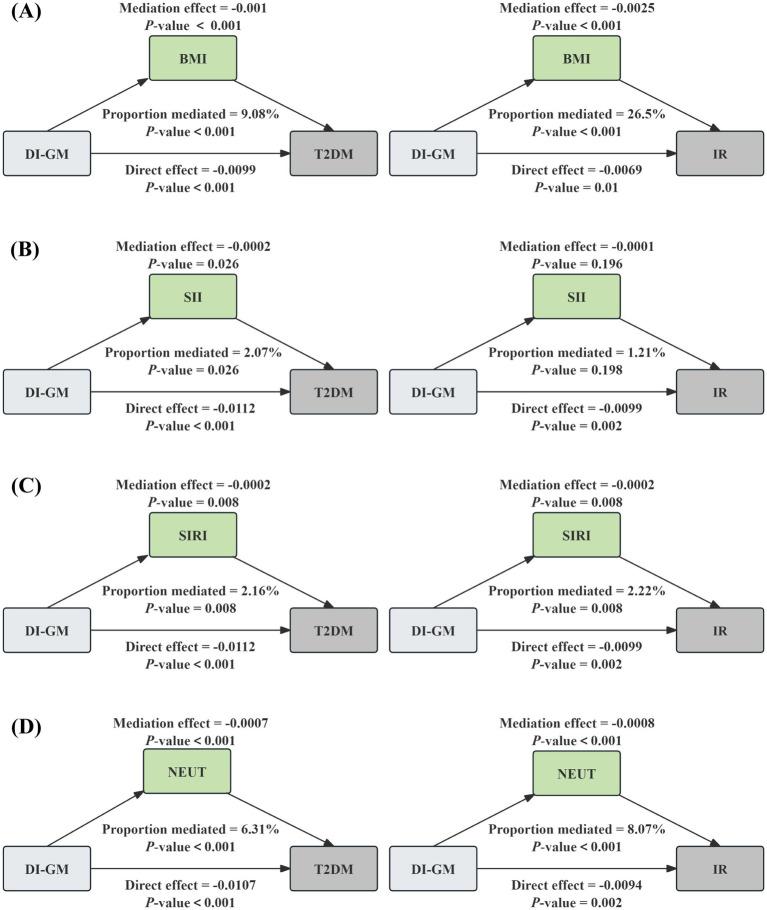
This cross-sectional research comprised 10,600 participants aged ≥20 from the National Health and Nutrition Examination Survey (NHANES) 2007-2018. We employed weighted multivariable linear and logistic regression models to examine the correlation of DI-GM with T2DM and IR. Linear or nonlinear relationships were examined by restricted cubic spline (RCS) regression. Additionally, subgroup and sensitivity analyses were performed to ensure the reliability of the results. Mediation analysis explored the roles of body mass index (BMI) and inflammatory factors in these associations.
RESULTS
Higher DI-GM were inversely associated with T2DM (OR = 0.93, 95%CI: 0.89-0.98) and IR (OR = 0.95, 95%CI: 0.91-0.99) after adjusting for confounders. DI-GM ≥ 6 group showed significantly lower risks of T2DM (OR = 0.74, 95%CI: 0.60-0.91) and IR (OR = 0.77, 95%CI: 0.62-0.95). RCS demonstrated a linear relationship between DI-GM and T2DM, as well as IR. DI-GM was also inversely correlated with the risk markers of T2DM. Mediation analysis showed that BMI and the systemic inflammation response index partly mediated the association of DI-GM with T2DM and IR, while the systemic immune-inflammation index mediated only the association with T2DM.
CONCLUSION
DI-GM is inversely associated with T2DM and IR, with BMI and inflammatory markers partly mediating this association.
背景
据报道,肠道微生物群与胰岛素抵抗(IR)和2型糖尿病(T2DM)的发病有关。肠道微生物群饮食指数(DI-GM)是反映肠道微生物群多样性的一个新指标。我们旨在评估DI-GM与T2DM和IR之间的关联。
方法
这项横断面研究纳入了2007 - 2018年美国国家健康与营养检查调查(NHANES)中10600名年龄≥20岁的参与者。我们采用加权多变量线性和逻辑回归模型来检验DI-GM与T2DM和IR的相关性。通过限制性立方样条(RCS)回归检验线性或非线性关系。此外,进行了亚组分析和敏感性分析以确保结果的可靠性。中介分析探讨了体重指数(BMI)和炎症因子在这些关联中的作用。
结果
在调整混杂因素后,较高的DI-GM与T2DM(OR = 0.93,95%CI:0.89 - 0.98)和IR(OR = 0.95,95%CI:0.91 - 0.99)呈负相关。DI-GM≥6组的T2DM(OR = 0.74,95%CI:0.60 - 0.91)和IR(OR = 0.77,95%CI:0.62 - 0.95)风险显著较低。RCS显示DI-GM与T2DM以及IR之间存在线性关系。DI-GM也与T2DM的风险标志物呈负相关。中介分析表明,BMI和全身炎症反应指数部分介导了DI-GM与T2DM和IR的关联,而全身免疫炎症指数仅介导了与T2DM的关联。
结论
DI-GM与T2DM和IR呈负相关,BMI和炎症标志物部分介导了这种关联。


 Zotero 插件