
2型糖尿病降糖治疗随机对照试验中的衰弱:一项关于衰弱患病率、治疗效果及不良事件的个体参与者数据荟萃分析
Frailty in randomized controlled trials of glucose-lowering therapies for type 2 diabetes: An individual participant data meta-analysis of frailty prevalence, treatment efficacy, and adverse events.
作者信息
Wightman Heather, Butterly Elaine, Wei Lili, McChrystal Ryan, Sattar Naveed, Adler Amanda, Phillippo David, Dias Sofia, Welton Nicky, Clegg Andrew, Witham Miles, Rockwood Kenneth, McAllister David A, Hanlon Peter
机构信息
School of Health and Wellbeing, University of Glasgow, Glasgow, United Kingdom.
School of Cardiovascular and Metabolic Health, University of Glasgow, Glasgow, United Kingdom.
出版信息
PLoS Med. 2025 Apr 7;22(4):e1004553. doi: 10.1371/journal.pmed.1004553. eCollection 2025 Apr.
BACKGROUND
The representation of frailty in type 2 diabetes trials is unclear. This study used individual participant data from trials of newer glucose-lowering therapies to quantify frailty and assess the association between frailty and efficacy and adverse events.
METHODS AND FINDINGS
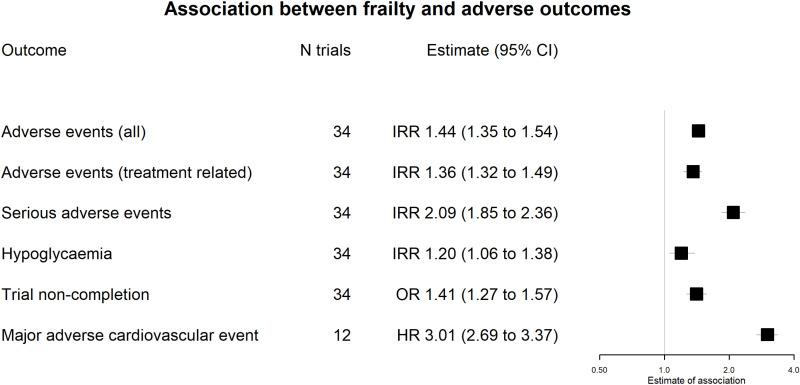
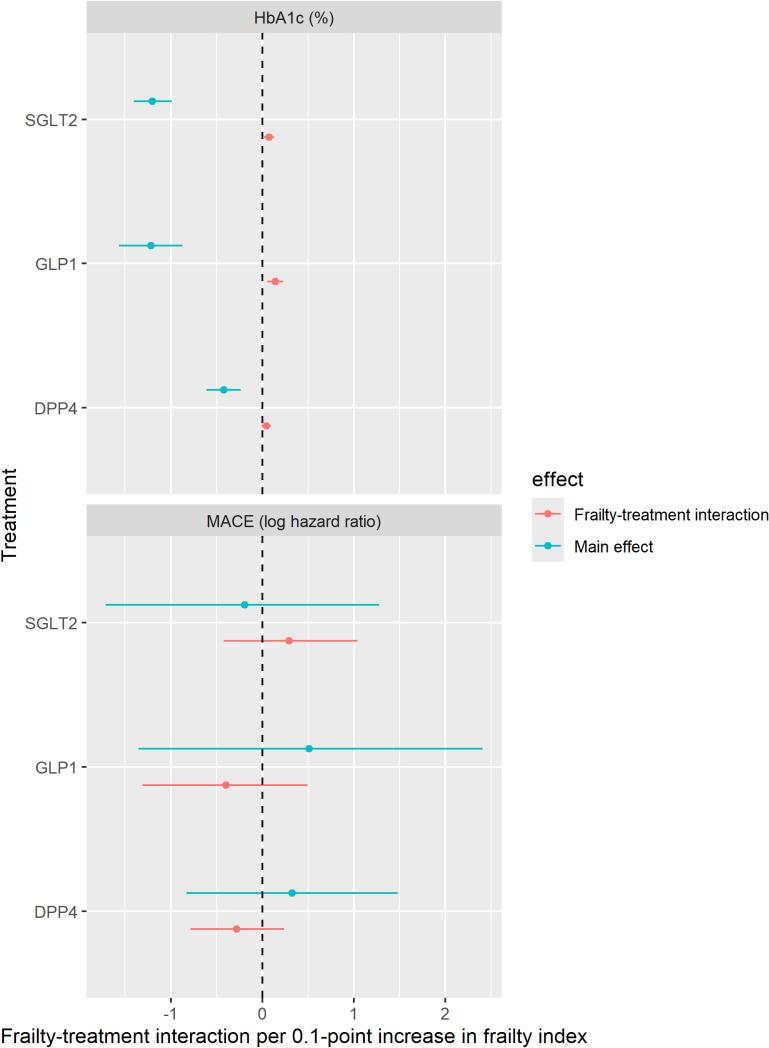
We analysed IPD from 34 trials of sodium-glucose cotransporter 2 (SGLT2) inhibitors, glucagon-like peptide-1 (GLP1) receptor agonists, and dipeptidyl peptidase 4 (DDP4) inhibitors. Frailty was quantified using a cumulative deficit frailty index (FI). For each trial, we quantified the distribution of frailty; assessed interactions between frailty and treatment efficacy (HbA1c and major adverse cardiovascular events [MACE], pooled using random-effects network meta-analysis); and associations between frailty and withdrawal, adverse events, and hypoglycaemic episodes. Trial participants numbered 25,208. Mean age across the included trials ranged from 53.8 to 74.2 years. Using a cut-off of FI > 0.2 to indicate frailty, median prevalence was 9.5% (IQR 2.4%-15.4%). Applying a higher threshold of FI > 0.3, median prevalence was 0.5% (IQR 0.1%-1.5%). Prevalence was higher in trials of older people and people with renal impairment however, even in these higher risk populations, people with FI > 0.4 were generally absent. For SGLT2 inhibitors and GLP1 receptor agonists, there was a small attenuation in efficacy on HbA1c with increasing frailty (0.08%-point and 0.14%-point smaller reduction, respectively, per 0.1-point increase in FI), below the level of clinical significance. Findings for the effect of treatment on MACE (and whether this varied by frailty) had high uncertainty, with few events occurring in trial follow-up. A 0.1-point increase in the FI was associated with more all-cause adverse events regardless of treatment allocation (incidence rate ratio, IRR 1.44, 95% CI 1.35-1.54, p < 0.0001), adverse events judged to the possibly or probably related to treatment (1.36, 1.23, to 1.49, p < 0.0001), serious adverse events (2.09, 1.85, to 2.36, p < 0.0001), hypoglycaemia (1.21, 1.06, to 1.38, p = 0.012), baseline risk of MACE (hazard ratio 3.01, 2.48, to 3.67, p < 0.0001) and with withdrawal from the trial (odds ratio 1.41, 1.27, to 1.57, p < 0.0001). The main limitation was that the large cardiovascular outcome trials did not include data on functional status and so we were unable to assess frailty in these larger trials.
CONCLUSIONS
Frailty was uncommon in these trials, and participants with a high degree of frailty were rarely included. Frailty is associated very modest attenuation of treatment efficacy for glycaemic outcomes and with greater incidence of both adverse events and MACE independent of treatment allocation. While these findings are compatible with calls to relax HbA1c-based targets in people living with frailty, they also highlight the need for inclusion of people living with frailty in trials. This would require changes to trial processes to facilitate the explicit assessment of frailty and support the participation of people living with frailty. Such changes are important as the absolute balance of risks and benefits remains uncertain among those with higher degrees of frailty, who are largely excluded from trials.
背景
2型糖尿病试验中衰弱的表现尚不清楚。本研究使用了新型降糖疗法试验中的个体参与者数据来量化衰弱程度,并评估衰弱与疗效及不良事件之间的关联。
方法与结果
我们分析了34项关于钠-葡萄糖协同转运蛋白2(SGLT2)抑制剂、胰高血糖素样肽-1(GLP1)受体激动剂和二肽基肽酶4(DDP4)抑制剂试验的个体参与者数据。使用累积缺陷衰弱指数(FI)对衰弱进行量化。对于每项试验,我们量化了衰弱的分布情况;评估了衰弱与治疗疗效(糖化血红蛋白和主要不良心血管事件 [MACE],采用随机效应网络荟萃分析进行汇总)之间的相互作用;以及衰弱与退出试验、不良事件和低血糖发作之间的关联。试验参与者有25208人。纳入试验的参与者平均年龄在53.8岁至74.2岁之间。使用FI>0.2作为表示衰弱的临界值,中位患病率为9.5%(四分位间距2.4%-15.4%)。采用更高的临界值FI>0.3,中位患病率为0.5%(四分位间距0.1%-1.5%)。在老年人和肾功能损害患者的试验中患病率更高,然而,即使在这些高风险人群中,FI>0.4的人群通常也不存在。对于SGLT2抑制剂和GLP1受体激动剂,随着衰弱程度增加,糖化血红蛋白的疗效有小幅减弱(FI每增加0.1分,分别减少0.08个百分点和0.14个百分点),低于临床意义水平。治疗对MACE的影响(以及这种影响是否因衰弱程度而异)的研究结果具有高度不确定性,试验随访中发生的事件很少。FI每增加0.1分,无论治疗分配如何,全因不良事件均更多(发生率比,IRR 1.44,95%CI 1.35-1.54,p<0.0001),被判定可能或很可能与治疗相关的不良事件(1.36,1.23至1.49,p<0.0001),严重不良事件(2.09,1.85至2.36,p<0.0001),低血糖(1.21,1.06至1.38,p = 0.012),MACE的基线风险(风险比3.01,2.48至3.67,p<0.0001)以及退出试验(比值比1.41,1.27至1.57,p<0.0001)。主要局限性在于大型心血管结局试验未包括功能状态数据,因此我们无法在这些大型试验中评估衰弱情况。
结论
在这些试验中衰弱并不常见,很少纳入高度衰弱的参与者。衰弱与血糖结局的治疗疗效小幅减弱以及不良事件和MACE的更高发生率相关,且与治疗分配无关。虽然这些发现与呼吁放宽衰弱患者基于糖化血红蛋白的目标一致,但它们也凸显了在试验中纳入衰弱患者的必要性。这将需要改变试验流程,以促进对衰弱的明确评估并支持衰弱患者的参与。这种改变很重要,因为在很大程度上被排除在试验之外的高度衰弱患者中,风险和益处的绝对平衡仍不确定。


 Zotero 插件