
传递气候变化物理知识。
Transferring climate change physical knowledge.
作者信息
Immorlano Francesco, Eyring Veronika, le Monnier de Gouville Thomas, Accarino Gabriele, Elia Donatello, Mandt Stephan, Aloisio Giovanni, Gentine Pierre
机构信息
Centro Euro-Mediterraneo sui Cambiamenti Climatici Foundation - Euro-Mediterranean Center on Climate Change, Lecce 73100, Italy.
Department of Computer Science, University of California, Irvine, CA 92697.
出版信息
Proc Natl Acad Sci U S A. 2025 Apr 15;122(15):e2413503122. doi: 10.1073/pnas.2413503122. Epub 2025 Apr 8.
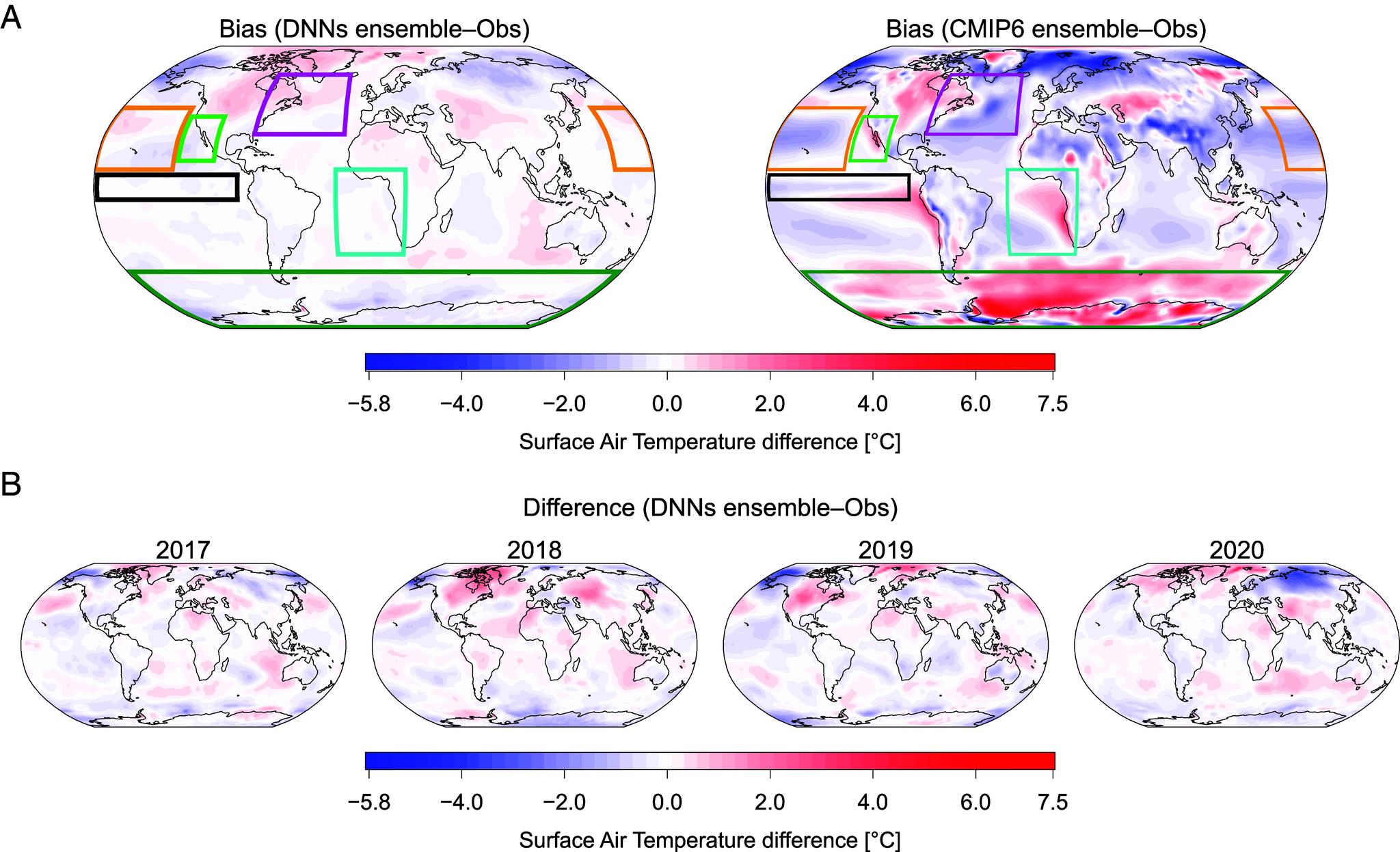
Precise and reliable climate projections are required for climate adaptation and mitigation, but Earth system models still exhibit great uncertainties. Several approaches have been developed to reduce the spread of climate projections and feedbacks, yet those methods cannot capture the nonlinear complexity inherent in the climate system. Using a Transfer Learning approach, we show that Machine Learning can be used to optimally leverage and merge the knowledge gained from global temperature maps simulated by Earth system models and observed in the historical period to reduce the spread of global surface air temperature fields projected in the 21st century. We reach an uncertainty reduction of more than 50% with respect to state-of-the-art approaches while giving evidence that our method provides improved regional temperature patterns together with narrower projections uncertainty, urgently required for climate adaptation.
气候适应和缓解需要精确可靠的气候预测,但地球系统模型仍存在很大的不确定性。已经开发了几种方法来减少气候预测和反馈的差异,但这些方法无法捕捉气候系统中固有的非线性复杂性。通过使用迁移学习方法,我们表明机器学习可用于最佳地利用和整合从地球系统模型模拟并在历史时期观测到的全球温度图中获得的知识,以减少21世纪预测的全球地表气温场的差异。相对于现有方法,我们将不确定性降低了50%以上,同时证明我们的方法提供了改进的区域温度模式以及更窄的预测不确定性,这是气候适应迫切需要的。


 Zotero 插件