
美国得克萨斯州南部以青年声音为中心对感染艾滋病毒的年轻人进行移动健康干预的调适:以人为本的设计方法
Centering Youth Voice in the Adaptation of an mHealth Intervention for Young Adults With HIV in South Texas, United States: Human-Centered Design Approach.
作者信息
Ho Nhat Minh, Johnson Catherine, Chidester Autumn, Viera Corral Ruby, Ramos Jacundo, Garcia Miguel, Gonuguntla Rishi, Cote Cyrena, Chandramohan Divya, Lin Hueylie, Taranova Anna, Nijhawan Ank E, Kools Susan, Ingersoll Karen, Dillingham Rebecca, Taylor Barbara S
机构信息
Joe R. and Teresa Lozano Long School of Medicine, The University of Texas Health Science Center at San Antonio, San Antonio, TX, United States.
Department of Public Health, Innovation and Equity, University Health, San Antonio, TX, United States.
出版信息
JMIR Form Res. 2025 Apr 8;9:e60531. doi: 10.2196/60531.
BACKGROUND
Young adults living with HIV are less likely to engage in care and achieve viral suppression, compared to other age groups. Young adults living with HIV also have a high degree of self-efficacy and willingness to adopt novel care modalities, including mobile health (mHealth) interventions. Interventions to increase care engagement could aid young adults living with HIV in overcoming structural and social barriers and leveraging youth assets to improve their health outcomes.
OBJECTIVE
The objective of the paper was to use an assets-based framework, positive youth development, and human-centered design principles to adapt an existing mHealth intervention, PositiveLinks (PL), to support care engagement for 18- to 29-year-olds with HIV.
METHODS
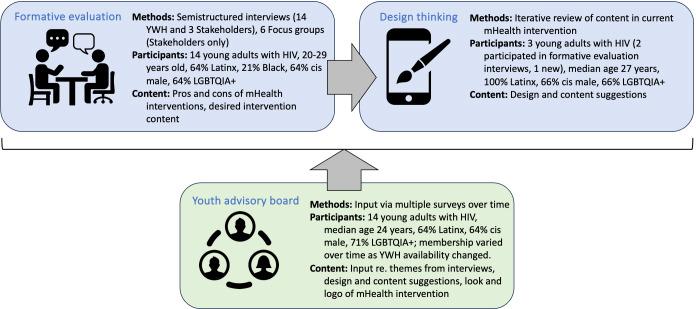
We conducted a formative evaluation including semistructured interviews with 14 young adults with HIV and focus groups with 26 stakeholders (providers, nurses, case managers, and clinic staff). Interviews covered barriers to care, provider communication, and concerns or suggestions about mHealth interventions. The research team used thematic analysis to review interview transcripts. In the second phase, human-centered design processes informed adaptation of the existing PL platform using data from real-time use suggestions of 3 young adults with HIV. Throughout the formative evaluation and adaptation, a Youth Advisory Board (YAB) provided input.
RESULTS
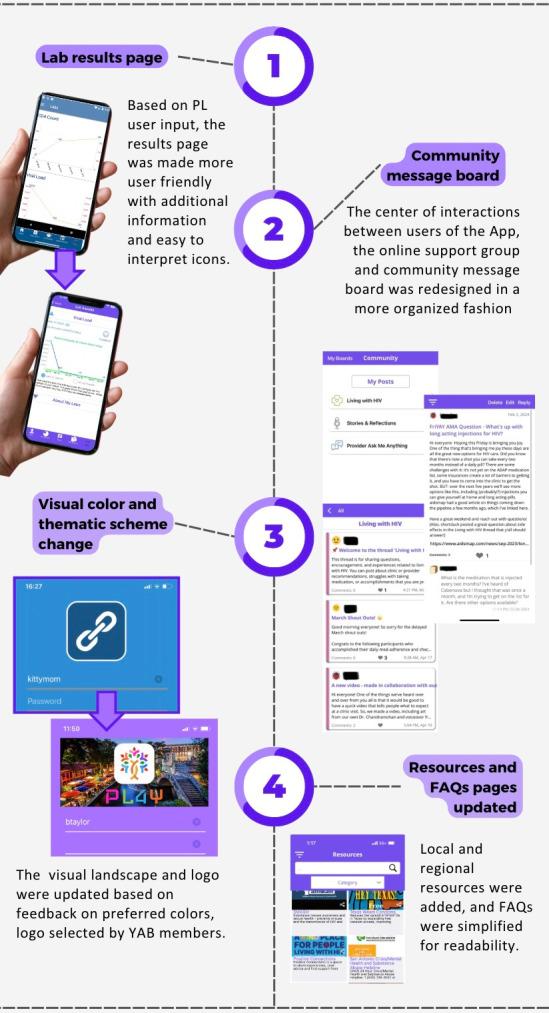
Young adults with HIV and stakeholders identified common elements of an mHealth intervention that would support care engagement including: the convenience of addressing needs through the app, online support groups to support interconnection, short videos or live chats with other young adults with HIV or providers, appointment and medication reminders, and medical information from a trustworthy source. Stakeholders also mentioned the need for youth empowerment. Concerns included worries about confidentiality, unintentional disclosures of status, urgent content in an unmoderated forum, and the impersonality of online platforms. Design suggestions from young adults with HIV included suggestions on appearance, new formatting for usability of the online support group, and prioritization of local content. Based on the feedback received, iterative changes were made to transform PL into Positive Links for Youth (PL4Y). Final votes on adaptations were made by the YAB. The overall appearance of the platform was changed, including logo, color, and font. The online support group was divided into 3 channels which support hashtags and content searches. The "Resources" and "Frequently Asked Questions" sections were condensed and revised to prioritize South Texas-specific content.
CONCLUSIONS
Our assets-based framework supported young adults with HIV and stakeholder input in the transformation of an mHealth intervention to meet the needs of 18- to 29-year-olds in South Texas. The human-centered design approach allowed young adults with HIV to suggest specific changes to the intervention's design to support usability and acceptability. This adapted version, PL4Y, is now ready for pilot testing in the final phase of this implementation science project.
背景
与其他年龄组相比,感染艾滋病毒的年轻成年人接受护理并实现病毒抑制的可能性较小。感染艾滋病毒的年轻成年人也具有高度的自我效能感,并且愿意采用包括移动健康(mHealth)干预措施在内的新型护理模式。增加护理参与度的干预措施可以帮助感染艾滋病毒的年轻成年人克服结构和社会障碍,并利用青年资产来改善他们的健康状况。
目的
本文的目的是使用基于资产的框架、积极的青年发展和以人为本的设计原则,对现有的移动健康干预措施“积极链接”(PL)进行调整,以支持18至29岁感染艾滋病毒者的护理参与。
方法
我们进行了一项形成性评估,包括对14名感染艾滋病毒的年轻成年人进行半结构化访谈,以及与26名利益相关者(提供者、护士、病例管理人员和诊所工作人员)进行焦点小组讨论。访谈涵盖了护理障碍、提供者沟通以及对移动健康干预措施的担忧或建议。研究团队使用主题分析来审查访谈记录。在第二阶段,以人为本的设计流程利用3名感染艾滋病毒的年轻成年人的实时使用建议数据,对现有的PL平台进行调整。在整个形成性评估和调整过程中,一个青年咨询委员会(YAB)提供了意见。
结果
感染艾滋病毒的年轻成年人和利益相关者确定了一项移动健康干预措施的共同要素,这些要素将支持护理参与,包括:通过应用程序满足需求的便利性、支持相互联系的在线支持小组、与其他感染艾滋病毒的年轻成年人或提供者的短视频或实时聊天、预约和用药提醒,以及来自可靠来源的医疗信息。利益相关者还提到了青年赋权的必要性。担忧包括对保密性的担忧、身份的无意披露、未加管理的论坛中的紧急内容以及在线平台的非人性化。感染艾滋病毒的年轻成年人提出的设计建议包括外观建议、在线支持小组可用性的新格式,以及本地内容的优先级。根据收到的反馈,进行了迭代更改,将PL转变为“青年积极链接”(PL4Y)。YAB对调整进行了最终投票。平台的整体外观发生了变化,包括标志、颜色和字体。在线支持小组分为3个频道,支持主题标签和内容搜索。“资源”和“常见问题”部分进行了精简和修订,以突出南德克萨斯州特定的内容。
结论
我们基于资产的框架支持了感染艾滋病毒的年轻成年人以及利益相关者的意见输入,对一项移动健康干预措施进行了改造,以满足南德克萨斯州18至29岁人群的需求。以人为本的设计方法使感染艾滋病毒的年轻成年人能够对干预措施的设计提出具体更改建议,以支持可用性和可接受性。这个经过调整的版本PL4Y现在已准备好在这个实施科学项目的最后阶段进行试点测试。
 Zotero 插件