
宫腔镜子宫中隔切除术对子宫中隔女性体外受精/卵胞浆内单精子注射结局的影响:一项倾向评分回顾性匹配研究
Effect of hysteroscopic septum resection on IVF/ICSI outcomes in women with septate uterus: a propensity-score retrospective matching study.
作者信息
Zhang Wei, He Shunzhi, Zhang Xiaoyan, Liu Zhenteng, Chu Min, Liu Xuemei, Bao Hongchu
机构信息
Department of Reproductive Medicine, Yantai Yuhuangding Hospital Affiliated to Qingdao University, Yantai, Shandong, China.
Shandong Provincial Key Medical and Health Laboratory of Reproductive Health and Genetics (Yantai Yuhuangding Hospital), Yantai, Shandong, China.
出版信息
Reprod Biol Endocrinol. 2025 Apr 8;23(1):53. doi: 10.1186/s12958-025-01378-z.
BACKGROUND
Hysteroscopic septum resection has been a widespread technique throughout the world in women with a septate uterus. The effectiveness of hysteroscopic septum resection before IVF was equivocal. This study aimed to investigate whether hysteroscopic septum resection could improve IVF outcomes for women with a septate uterus.
METHODS
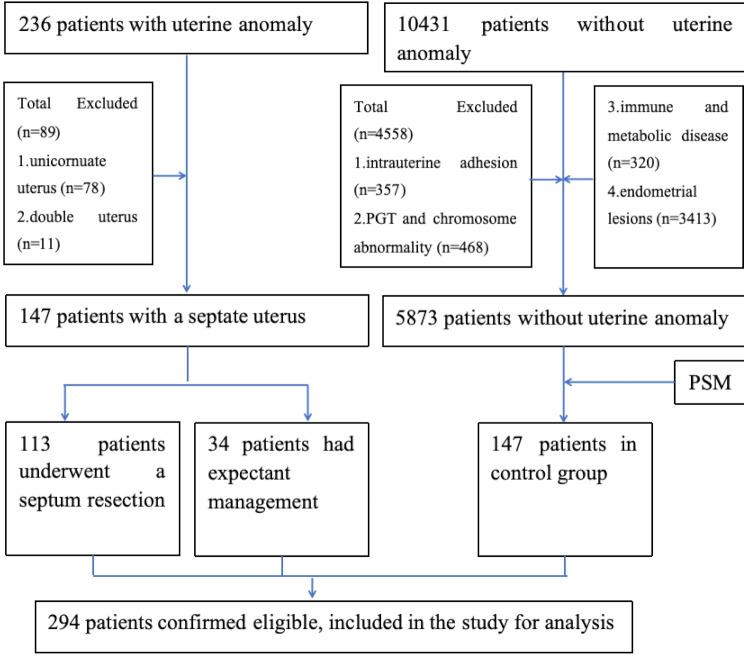
This retrospective case-control study was carried out from January 2017 to December 2022. We included subfertile women with septate uterus (n = 147), including 113 women undergoing hysteroscopic septum resection and 34 women opting for expectant management before IVF/ICSI. In addition, we selected 147 women with normal uteri using propensity score matching (PSM). The clinical outcomes of IVF/ICSI were compared by logistic regression and Cox proportional regression in each group.
RESULTS
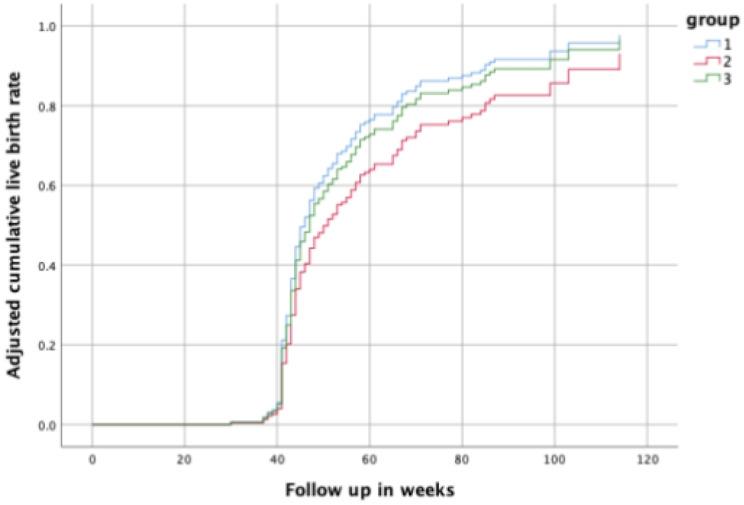
During follow-up time, clinical pregnancy occurred in 66 women who underwent hysteroscopic septum resection (58.41%), compared to 23 women opting for expectant management (67.65%, OR 1.783, 95% CI 0.725-4.380) and 87 women with normal uteri (59.18%, OR 2.601, 95% CI 1.202-5.631). Miscarriage occurred in 12 women who underwent hysteroscopic septum resection (18.18%) versus 5 women who had expectant management (21.74%, OR 1.098, 95% CI 0.323-3.734) and 8 women with normal uteri (9.20%, OR 0.278, 95% CI 0.078-0.997), while preterm birth occurred in 7 women who underwent hysteroscopic septum resection (10.61%) versus 1 women who had expectant management (4.35%, OR 0.509, 95% CI 0.056-4.666) and 9 women with normal uteri (10.34%, OR 1.472, 95% CI 0.291-7.447). Live birth occurred in 54 women following hysteroscopic septum resection (47.79%) compared to 18 women following expectant management (52.94%, OR 1.368, 95% CI 0.589-3.175) and 78 women with normal uteri (53.06%, OR 1.641, 95% CI 0.941-2.864).
CONCLUSIONS
Women who underwent hysteroscopic septum resection had lower clinical pregnancy rate and higher risk of miscarriage compared to those with normal uteri, but there was no significant difference in live birth rate between the groups.
TRIAL REGISTRATION
This is a retrospective case-control study.
背景
宫腔镜下纵隔切除术在患有纵隔子宫的女性中已成为一种在全球广泛应用的技术。在体外受精(IVF)前进行宫腔镜下纵隔切除术的有效性尚不明确。本研究旨在调查宫腔镜下纵隔切除术是否能改善纵隔子宫女性的IVF结局。
方法
本回顾性病例对照研究于2017年1月至2022年12月进行。我们纳入了患有纵隔子宫的亚生育期女性(n = 147),其中113名女性接受了宫腔镜下纵隔切除术,34名女性在IVF/卵胞浆内单精子注射(ICSI)前选择了期待治疗。此外,我们使用倾向评分匹配(PSM)选择了147名子宫正常的女性。通过逻辑回归和Cox比例回归比较了每组IVF/ICSI的临床结局。
结果
在随访期间,113名接受宫腔镜下纵隔切除术的女性中有66名发生临床妊娠(58.41%),相比之下,34名选择期待治疗的女性中有23名发生临床妊娠(67.65%,比值比[OR]1.783,95%置信区间[CI]0.725 - 4.380),147名子宫正常的女性中有87名发生临床妊娠(59.18%,OR 2.601,95% CI 1.202 - 5.631)。113名接受宫腔镜下纵隔切除术的女性中有12名发生流产(18.18%),而34名接受期待治疗的女性中有5名发生流产(21.74%,OR 1.098,95% CI 0.323 - 3.734),147名子宫正常的女性中有8名发生流产(9.20%,OR 0.278,95% CI 0.078 - 0.997);113名接受宫腔镜下纵隔切除术的女性中有7名发生早产(10.61%),34名接受期待治疗的女性中有1名发生早产(4.35%,OR 0.509,95% CI 0.056 - 4.666),147名子宫正常的女性中有9名发生早产(10.34%,OR 1.472,95% CI 0.291 - 7.447)。113名接受宫腔镜下纵隔切除术的女性中有54名活产(47.79%),34名接受期待治疗的女性中有18名活产(52.94%,OR 1.368,95% CI 0.589 - 3.175),147名子宫正常的女性中有78名活产(53.06%,OR 1.641,95% CI 0.941 - 2.864)。
结论
与子宫正常的女性相比,接受宫腔镜下纵隔切除术的女性临床妊娠率较低且流产风险较高,但两组间活产率无显著差异。试验注册:这是一项回顾性病例对照研究。

 Zotero 插件