
基底细胞的长期扩增及新的分化方法揭示了正常上皮细胞中Claudin表达转换的机制。
Long-term expansion of basal cells and the novel differentiation methods identify mechanisms for switching Claudin expression in normal epithelia.
作者信息
Inoko Akihito, Soga Norihito, Suzuki Minako, Kiyono Tohru, Ikenouchi Junichi, Kojima Takahiro, Sato Yoshikatsu, Saito Daisuke, Miyamoto Tatsuo, Goshima Naoki, Ito Hideaki, Kasai Kenji
机构信息
Department of Pathology, Aichi Medical University School of Medicine, Nagakute, Japan.
Department of Urology, Aichi Cancer Center Hospital, Nagoya, Japan.
出版信息
Sci Rep. 2025 Apr 9;15(1):12172. doi: 10.1038/s41598-025-95463-3.
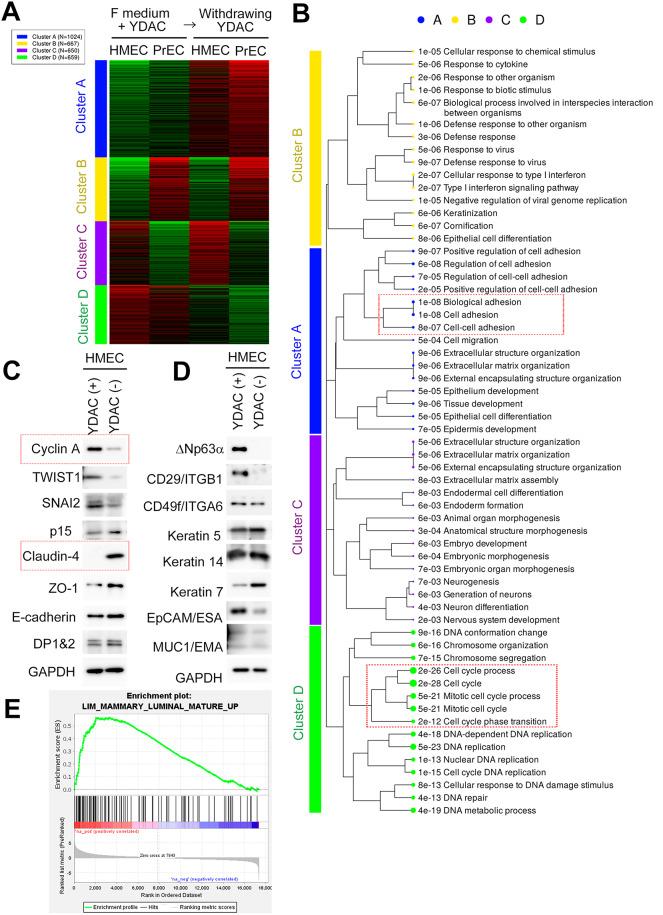
Epithelia are tightly connected cellular sheets, that shield our body from the external environment. They are continuously maintained by a pooled population of undifferentiated cells through differentiation. However, the maintenance mechanisms remain incompletely understood due to the difficulty of experimentally observing the differentiation process. To address this issue, we developed a culture method for long-term expansion of primary mammary basal cells with a set of compounds, that includes undifferentiated cells. An effective differentiation method regarding Claudin expression was also developed by simply removing compounds. To verify this differentiation-switching technique, we obtained microarray data comparing each differentiation state. Subsequent cellular analysis confirmed key transcription factors in each state: (1) EGR1 in undifferentiated basal cells is important for suppressing Claudin expression through maintaining the epithelial-mesenchymal transition (EMT) transcription factor TWIST1, (2) ELF3 in differentiated cells is important for actin organization and subsequent Claudin localization at the cell-cell border, that corresponds to the amount of GRHL3, an actin organizer. Their relevance was also observed in tissues and organoids. In summary, we present an effective tool for verifying molecular mechanisms that determine Claudin status in normal basal cell differentiation, that would be beneficial in epithelial cell biology, cancer biology, physiology, and regeneration research.
上皮组织是紧密相连的细胞层,可保护我们的身体免受外部环境的影响。它们通过分化由一群未分化细胞不断维持。然而,由于实验观察分化过程存在困难,维持机制仍未完全了解。为了解决这个问题,我们开发了一种用一组化合物长期扩增原代乳腺基底细胞的培养方法,其中包括未分化细胞。通过简单地去除化合物,还开发了一种关于紧密连接蛋白表达的有效分化方法。为了验证这种分化转换技术,我们获得了比较每种分化状态的微阵列数据。随后的细胞分析确定了每种状态下的关键转录因子:(1)未分化基底细胞中的早期生长反应因子1(EGR1)通过维持上皮-间质转化(EMT)转录因子TWIST1对抑制紧密连接蛋白表达很重要;(2)分化细胞中的ELF3对肌动蛋白组织以及随后紧密连接蛋白在细胞-细胞边界的定位很重要,这与肌动蛋白组织者GRHL3的量相对应。它们的相关性在组织和类器官中也得到了观察。总之,我们提供了一种有效的工具,用于验证在正常基底细胞分化中决定紧密连接蛋白状态的分子机制,这将有益于上皮细胞生物学、癌症生物学、生理学和再生研究。




 Zotero 插件