
慢性肝衰竭急性发作患者死亡的预后因素
Prognostic factors for mortality in patients with acute-on-chronic liver failure.
作者信息
Jiang Huijie, Zhao Zhihao, Cui Shiyu, Kong Xianggen, Jiang Xuemei
机构信息
Department of Liver Diseases, Public Health Clinical Center Affiliated to Shandong University, Jinan, China.
出版信息
Eur J Gastroenterol Hepatol. 2025 Jul 1;37(7):833-843. doi: 10.1097/MEG.0000000000002958. Epub 2025 May 28.
OBJECTIVE
The aim is to explore significant prognostic factors for 90-day mortality in patients with acute-on-chronic liver failure (ACLF) and assist clinicians in the early identification of critically ill ACLF patients.
METHODS
A retrospective analysis was conducted on 288 ACLF patients, who were classified into survivors ( n = 187) and nonsurvivors ( n = 101) based on 90-day outcomes. Multivariate stepwise logistic regression analyses were employed to identify significant prognostic factors and construct a novel prognostic model, the AHUCTPI. The model's performance was assessed and the internal validation was performed. Additionally, the influence of dynamic changes in laboratory markers on 90-day mortality was examined.
RESULTS
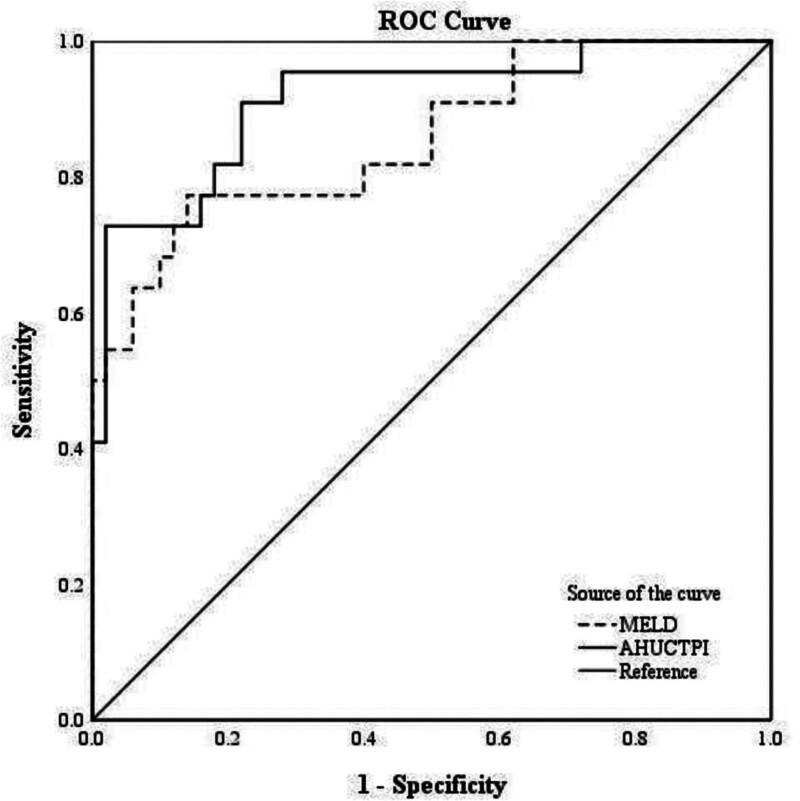
Independent risk factors for 90-day mortality included age ≥45 years, presence of hepatic encephalopathy (HE), and upper gastrointestinal bleeding (UGB) during hospitalization, imaging-confirmed cirrhosis at admission, elevated baseline total bilirubin (TBIL), reduced baseline platelet-to-neutrophil ratio (PNR), and elevated baseline international normalized ratio (INR) ( P < 0.05 for all). The AHUCTPI model's formula is as follows: Logit ( p ) = -10.019 + 1.808 × age (1 if ≥45 years, 0 if <45 years) + 1.048 × HE (1 if present, 0 if absent) + 1.721 × UGB (1 if present, 0 if absent) + 1.362 × cirrhosis (1 if present, 0 if absent) + 0.008 × TBIL (μmol/L) - 0.039 × PNR + 1.963 × INR. The AUHCTPI model demonstrated superior predictive accuracy compared with the MELD (Model for End-Stage Liver Disease) score, with the area under the receiver operating characteristic curve values of 0.914 and 0.739, respectively, and calibration curves closely approximating the ideal curve.
CONCLUSION
ACLF is a complex, dynamic syndrome. Age, HE, and UGB during hospitalization, imaging-diagnosed cirrhosis at admission, baseline TBIL, PNR, and INR were significant predictors for 90-day mortality in ACLF patients, and the AHUCTPI model provides excellent calibration and discrimination. Dynamic monitoring of laboratory trends enhances prognostic accuracy and supports timely clinical decision-making.
目的
旨在探讨慢加急性肝衰竭(ACLF)患者90天死亡率的重要预后因素,并协助临床医生早期识别ACLF危重症患者。
方法
对288例ACLF患者进行回顾性分析,根据90天预后将其分为存活者(n = 187)和非存活者(n = 101)。采用多因素逐步逻辑回归分析确定重要预后因素并构建新的预后模型AHUCTPI。评估该模型的性能并进行内部验证。此外,还研究了实验室指标动态变化对90天死亡率的影响。
结果
90天死亡率的独立危险因素包括年龄≥45岁、存在肝性脑病(HE)、住院期间发生上消化道出血(UGB)、入院时影像学确诊肝硬化、基线总胆红素(TBIL)升高、基线血小板与中性粒细胞比值(PNR)降低以及基线国际标准化比值(INR)升高(均P < 0.05)。AHUCTPI模型公式如下:Logit (p) = -10.019 + 1.808 × 年龄(≥45岁为1,<45岁为0)+ 1.048 × HE(存在为1,不存在为0)+ 1.721 × UGB(存在为1,不存在为0)+ 1.362 × 肝硬化(存在为1,不存在为0)+ 0.008 × TBIL(μmol/L) - 0.039 × PNR + 1.963 × INR。与终末期肝病模型(MELD)评分相比,AHUCTPI模型显示出更高的预测准确性,受试者工作特征曲线下面积值分别为0.914和0.739,校准曲线与理想曲线密切近似。
结论
ACLF是一种复杂的动态综合征。年龄、住院期间的HE和UGB、入院时影像学诊断的肝硬化、基线TBIL、PNR和INR是ACLF患者90天死亡率的重要预测因素,AHUCTPI模型具有良好的校准和区分能力。动态监测实验室指标趋势可提高预后准确性并支持及时的临床决策。


 Zotero 插件