
细菌衍生抗氧化代谢产物综述:其生产、纯化、表征、潜在应用及局限性
A review on bacteria-derived antioxidant metabolites: their production, purification, characterization, potential applications, and limitations.
作者信息
Arslan Nazli Pinar, Azad Fakhrul, Orak Tugba, Budak-Savas Aysenur, Ortucu Serkan, Dawar Pranav, Baltaci Mustafa Ozkan, Ozkan Hakan, Esim Nevzat, Taskin Mesut
机构信息
Vocational School of Health Services, Bingol University, Bingol, Turkey.
Department of Biochemistry and Cell Biology, Chobanian and Avedisian School of Medicine, Boston University, Boston, MA, USA.
出版信息
Arch Pharm Res. 2025 Apr;48(4):253-292. doi: 10.1007/s12272-025-01541-5. Epub 2025 Apr 10.
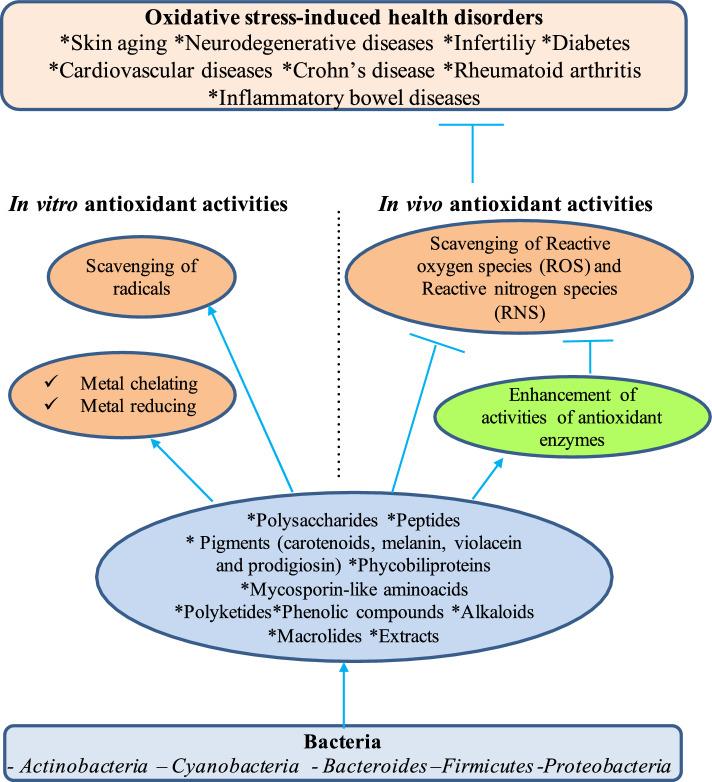
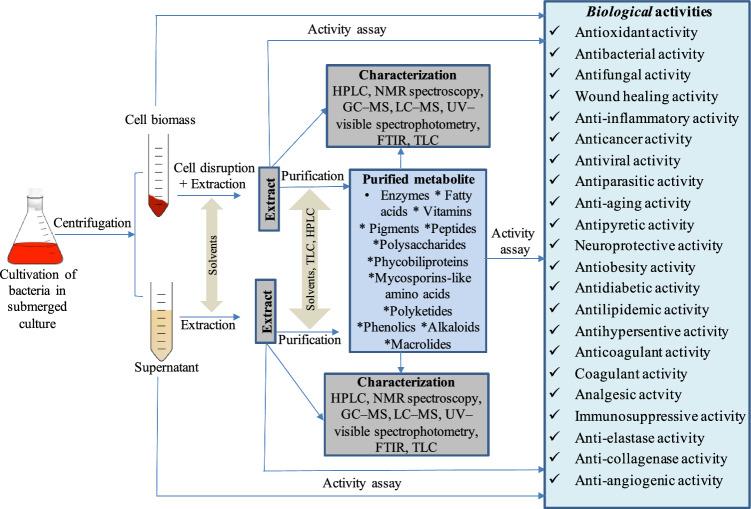
Antioxidants are organic molecules that scavenge reactive oxygen species (ROS) and reactive nitrogen species (RNS), thereby maintaining cellular redox balance in living organisms. The human body synthesizes endogenous antioxidants, whereas humans obtain exogenous antioxidants from other organisms such as plants, animals, fungi, and bacteria. This review primarily focuses on the antioxidant potential of natural metabolites and extracts from five major bacterial phyla, including the well-studied Actinobacteria and Cyanobacteria, as well as less-studied Bacteroides, Firmicutes, and Proteobacteria. The literature survey revealed that the metabolites and the extracts with antioxidant activity can be obtained from bacterial cells and their culture supernatants. The metabolites with antioxidant activity include pigments, phycobiliproteins, polysaccharides, mycosporins-like amino acids, peptides, phenolic compounds, and alkaloids. Both metabolites and extracts demonstrate in vitro antioxidant capacity through radical-scavenging, metal-reducing, and metal-chelating activity assays. In in vivo models, they can scavenge ROS and RNS directly and/or indirectly eliminate them by enhancing the activities of antioxidant enzymes, such as catalase, superoxide dismutase, and glutathione peroxidase. Due to their antioxidant activities, they may find applications in the cosmetic industry as anti-aging agents for the skin and in medicine as drugs or supplements for combating oxidative stress-related disorders, such as neurodegenerative diseases and diabetes. The literature survey also elucidated that some metabolites and extracts with antioxidant activity also exhibited strong antimicrobial properties. Therefore, we consider that they may have future applications in the treatment of infectious diseases, the preparation of pathogen-free healthy foods, and the extension of food shelf life.
抗氧化剂是一类有机分子,可清除活性氧(ROS)和活性氮(RNS),从而维持生物体细胞内的氧化还原平衡。人体能够合成内源性抗氧化剂,而人类则从植物、动物、真菌和细菌等其他生物体中获取外源性抗氧化剂。本综述主要关注来自五个主要细菌门类的天然代谢产物和提取物的抗氧化潜力,其中包括研究充分的放线菌门和蓝细菌门,以及研究较少的拟杆菌门、厚壁菌门和变形菌门。文献调查显示,具有抗氧化活性的代谢产物和提取物可从细菌细胞及其培养上清液中获得。具有抗氧化活性的代谢产物包括色素、藻胆蛋白、多糖、类菌孢素氨基酸、肽、酚类化合物和生物碱。代谢产物和提取物均通过自由基清除、金属还原和金属螯合活性测定来证明其体外抗氧化能力。在体内模型中,它们可以直接清除ROS和RNS,和/或通过增强过氧化氢酶、超氧化物歧化酶和谷胱甘肽过氧化物酶等抗氧化酶的活性来间接消除它们。由于其抗氧化活性,它们可能在化妆品行业中用作皮肤抗衰老剂,在医学上用作对抗氧化应激相关疾病(如神经退行性疾病和糖尿病)的药物或补充剂。文献调查还阐明,一些具有抗氧化活性的代谢产物和提取物也表现出很强的抗菌特性。因此,我们认为它们可能在传染病治疗、无病原体健康食品制备以及延长食品保质期方面有未来应用。


 Zotero 插件