
人工关节感染中万古霉素高治疗浓度与低治疗浓度的比较:一项回顾性队列分析。
High vs. low vancomycin therapeutic concentrations in periprosthetic joint infection: A retrospective cohort analysis.
作者信息
Cheng Jingdong, Wang Dehua, Chen Yanqing, Zhao Qingqing, Ou Qianyi, Zhang Liangming, Li Xinyu
机构信息
Department of Pharmacy, The First Affiliated Hospital of Chongqing Medical University, Chongqing, China.
Department of Pharmacy, Panzhihua Central Hospital, Panzhihua, Sichuan, China.
出版信息
Front Pharmacol. 2025 Mar 27;16:1555276. doi: 10.3389/fphar.2025.1555276. eCollection 2025.
OBJECTIVE
Current guidelines recommend vancomycin concentrations of 10-20 μg/mL for most infections, with higher levels (15-20 μg/mL) suggested for severe cases. However, evidence supporting these recommendations in periprosthetic joint infection (PJI) is limited. This study aims to evaluate the impact of different vancomycin concentration ranges (10-15 vs. 15-20 μg/mL) on the safety and effectiveness in PJI population.
METHODS
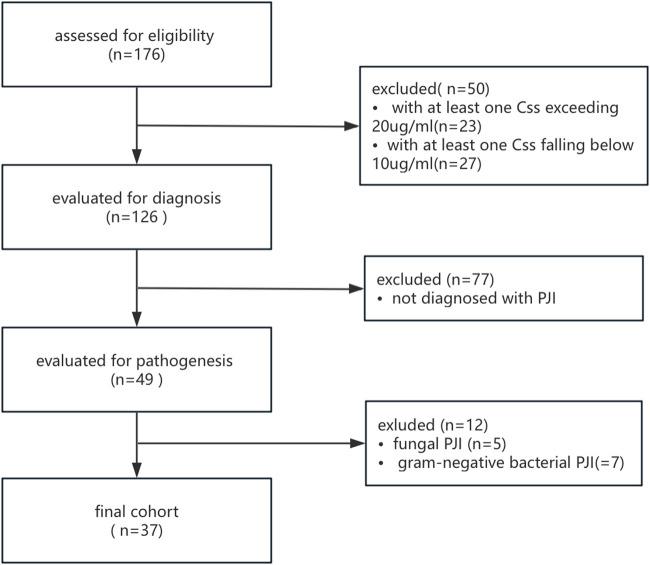
This retrospective study included 37 patients with vancomycin Therapeutic Drug Monitoring due to periprosthetic joint infection. Patients were categorized into two groups according to vancomycin concentrations, low concentration group (10-15 μg/mL) and high concentration group (15-20 μg/mL). Patients were followed up for at least 2 years. The long term clinical outcomes, inflammatory markers, as well as adverse events were compared. A physiologically based pharmacokinetic model was established to compare vancomycin distribution in kidney and bone marrow between the two groups.
RESULTS
There were 23 (62.16%) patients classified as the HC group and 14 (37.84%) as the LC group. The average steady-state trough concentration (Css) in the HC group was 17.74 μg/mL, and in the LC group was 12.11 μg/mL. At the end of follow-up, two patients (5.40%) in the HC group had died, and one (2.7%) was readmitted for joint fusion due to recurrent infections, whereas no deaths or readmissions occurred in the LC group. However, no significant differences were identified. Similar improvements from baseline were observed across WOMAC, Harris, HSS, and SF-12 scores between the groups. The synovial white blood cell (WBC) count was significantly lower in the HC group compared to the LC group (5,481 vs. 7,106/μL, = 0.009), with a more pronounced reduction from baseline noted. The PBPK model showed a greater increase in drug distribution to the bone marrow in the HC group (20.66 μg/mL vs. 14.34 μg/mL), with a smaller rise in the kidney (376.2 μg/mL vs. 327.7 μg/mL).
CONCLUSION
Maintaining vancomycin concentrations of 15-20 μg/mL is associated with better infection control for PJI patients who present with higher synovial WBC account, without compromising patient safety, joint function, or long-term quality of life.
目的
当前指南建议大多数感染患者的万古霉素浓度为10 - 20μg/mL,重症病例建议更高浓度(15 - 20μg/mL)。然而,支持这些建议用于人工关节周围感染(PJI)的证据有限。本研究旨在评估不同万古霉素浓度范围(10 - 15μg/mL与15 - 20μg/mL)对PJI患者安全性和有效性的影响。
方法
这项回顾性研究纳入了37例因人工关节周围感染进行万古霉素治疗药物监测的患者。根据万古霉素浓度将患者分为两组,低浓度组(10 - 15μg/mL)和高浓度组(15 - 20μg/mL)。对患者进行至少2年的随访。比较长期临床结局、炎症标志物以及不良事件。建立基于生理的药代动力学模型,比较两组间万古霉素在肾脏和骨髓中的分布。
结果
高浓度组有23例(62.16%)患者,低浓度组有14例(37.84%)患者。高浓度组的平均稳态谷浓度(Css)为17.74μg/mL,低浓度组为12.11μg/mL。随访结束时,高浓度组有2例(5.40%)患者死亡,1例(2.7%)因反复感染再次入院行关节融合术,而低浓度组无死亡或再次入院情况。然而,未发现显著差异。两组间在WOMAC、Harris、HSS和SF - 12评分方面从基线开始均有相似改善。高浓度组滑膜白细胞(WBC)计数显著低于低浓度组(5481对7106/μL,P = 0.009),且从基线下降更为明显。基于生理的药代动力学模型显示,高浓度组药物在骨髓中的分布增加幅度更大(20.66μg/mL对14.34μg/mL),在肾脏中的升高幅度较小(376.2μg/mL对327.7μg/mL)。
结论
对于滑膜白细胞计数较高的PJI患者,维持万古霉素浓度在15 - 20μg/mL与更好的感染控制相关,且不影响患者安全、关节功能或长期生活质量。


 Zotero 插件