
优化风险因素以指导韩国婴儿高效使用帕利珠单抗。
Optimizing risk factors to guide COST-effective use of palivizumab in KOREAN infants.
作者信息
Kang Ji-Man, Carbonell-Estrany Xavier, Paes Bosco, Rodgers-Gray Barry, Fullarton John, Tarride Jean-Eric, Yang Hyeon-Jong, Chang Yun Sil, Keary Ian
机构信息
Department of Pediatrics, Severance Children's Hospital, Yonsei University College of Medicine, Seoul, South Korea.
Institute for Immunology and Immunological Diseases, Yonsei University College of Medicine, Seoul, South Korea.
出版信息
Pediatr Int. 2025 Jan-Dec;67(1):e70021. doi: 10.1111/ped.70021.
BACKGROUND
Korean infants born at 32-35 weeks gestational age (wGA) receive palivizumab prophylaxis to prevent respiratory syncytial virus hospitalization (RSVH) if they are born during the RSV season and have a sibling. The aim of this study was to evaluate the impact of using the International Risk Scoring Tool (IRST) to target prophylaxis in Korea.
METHODS
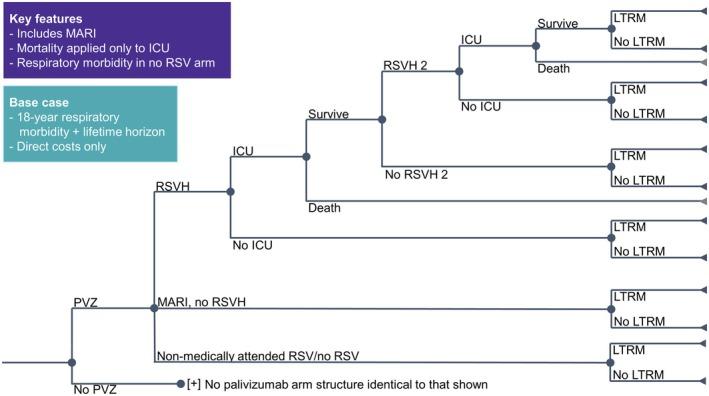
The IRST includes 3 risk factors: birth 3 months before to 2 months after the RSV season starts; smokers in the household and/or smoking while pregnant; and, siblings/daycare. First, the accuracy of the Korean guidelines to predict RSVH was compared to that of the IRST using a historic dataset of 13,475 infants born 32-35 wGA. Second, a published cost-utility model was adapted using Korean-specific parameters for costs (2022) and resource use to assess the cost-effectiveness of palivizumab versus no prophylaxis guided either by the Korean guidelines or the IRST.
RESULTS
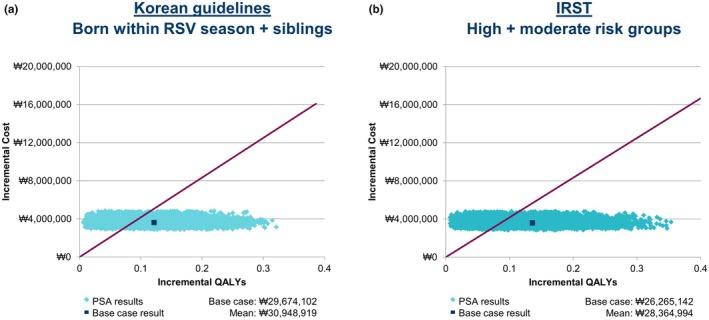
Using the Korean guidelines identified 26.9% of RSVHs, with an area under the receiver operating characteristic curve of 0.512. The corresponding results for infants assessed at moderate- to high-risk by the IRST were 85.1% and 0.773, respectively. The incremental cost per quality-adjusted life year (QALY) for prophylaxis versus no prophylaxis was ₩29,674,102 (USD22,977) using the Korean guidelines, with a 67.0% probability for cost-effectiveness against a willingness-to-pay threshold of ₩41,655,203 (USD32,255). For the IRST, it was ₩26,265,142 (USD20,338)/QALY and 70.8% probability.
CONCLUSIONS
Adoption of the IRST in Korea would provide greater protection of the most vulnerable infants born 32-35 wGA against RSVH whilst improving cost-effectiveness.
背景
韩国孕32 - 35周(wGA)出生的婴儿,如果在呼吸道合胞病毒(RSV)流行季节出生且有兄弟姐妹,会接受帕利珠单抗预防治疗以防止因RSV住院(RSVH)。本研究的目的是评估在韩国使用国际风险评分工具(IRST)进行靶向预防的影响。
方法
IRST包括3个风险因素:在RSV季节开始前3个月至开始后2个月出生;家庭中有吸烟者和/或孕期吸烟;以及有兄弟姐妹/日托。首先,使用13475名孕32 - 35周出生婴儿的历史数据集,将韩国预测RSVH指南的准确性与IRST的准确性进行比较。其次,采用已发表的成本效用模型,使用韩国特定的成本参数(2022年)和资源使用情况,评估在韩国指南或IRST指导下,帕利珠单抗预防与不预防的成本效益。
结果
使用韩国指南识别出26.9%的RSVH病例,受试者工作特征曲线下面积为0.512。IRST评估为中高风险的婴儿的相应结果分别为85.1%和0.773。使用韩国指南时,预防与不预防相比,每质量调整生命年(QALY)的增量成本为29674102韩元(22977美元),相对于41655203韩元(32255美元)的支付意愿阈值,成本效益概率为67.0%。对于IRST,该值为26265142韩元(20338美元)/QALY,概率为70.8%。
结论
在韩国采用IRST将为孕32 - 35周出生的最脆弱婴儿提供更大的保护,使其免受RSVH影响,同时提高成本效益。


 Zotero 插件