
脑转移瘤切除术围手术期地塞米松使用的实践差异与结局
Practice Variation in Perioperative Dexamethasone Use and Outcomes in Brain Metastasis Resection.
作者信息
Wasilewski David, Araceli Tommaso, Rafaelian Artem, Demetz Matthias, Asey Benedikt, Ersoy Tunc-Faik, Dauth Alice, Neumeister Anne, Peukert Ricarda, Pöser Paul, Krämer Christopher, Bukatz Jan, Shaked Zoe, Jelgersma Claudius, Früh Anton, Xu Ran, Misch Martin, Capper David, Ehret Felix, Frost Nikolaj, Bullinger Lars, Keilholz Ulrich, Senft Christian, Schmidt Leon, Krenzlin Harald, Ringel Florian, Pohrt Anne, Meyer Hanno S, Gempt Jens, Kerschbaumer Johannes, Freyschlag Christian, Thomé Claudius, Simon Matthias, Dubinski Daniel, Freiman Thomas, Schmidt Nils Ole, Proescholdt Martin, Vajkoczy Peter, Onken Julia
机构信息
Department of Neurosurgery, Charité-Universitätsmedizin Berlin, corporate member of Freie Universität Berlin and Humboldt-Universität zu Berlin, Berlin, Germany.
Charité Comprehensive Cancer Center, Charité-Universitätsmedizin Berlin, corporate member of Freie Universität Berlin and Humboldt-Universität zu Berlin, Berlin, Germany.
出版信息
JAMA Netw Open. 2025 Apr 1;8(4):e254689. doi: 10.1001/jamanetworkopen.2025.4689.
IMPORTANCE
Variations in perioperative dexamethasone dosing are common in brain metastasis resection, but their impact on patient outcomes remains unclear.
OBJECTIVE
To evaluate the association between perioperative dexamethasone dosing and patient outcomes, focusing on overall survival (OS) and progression-free survival (PFS).
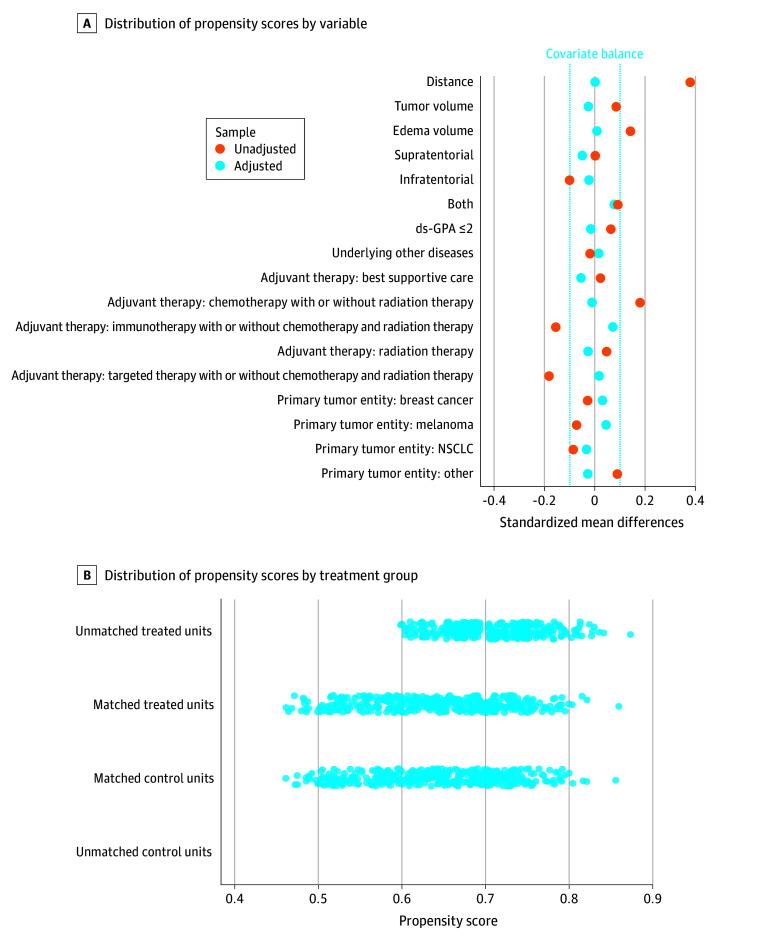
DESIGN, SETTING, AND PARTICIPANTS: This retrospective multicenter comparative effectiveness study used data collected from January 2010 to December 2023. Patients with symptomatic brain metastases undergoing primary surgical resection at 7 neurological centers in Germany and 1 in Austria and who had complete records of perioperative dexamethasone dosing were included. Propensity score matching (PSM) was used to control for confounders. Analysis was conducted from March to June 2024.
EXPOSURES
Cumulative perioperative dexamethasone administration over 27 days, dichotomized at 122 mg using maximally selected rank statistics.
MAIN OUTCOMES AND MEASURES
The primary outcome was OS. Secondary outcomes included extracranial PFS (ecPFS) and intracranial PFS (icPFS) as well as incidence of wound revision surgery after brain metastasis resection. Hazard ratios (HRs) were calculated using Cox proportional hazards models.
RESULTS
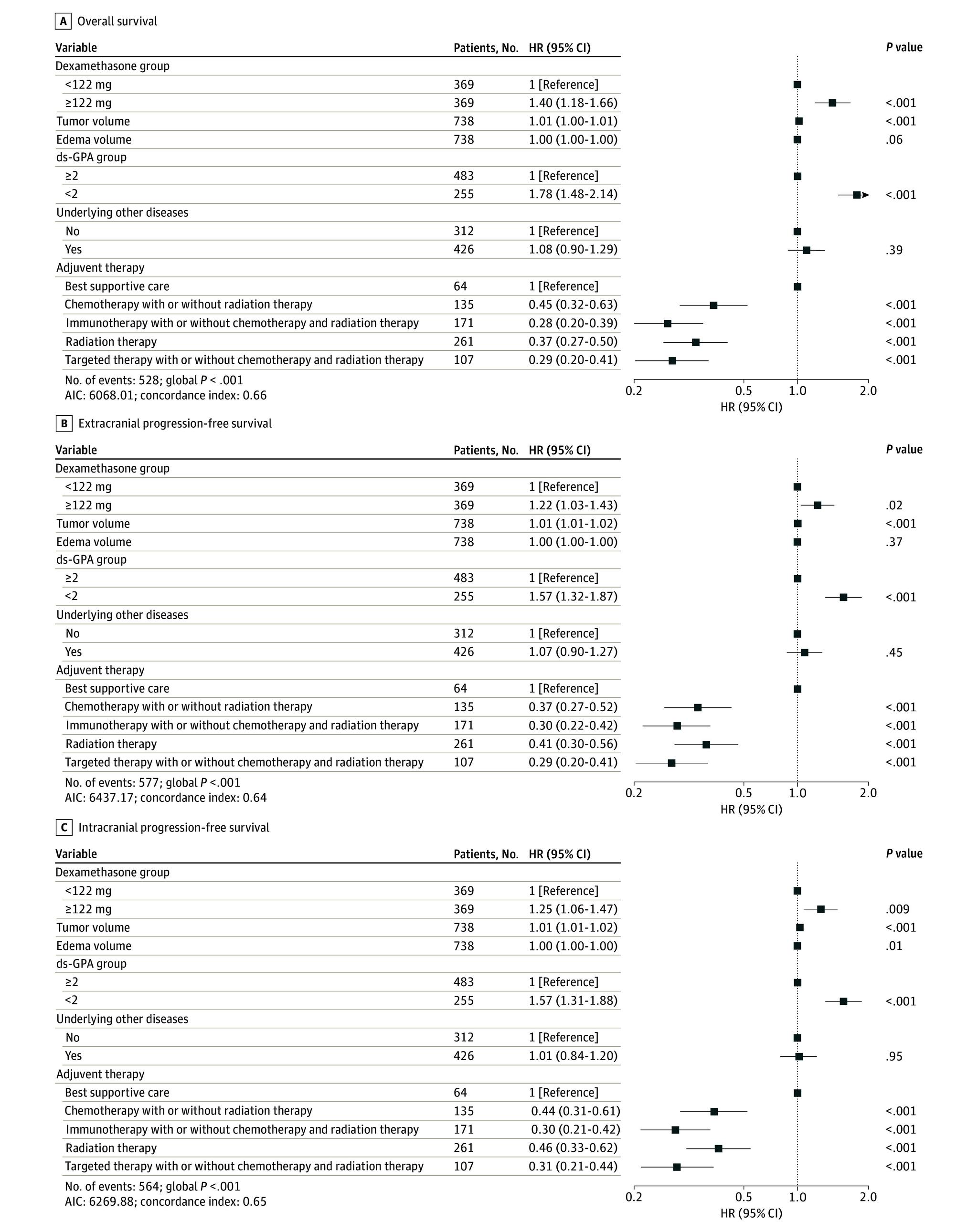
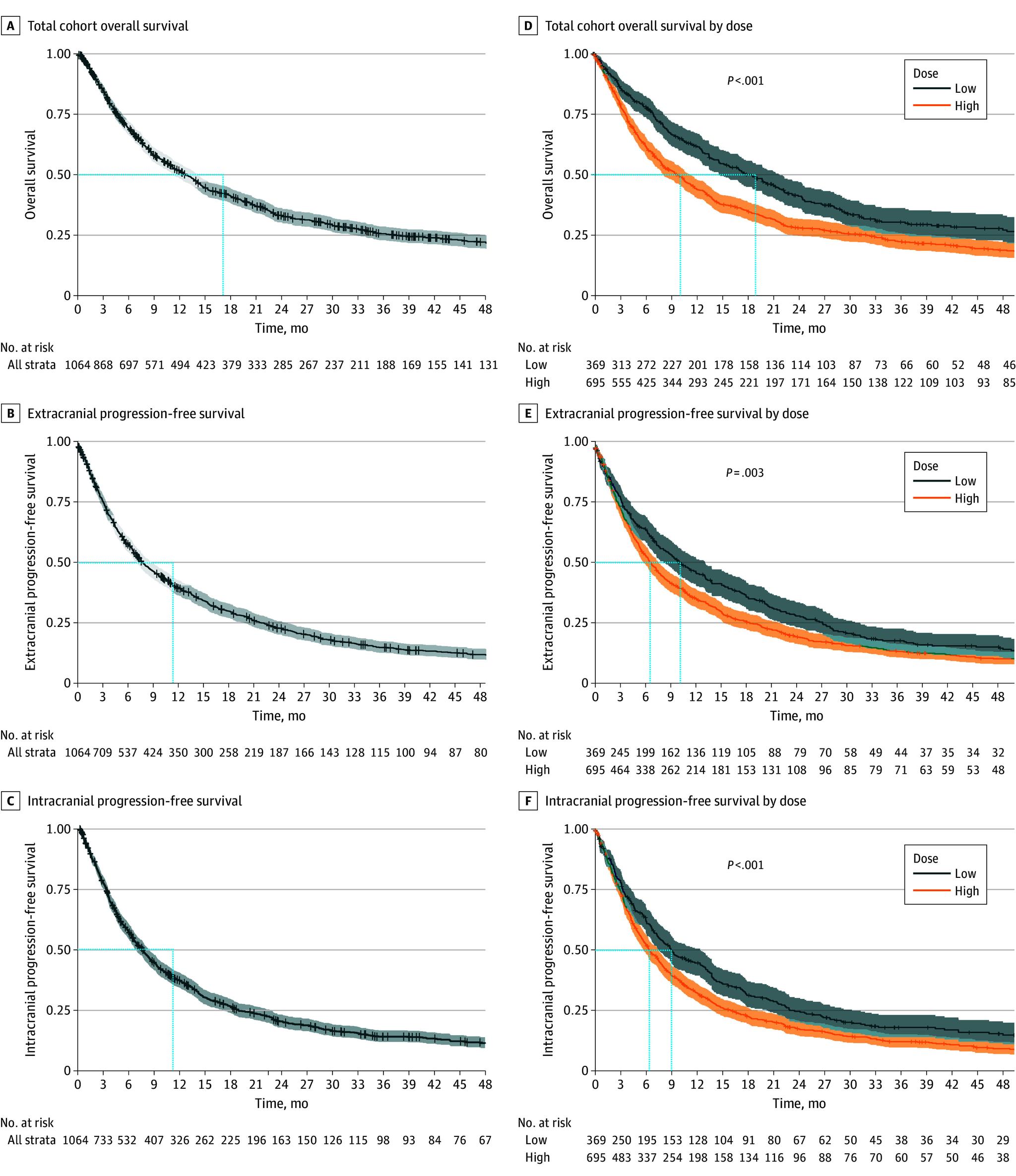
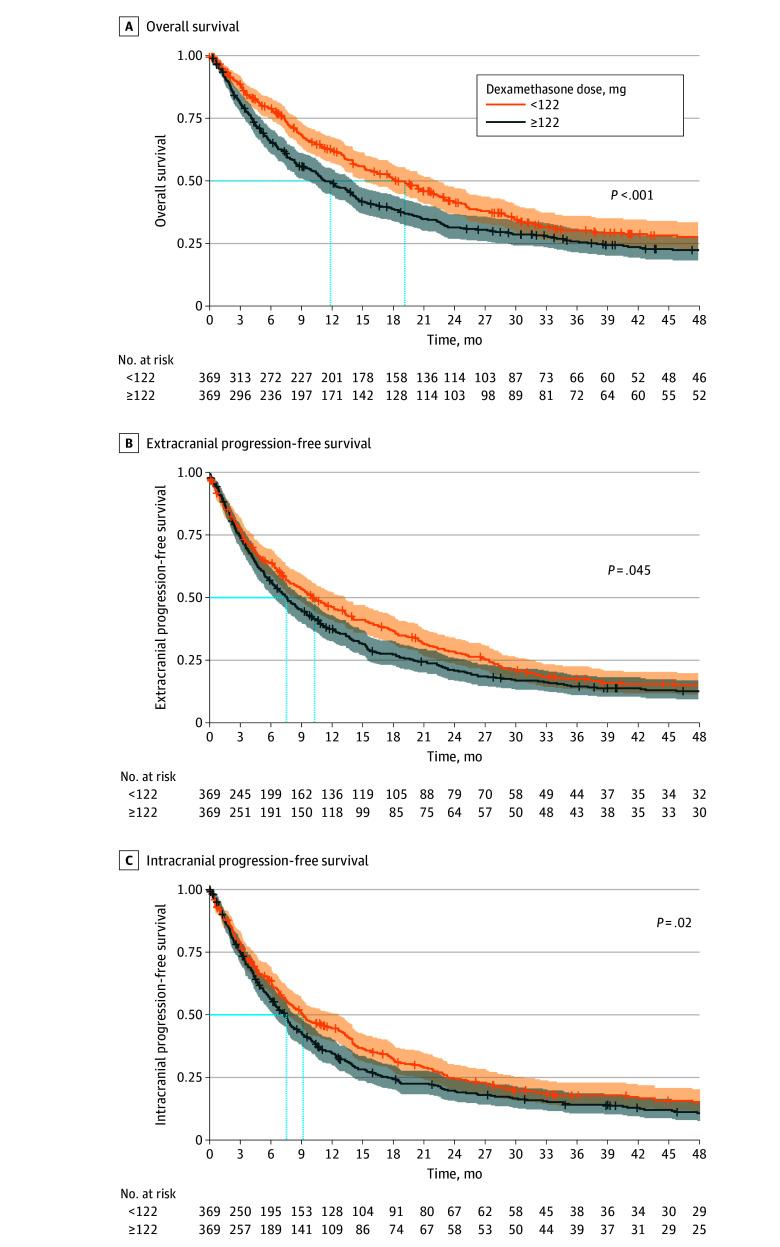
A total of 1064 patients were included in the analysis. The median (IQR) age was 64 (56-72) years, with 489 female patients (49%) and 541 male patients (51%). Non-small cell lung cancer (NSCLC) was the most common tumor entity (564 patients [53%]), followed by breast cancer (146 patients [14%]) and melanoma (138 patients [13%]). After PSM, patients receiving cumulative dexamethasone doses less than 122 mg had a median OS of 19.1 (95% CI, 15.2-22.4) months compared with 12.0 (95% CI, 9.1-14.7) months for those receiving 122 mg or more (P = .002). Multivariable analysis showed an independent association between higher cumulative dexamethasone doses and reduced OS (HR, 1.40; 95% CI, 1.18-1.66; P < .001). Secondary analyses demonstrated consistent findings with icPFS and ecPFS and a dose-response association between cumulative dexamethasone and hazard for death.
CONCLUSIONS AND RELEVANCE
In this study, higher cumulative perioperative dexamethasone was associated with reduced OS, icPFS, and ecPFS in patients undergoing brain metastasis resection. These findings suggest that stricter dosing protocols could improve outcomes. Prospective trials are warranted to confirm these associations and guide evidence-based practice.
重要性
围手术期地塞米松给药剂量的差异在脑转移瘤切除术中很常见,但其对患者预后的影响仍不清楚。
目的
评估围手术期地塞米松给药剂量与患者预后之间的关联,重点关注总生存期(OS)和无进展生存期(PFS)。
设计、设置和参与者:这项回顾性多中心比较有效性研究使用了2010年1月至2023年12月收集的数据。纳入了在德国7个神经中心和奥地利1个神经中心接受原发性手术切除的有症状脑转移瘤患者,且这些患者有围手术期地塞米松给药的完整记录。采用倾向评分匹配(PSM)来控制混杂因素。分析于2024年3月至6月进行。
暴露因素
27天内围手术期地塞米松的累积给药量,使用最大选择秩统计量以122mg进行二分法划分。
主要结局和测量指标
主要结局是OS。次要结局包括颅外PFS(ecPFS)和颅内PFS(icPFS)以及脑转移瘤切除术后伤口修复手术的发生率。使用Cox比例风险模型计算风险比(HRs)。
结果
共有1064例患者纳入分析。中位(IQR)年龄为64(56 - 72)岁,其中女性患者489例(49%),男性患者541例(51%)。非小细胞肺癌(NSCLC)是最常见的肿瘤类型(564例患者[53%]),其次是乳腺癌(146例患者[14%])和黑色素瘤(138例患者[13%])。PSM后,接受累积地塞米松剂量小于122mg的患者中位OS为19.1(95%CI,15.2 - 22.4)个月,而接受122mg或更多剂量的患者为12.0(95%CI,9.1 - 14.7)个月(P = 0.002)。多变量分析显示,较高的累积地塞米松剂量与OS降低独立相关(HR,1.40;95%CI,1.18 - 1.�6;P < 0.001)。次要分析显示,icPFS和ecPFS有一致的结果,且累积地塞米松与死亡风险之间存在剂量反应关联。
结论和相关性
在本研究中,较高的围手术期地塞米松累积剂量与脑转移瘤切除患者的OS、icPFS和ecPFS降低相关。这些发现表明,更严格的给药方案可能改善预后。有必要进行前瞻性试验以证实这些关联并指导循证实践。
 Zotero 插件