
呼吸道合胞病毒住院儿童重症疾病的危险因素
Risk Factors for Severe Disease Among Children Hospitalized With Respiratory Syncytial Virus.
作者信息
Kirolos Nardin, Mtaweh Haifa, Datta Rohini R, Farrar Daniel S, Seaton Claire, Bone Jeffrey N, Muttalib Fiona, Kaziev Caitlyn L, Fortini Jonathan, Mahant Sanjay, Campigotto Aaron, Freire Gabrielle, Yeung Rae S M, Rayment Jonathan H, Yang Connie, Srigley Jocelyn A, Sadarangani Manish, Buchanan Francine, Morris Shaun K, Gill Peter J
机构信息
Department of Pediatrics, University of Toronto, Toronto, Ontario, Canada.
Interdepartmental Division of Critical Care Medicine, The Hospital for Sick Children, Toronto, Ontario, Canada.
出版信息
JAMA Netw Open. 2025 Apr 1;8(4):e254666. doi: 10.1001/jamanetworkopen.2025.4666.
IMPORTANCE
A resurgence of respiratory syncytial virus (RSV)-associated acute respiratory tract infection (ARI) was observed in 2022 and 2023 after the COVID-19 pandemic. Changes in the demographic characteristics, disease severity, and outcomes of patients were observed, which could impact the identification of risk groups for interventions aimed at reducing the severity of RSV disease.
OBJECTIVES
To identify factors associated with severe clinical outcomes among children hospitalized with RSV-associated ARIs in 2022 and 2023.
DESIGN, SETTING, AND PARTICIPANTS: This observational cohort study, conducted at 2 large, Canadian, tertiary-level pediatric hospitals, comprised all 709 cases of RSV-associated ARI among children younger than 18 years who were admitted to the hospital or intensive care unit (ICU) from July 1, 2022, to June 30, 2023.
EXPOSURE
Diagnosis of RSV-associated ARI.
MAIN OUTCOMES AND MEASURES
The primary outcome of severe disease was defined as requiring noninvasive or invasive ventilation or death. Risk factors for severe disease and ICU admission (secondary outcome) were assessed using multivariable Poisson regression, and results were reported as adjusted risk ratios (ARRs) with 95% CIs, with age-stratified models (<2 years and ≥2 years).
RESULTS
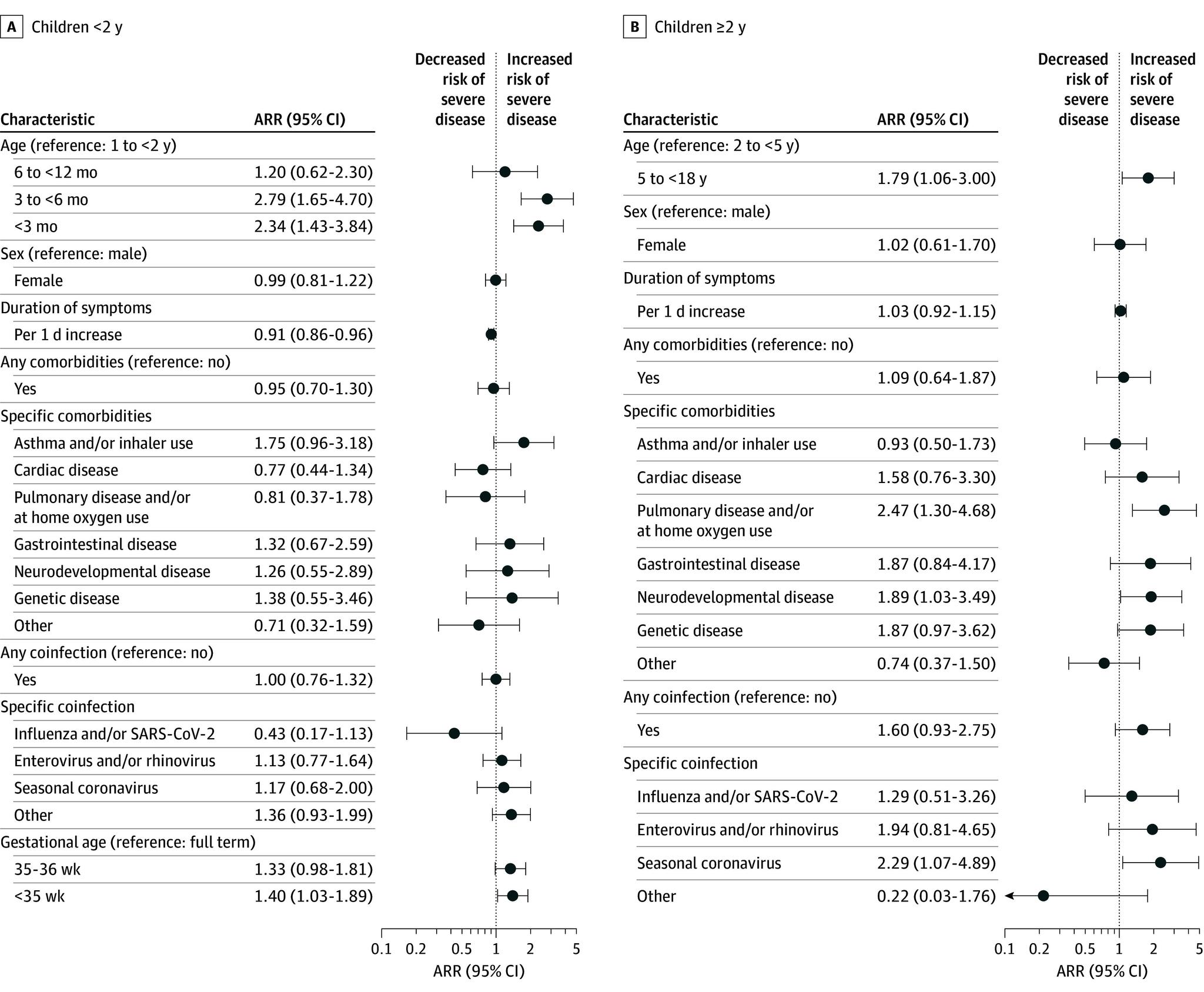
A total of 709 cases (median age, 13.1 months [IQR, 2.0-36.6 months]; 442 boys [62.3%]) were admitted with RSV-associated ARI; 452 (63.8%) were younger than 2 years, and 257 (36.2%) were aged 2 years or older. Severe disease was documented for 204 cases (28.8%). Patients with severe disease were younger than those with nonsevere disease (median age, 2.6 months [IQR, 1.3-16.0 months] vs 18.6 months [IQR, 4.5-39.1 months]; P < .001). Pulmonary disease and use of home oxygen (ARR, 2.47 [95% CI, 1.30-4.68]) and neurologic, neuromuscular, and developmental conditions (ARR, 1.89 [95% CI, 1.03-3.49]) were associated with severe disease among children aged 2 years or older. Among children younger than 2 years, age younger than 3 months (ARR, 2.34 [95% CI, 1.43-3.84]), age 3 to less than 6 months (ARR, 2.79 [95% CI, 1.65-4.70]), and prematurity (ARR, 1.40 [95% CI, 1.03-1.89]) were associated with severe disease.
CONCLUSIONS AND RELEVANCE
In this cohort study of children hospitalized with RSV in 2022 and 2023, severe RSV disease was more likely among those aged 2 years or older with pulmonary and neurologic, neuromuscular, or developmental conditions. For children younger than 2 years, age younger than 6 months and prematurity were the main risk factors. These findings support prevention strategies for all younger children, including premature infants, with potential benefit for children aged 2 years or older in specific high-risk groups.
重要性
在2019冠状病毒病大流行之后,2022年和2023年观察到呼吸道合胞病毒(RSV)相关的急性呼吸道感染(ARI)有所回升。观察到患者的人口统计学特征、疾病严重程度和结局发生了变化,这可能会影响旨在降低RSV疾病严重程度的干预措施的风险群体识别。
目的
确定2022年和2023年因RSV相关ARI住院的儿童中与严重临床结局相关的因素。
设计、地点和参与者:这项观察性队列研究在加拿大2家大型三级儿科医院进行,纳入了2022年7月1日至2023年6月30日期间入住医院或重症监护病房(ICU)的所有709例18岁以下儿童的RSV相关ARI病例。
暴露因素
RSV相关ARI的诊断。
主要结局和测量指标
严重疾病的主要结局定义为需要无创或有创通气或死亡。使用多变量泊松回归评估严重疾病和入住ICU(次要结局)的危险因素,结果报告为调整风险比(ARR)及95%置信区间(CI),并采用年龄分层模型(<2岁和≥2岁)。
结果
共有709例(中位年龄13.1个月[四分位间距,2.0 - 36.6个月];442例为男孩[62.3%])因RSV相关ARI入院;452例(63.8%)年龄小于两岁,257例(36.2%)年龄为2岁或以上。记录到204例(28.8%)有严重疾病。患有严重疾病的患者比非严重疾病的患者年龄更小(中位年龄,2.6个月[四分位间距,1.3 - 16.0个月]对18.6个月[四分位间距,4.5 - 39.1个月];P <.001)。在2岁或以上的儿童中,肺部疾病和家庭氧疗的使用(ARR,2.47[95%CI,1.30 - 4.68])以及神经、神经肌肉和发育状况(ARR,1.89[95%CI,1.03 - 3.49])与严重疾病相关。在2岁以下的儿童中,年龄小于3个月(ARR,2.34[95%CI,1.43 - 3.84])、3至小于6个月(ARR,2.79[95%CI,1.65 - 4.70])和早产(ARR,1.40[95%CI,1.03 - 1.89])与严重疾病相关。
结论及意义
在这项对2022年和2023年因RSV住院儿童的队列研究中,2岁或以上患有肺部疾病以及神经、神经肌肉或发育状况的儿童更易患严重RSV疾病。对于2岁以下儿童,年龄小于6个月和早产是主要危险因素。这些发现支持针对所有年幼儿童,包括早产儿的预防策略,对特定高危群体中2岁或以上的儿童可能有益。

 Zotero 插件