
免疫检查点抑制剂疗法与发生黑色素瘤脑转移的风险降低相关。
Immune checkpoint inhibitor therapy is associated with a decreased risk of developing melanoma brain metastases.
作者信息
Fager Anna, Samuelsson Matilda, Olofsson Bagge Roger, Pivodic Aldina, Bjursten Sara, Levin Max, Jespersen Henrik, Ny Lars
机构信息
Department of Oncology, Sahlgrenska University Hospital, Gothenburg, Sweden.
Department of Oncology, Institute of Clinical Sciences, Sahlgrenska Academy, University of Gothenburg, Gothenburg, Sweden.
出版信息
BJC Rep. 2025 Apr 11;3(1):22. doi: 10.1038/s44276-025-00137-2.
BACKGROUND
Despite recent advancements in metastatic melanoma treatment, the emergence of melanoma brain metastases (MBM) continues to pose a challenge. This study aimed to explore factors associated with MBM development.
METHODS
This retrospective study included patients diagnosed with advanced melanoma (unresectable stages III and IV [M1a-c]) between 2013 and 2019 at Sahlgrenska University Hospital, Gothenburg, Sweden. Differences in baseline and primary tumor characteristics, mutational status, biomarker levels, and first-line treatment between patients who developed MBM (BM+) and patients who did not develop MBM (BM-) were analyzed using univariable and multivariable Cox proportional hazard regression.
RESULT
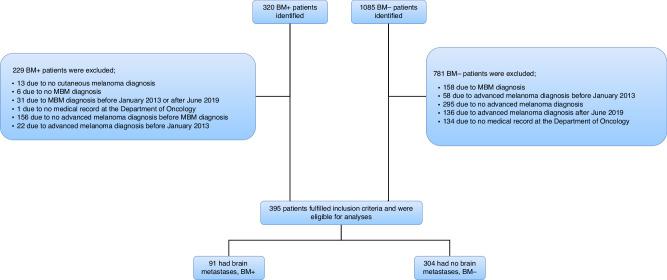
Of 395 patients, 91 subsequently developed MBM. Patients who received immune checkpoint inhibitors (ICI) as first-line treatment had a reduced risk of MBM development (p ≤ 0.001). None of the eleven patients who received CTLA-4 inhibitors as monotherapy or in combination with PD-1 inhibitors as first-line treatment developed brain metastases. Elevated plasma levels of S100B (p = 0.021) and higher metastatic stage (p = 0.047) were also associated with an increased risk of MBM development.
CONCLUSION
ICI treatment is associated with a decreased risk of MBM development, suggesting a protective role. Elevated S100B levels and stage IV disease at advanced melanoma diagnosis might indicate an increased risk of MBM development.
背景
尽管转移性黑色素瘤治疗最近取得了进展,但黑色素瘤脑转移(MBM)的出现仍然是一个挑战。本研究旨在探讨与MBM发生相关的因素。
方法
这项回顾性研究纳入了2013年至2019年期间在瑞典哥德堡萨尔格伦斯卡大学医院被诊断为晚期黑色素瘤(不可切除的III期和IV期[M1a - c])的患者。使用单变量和多变量Cox比例风险回归分析发生MBM的患者(BM +)和未发生MBM的患者(BM -)在基线和原发性肿瘤特征、突变状态、生物标志物水平及一线治疗方面的差异。
结果
395例患者中,91例随后发生了MBM。接受免疫检查点抑制剂(ICI)作为一线治疗的患者发生MBM的风险降低(p≤0.001)。11例接受CTLA - 4抑制剂单药治疗或与PD - 1抑制剂联合作为一线治疗的患者均未发生脑转移。血浆S100B水平升高(p = 0.021)和更高的转移分期(p = 0.047)也与MBM发生风险增加相关。
结论
ICI治疗与MBM发生风险降低相关,提示其具有保护作用。晚期黑色素瘤诊断时S100B水平升高和IV期疾病可能表明MBM发生风险增加。

 Zotero 插件