
整合炎症、营养与免疫:CALLY指数作为消化系统癌症预后工具的系统评价与荟萃分析
Integrating inflammation, nutrition, and immunity: the CALLY index as a prognostic tool in digestive system cancers - a systematic review and meta-analysis.
作者信息
Wu Bo, Liu Jingting, Shao Chaodan, Yu Dongli, Liao Jianhua
机构信息
Department of Surgery, Zhejiang Hospital, 12 Lingyin Road, Zhejiang, 310013, China.
Department of Health Management, Sir Run Run Shaw International Medical Centre, 9 Jingtan Road, Hangzhou, Zhejiang, 310000, China.
出版信息
BMC Cancer. 2025 Apr 11;25(1):672. doi: 10.1186/s12885-025-14074-3.
BACKGROUND
Digestive system cancers remain a leading cause of cancer-related mortality globally, underscoring the need for reliable prognostic tools. The C-reactive protein-Albumin-Lymphocyte (CALLY) index, which reflects inflammation, nutrition, and immunity, has shown potential in predicting survival. However, comprehensive evaluations of its role in digestive system cancers are still limited.
METHODS
A meta-analysis of English-language studies from online databases was performed to assess the prognostic value of the CALLY index. Pooled hazard ratios (HRs) were calculated for overall survival (OS), disease-free survival (DFS), recurrence-free survival (RFS), and cancer-specific survival (CSS).
RESULTS
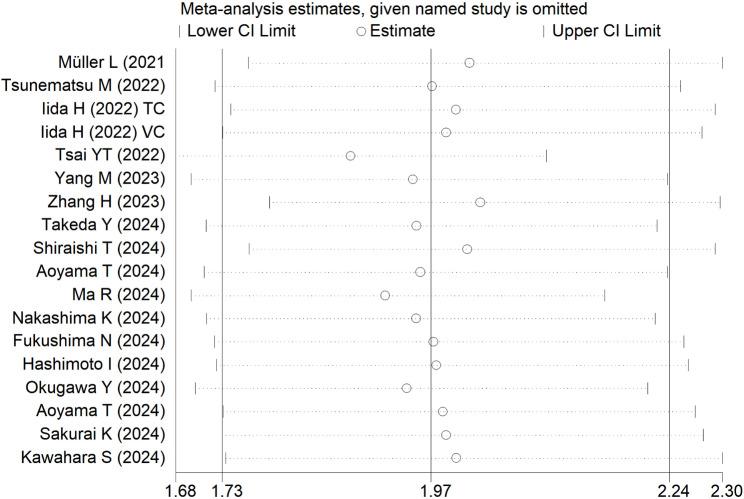
A total of eighteen articles (19 studies, encompassing 7,951 patients) were included. A lower CALLY index was significantly associated with poorer outcomes across all survival endpoints. The pooled HR for OS was 1.973 (95% CI: 1.734-2.244), with HRs for DFS, RFS, and CSS being 2.093 (95% CI: 1.682-2.604), 1.462 (95% CI: 1.292-1.654), and 2.456 (95% CI: 1.887-3.221), respectively (all P < 0.001). Subgroup analyses for OS demonstrated consistent prognostic significance across various treatment strategies, cancer types, cutoff values, sample sizes, and regions. Notably, the CALLY index was a strong predictor of OS in surgical patients (HR = 2.014, 95% CI: 1.794-2.260, P < 0.001). Sensitivity analyses validated the robustness of these findings, with minimal publication bias (Egger's test P = 0.053).
CONCLUSIONS
The CALLY index serves as a cost-effective and reliable biomarker for predicting prognosis in digestive system cancers. Its utility as a pre-treatment risk stratification tool, which integrates key factors of inflammation, nutrition, and immunity, renders it valuable for guiding clinical decision-making.
背景
消化系统癌症仍是全球癌症相关死亡的主要原因,这凸显了对可靠预后工具的需求。反映炎症、营养和免疫的C反应蛋白-白蛋白-淋巴细胞(CALLY)指数在预测生存方面已显示出潜力。然而,对其在消化系统癌症中作用的全面评估仍然有限。
方法
对在线数据库中的英文研究进行荟萃分析,以评估CALLY指数的预后价值。计算总生存(OS)、无病生存(DFS)、无复发生存(RFS)和癌症特异性生存(CSS)的合并风险比(HRs)。
结果
共纳入18篇文章(19项研究,涵盖7951例患者)。较低的CALLY指数与所有生存终点的较差预后显著相关。OS的合并HR为1.973(95%CI:1.734-2.244),DFS、RFS和CSS的HR分别为2.093(95%CI:1.682-2.604)、1.462(95%CI:1.292-1.654)和2.456(95%CI:1.887-3.221)(均P<0.001)。OS的亚组分析表明,在各种治疗策略、癌症类型、临界值、样本量和地区中,其预后意义一致。值得注意的是,CALLY指数是手术患者OS的有力预测指标(HR=2.014,95%CI:1.794-2.260,P<0.001)。敏感性分析验证了这些发现的稳健性,发表偏倚最小(Egger检验P=0.053)。
结论
CALLY指数是预测消化系统癌症预后的一种经济有效且可靠的生物标志物。其作为一种整合炎症、营养和免疫关键因素的治疗前风险分层工具,对指导临床决策具有重要价值。


 Zotero 插件