
环境污染与人类生育能力:探究细颗粒物(PM2.5)暴露与辅助生殖技术结局之间的关系。
Environmental pollution and human fertility: investigating the relationship between PM2.5 exposure and assisted reproductive technology outcomes.
作者信息
Li Fei, Duan Xiaoyan, Li Mingming, Gao Yumei, Kang Yuejuan, Zheng WenJun, Guo XueYan, Chen Ying
机构信息
Center for Reproductive Medicine, Clinical College, The First People'S Hospital of Shangqiu, Xinxiang Medical University, 292 Kaixuan South Road, Shangqiu, Henan, China.
Zhengzhou University, Henan, China.
出版信息
BMC Public Health. 2025 Apr 11;25(1):1357. doi: 10.1186/s12889-025-22518-5.
OBJECTIVE
To investigate the impact of seasonal variations in particulate matter with an aerodynamic diameter of 2.5 µm or less (PM2.5) exposure on assisted reproductive technology (ART) outcomes.
METHODS
This retrospective study, conducted at the First People's Hospital of Shangqiu, analyzed data from 13,476 patients who underwent ART procedures between February 2018 and December 2022. Patients were categorized based on seasonal PM2.5 exposure levels. A generalized additive model (GAM), linear regression analysis, and multivariate logistic regression were used to assess the relationship between PM2.5 exposure and ART outcomes, including oocyte and embryo quality, pregnancy rates, live birth rates, and miscarriage rates.
RESULTS
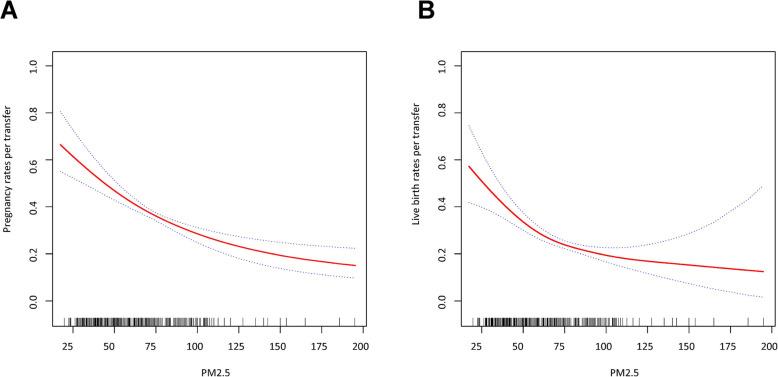
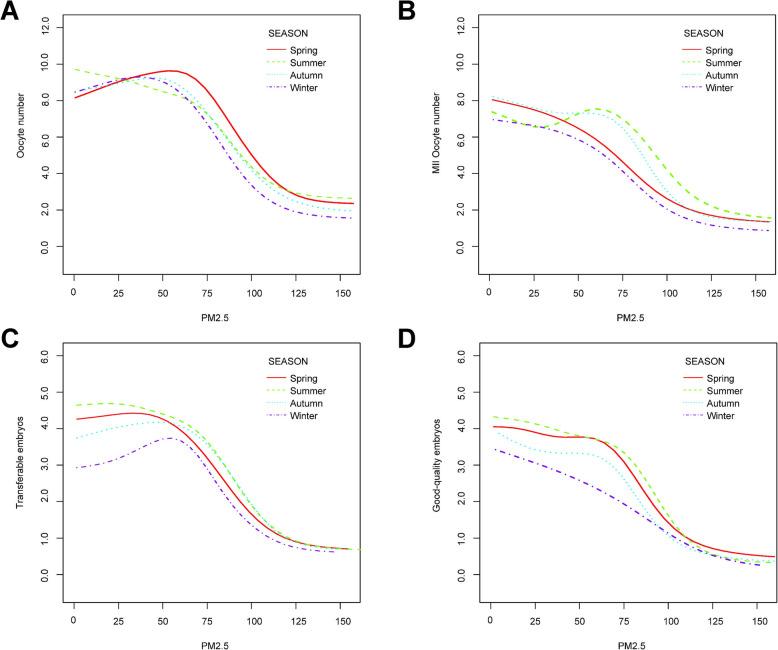
Significant differences were observed in oocyte number, metaphase II (MII) oocyte number, transferable embryos, and good-quality embryos across seasonal PM2.5 exposure subgroups. Pregnancy rates and live birth rates also demonstrated statistically significant variations. Linear regression analysis revealed a consistent negative correlation between PM2.5 concentrations and key ART outcomes. Multivariate logistic regression analysis, adjusting for age and seasonal variations, confirmed a significant negative association between PM2.5 exposure and both pregnancy rates (OR = 0.995, 95% CI: 0.994-0.996, p < 0.001) and live birth rates (OR = 0.996, 95% CI: 0.995-0.997, p < 0.001). However, no significant relationship was found between PM2.5 exposure and miscarriage rates. GAM analysis further identified a nonlinear, threshold-like association between pregnancy outcomes and predictive factors, with significantly higher live birth rates observed in spring, summer, and autumn compared to winter.
CONCLUSIONS
The study complements existing evidence that exposure to PM2.5 can lead to decreased success rates of pregnancy and live births, as well as significantly impact the outcomes of ART. Future research should focus on developing strategies to mitigate the adverse effects of environmental pollution on ART success rates.
目的
探讨暴露于空气动力学直径小于或等于2.5微米的颗粒物(PM2.5)的季节变化对辅助生殖技术(ART)结局的影响。
方法
这项回顾性研究在商丘市第一人民医院进行,分析了2018年2月至2022年12月期间接受ART治疗的13476例患者的数据。根据季节性PM2.5暴露水平对患者进行分类。采用广义相加模型(GAM)、线性回归分析和多因素逻辑回归分析,评估PM2.5暴露与ART结局之间的关系,包括卵母细胞和胚胎质量、妊娠率、活产率和流产率。
结果
在不同季节PM2.5暴露亚组中,卵母细胞数量、中期II(MII)卵母细胞数量、可移植胚胎和优质胚胎存在显著差异。妊娠率和活产率也显示出统计学上的显著差异。线性回归分析显示PM2.5浓度与关键ART结局之间存在一致的负相关。多因素逻辑回归分析在调整年龄和季节变化后,证实PM2.5暴露与妊娠率(OR = 0.995,95%CI:0.994 - 0.996,p < 0.001)和活产率(OR = 0.996,95%CI:0.995 - 0.997,p < 0.001)均存在显著负相关。然而,未发现PM2.5暴露与流产率之间存在显著关系。GAM分析进一步确定了妊娠结局与预测因素之间的非线性、阈值样关联,与冬季相比,春季、夏季和秋季的活产率显著更高。
结论
该研究补充了现有证据,即暴露于PM2.5会导致妊娠和活产成功率降低,并显著影响ART结局。未来的研究应侧重于制定策略,以减轻环境污染对ART成功率的不利影响。
 Zotero 插件