
酸中毒诱导的p38激酶激活引发肾近端小管细胞与成纤维细胞之间由白细胞介素-6介导的串扰,导致它们的炎症反应。
Acidosis-induced p38-kinase activation triggers an IL-6-mediated crosstalk of renal proximal tubule cells with fibroblasts leading to their inflammatory response.
作者信息
Schulz Marie-Christin, Wolff Nathalie, Kopf Michael, Gekle Micheal
机构信息
Julius-Bernstein-Institut für Physiologie, Universität Halle- Wittenberg, Magdeburger Straße 6, 06112, Halle (Saale), Germany.
出版信息
Cell Commun Signal. 2025 Apr 11;23(1):180. doi: 10.1186/s12964-025-02180-5.
BACKGROUND
Local interstitial acidosis in chronic kidney disease (CKD) induces inflammatory responses and dedifferentiation of proximal tubule cells (PTCs), disrupting cellular crosstalk through cytokine and COX-2 metabolite secretion. This promotes a switch to an inflammatory fibroblast phenotype, further exacerbating inflammation and PTC dedifferentiation. p38-signaling and downstream transcription factors, including P-CREB and c-fos, contribute to these responses. This study investigates the impact of acidosis on inflammatory responses in PTCs and fibroblasts, focusing on cellular crosstalk and the role of p38-signaling.
METHODS
HK-2 (human PTCs) and CCD-1092Sk (human fibroblasts) were exposed to acidic or control media in mono- and coculture for 30 min, 3 h, or 48 h. Protein expression of IL-6, phosphorylated (P-) and total CREB, P- and total SRF, c-fos, and P- and total p38 was analyzed by western blot. IL-6 secretion was measured using ELISA. The impact of p38 and IL-6 receptor activity was assessed by pharmacological intervention.
RESULTS
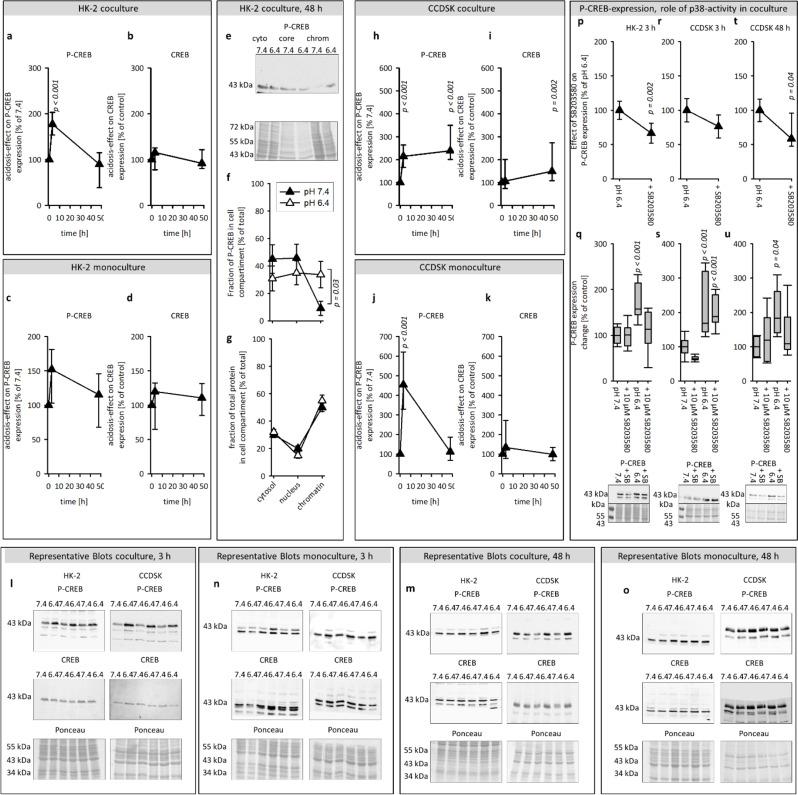
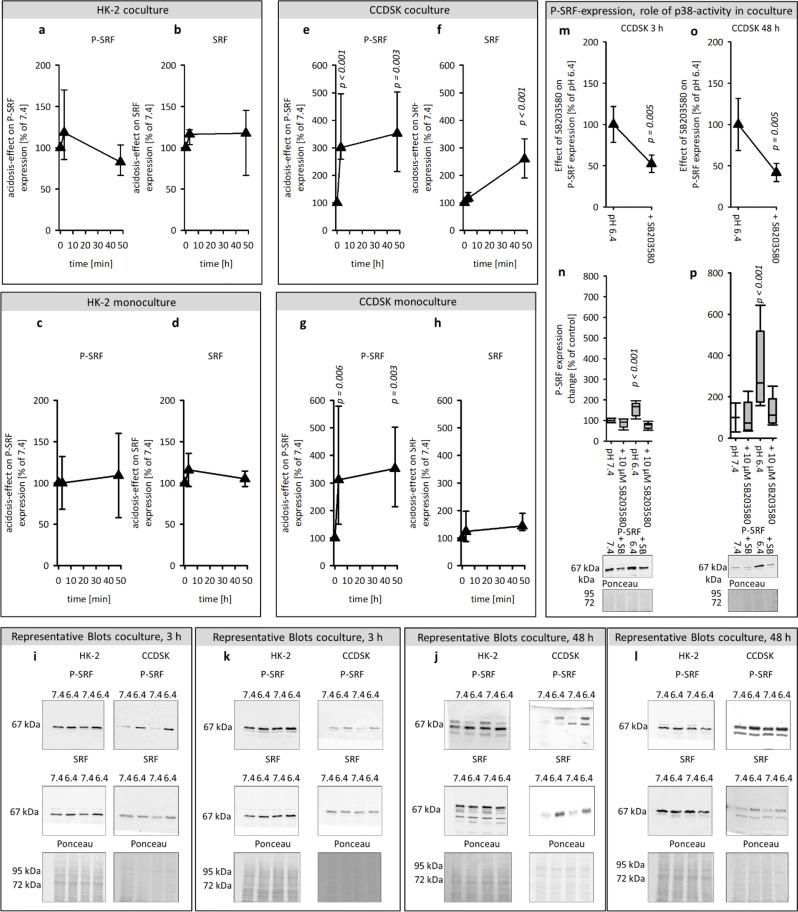
In coculture, acidosis initially caused a transient decrease in IL-6 secretion but significantly increased IL-6 levels after 48 h. Acidosis induced intracellular IL-6 expression in HK-2 cells within 3 h independent of culture conditions, with sustained IL-6 protein increase after 48 h only in coculture. Acidosis also enhanced P-CREB and c-fos expression in coculture during the first 3 h. Regardless of culture conditions, acidosis increased IL-6, c-fos, and P-SRF expression in CCDSK cells after 48 h. P-CREB and COX-2 expression were elevated in CCDSK in coculture. Acidosis-mediated effects on IL-6, P-CREB, and P-SRF expression were p38-dependent in both cell lines. Finally, we assessed the pH-dependency of IL-6 action and found that IL-6 addition increased COX-2 expression via the IL-6 receptor in acidic but not control media. Thus, acidosis enhances IL-6 secretion and potentiates its receptor-mediated biological effects.
CONCLUSION
This study identifies IL-6 as a key mediator of tubule-fibroblast crosstalk in an acidic milieu, promoting inflammatory processes. Acidosis induces IL-6 expression, secretion, and biological effects, with p38 kinase as a crucial mediator. If validated in vivo, these findings could enhance understanding of CKD and support early interventions.
背景
慢性肾脏病(CKD)中的局部间质酸中毒可诱导炎症反应以及近端肾小管细胞(PTC)去分化,通过细胞因子和COX-2代谢产物分泌破坏细胞间通讯。这促使向炎症性成纤维细胞表型转变,进一步加剧炎症和PTC去分化。p38信号通路及包括磷酸化CREB(P-CREB)和c-fos在内的下游转录因子参与这些反应。本研究调查酸中毒对PTC和成纤维细胞炎症反应的影响,重点关注细胞间通讯及p38信号通路的作用。
方法
将HK-2(人PTC)和CCDSK-1092Sk(人成纤维细胞)在单培养和共培养条件下暴露于酸性或对照培养基中30分钟、3小时或48小时。通过蛋白质印迹法分析白细胞介素-6(IL-6)、磷酸化(P-)和总CREB、P-和总血清反应因子(SRF)、c-fos以及P-和总p38的蛋白表达。使用酶联免疫吸附测定法(ELISA)测量IL-6分泌。通过药物干预评估p38和IL-6受体活性的影响。
结果
在共培养中,酸中毒最初导致IL-6分泌短暂减少,但48小时后IL-6水平显著升高。酸中毒在3小时内诱导HK-2细胞内IL-6表达,与培养条件无关,仅在共培养中48小时后IL-6蛋白持续增加。酸中毒在最初3小时内还增强了共培养中P-CREB和c-fos的表达。无论培养条件如何,48小时后酸中毒均增加了CCDSK细胞中IL-6、c-fos和P-SRF的表达。共培养中CCDSK细胞中P-CREB和COX-2表达升高。酸中毒对IL-6、P-CREB和P-SRF表达的介导作用在两种细胞系中均依赖于p38。最后,我们评估了IL-6作用的pH依赖性,发现添加IL-6在酸性而非对照培养基中通过IL-6受体增加COX-2表达。因此,酸中毒增强IL-6分泌并增强其受体介导的生物学效应。
结论
本研究确定IL-6是酸性环境中肾小管-成纤维细胞间通讯的关键介质,促进炎症过程。酸中毒诱导IL-6表达、分泌和生物学效应,p38激酶是关键介质。如果在体内得到验证,这些发现可能增进对CKD的理解并支持早期干预。



 Zotero 插件