
氧化应激与癫痫之间的关联:一项双向两样本孟德尔随机化研究。
The associations between oxidative stress and epilepsy: a bidirectional two-sample Mendelian randomization study.
作者信息
Zhang Lan, Zhang Ningning, Sun Xuyan, Chen Sirui, Xu Yuanhang, Liu Yaqing, Li Junqiang, Luo Dadong, Tian Xin, Wang Tiancheng
机构信息
The Second Hospital & Clinical Medical School, Lanzhou University, Lanzhou, 730030, China.
Department of Neurology, Epilepsy Center, The Second Hospital of Lanzhou University, Lanzhou, 730030, China.
出版信息
Acta Epileptol. 2024 Dec 1;6(1):33. doi: 10.1186/s42494-024-00173-4.
BACKGROUND
Studies on the association between oxidative stress and epilepsy have yielded varied results. In this study, we aimed to investigate the causal relationship between oxidative stress markers and epilepsy.
METHODS
A bidirectional two-sample Mendelian randomization (MR) study was performed based on publicly available statistics from genome-wide association studies. To explore the causal effects, single nucleotide polymorphisms were selected as instrumental variables. Inverse-variance weighted method was performed for primary analysis, supplemented by weighted median, MR-Egger, simple mode, and weighted mode. Furthermore, sensitivity analyses were performed to detect heterogeneity and pleiotropy.
RESULTS
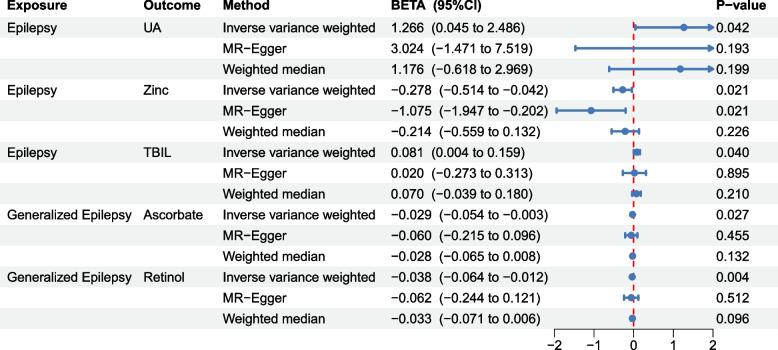
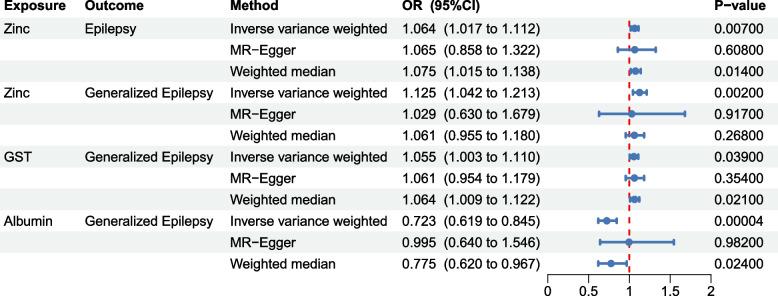
Our results showed that part of the oxidative stress biomarkers are associated with epilepsy and its subtypes. Zinc is associated with increased risk of epilepsy and generalized epilepsy (odds ratio [OR] = 1.064 and 1.125, respectively). Glutathione transferase is associated with increased risk of generalized epilepsy (OR = 1.055), while albumin is associated with decreased risk of generalized epilepsy (OR = 0.723). Inverse MR analysis revealed that epilepsy is associated with increased levels of uric acid and total bilirubin (beta = 1.266 and 0.081, respectively), as well as decreased zinc level (beta = - 0.278). Furthermore, generalized epilepsy is associated with decreased ascorbate and retinol levels (beta = - 0.029 and - 0.038, respectively).
CONCLUSIONS
Our study presented novel evidence of potential causal relationships between oxidative stress and epilepsy, suggesting potential therapeutic targets for epilepsy.
背景
关于氧化应激与癫痫之间关联的研究结果各异。在本研究中,我们旨在探究氧化应激标志物与癫痫之间的因果关系。
方法
基于全基因组关联研究的公开统计数据进行了双向两样本孟德尔随机化(MR)研究。为探究因果效应,选择单核苷酸多态性作为工具变量。采用逆方差加权法进行主要分析,并辅以加权中位数法、MR-Egger法、简单模式法和加权模式法。此外,进行了敏感性分析以检测异质性和多效性。
结果
我们的结果表明,部分氧化应激生物标志物与癫痫及其亚型相关。锌与癫痫和全身性癫痫风险增加相关(优势比[OR]分别为1.064和1.125)。谷胱甘肽转移酶与全身性癫痫风险增加相关(OR = 1.055),而白蛋白与全身性癫痫风险降低相关(OR = 0.723)。反向MR分析显示,癫痫与尿酸和总胆红素水平升高相关(β分别为1.266和0.081),以及锌水平降低相关(β = -0.278)。此外,全身性癫痫与抗坏血酸和视黄醇水平降低相关(β分别为-0.029和-0.038)。
结论
我们的研究提供了氧化应激与癫痫之间潜在因果关系的新证据,提示了癫痫的潜在治疗靶点。

 Zotero 插件