
具有抗菌活性的树枝状大分子对模型脂质膜的作用分子机制
Molecular Mechanisms of Action of Dendrimers with Antibacterial Activities on Model Lipid Membranes.
作者信息
Jordanova Albena, Tsanova Asya, Stoimenova Emilia, Minkov Ivan, Kostadinova Aneliya, Hazarosova Rusina, Angelova Ralitsa, Antonova Krassimira, Vitkova Victoria, Staneva Galya, Grabchev Ivo
机构信息
Faculty of Medicine, Sofia University "St. Kliment Ohridski", 1 Koziak Street, 1407 Sofia, Bulgaria.
Rostislaw Kaischew Institute of Physical Chemistry, Bulgarian Academy of Sciences, Acad. G. Bonchev Str., Bl. 11, 1113 Sofia, Bulgaria.
出版信息
Polymers (Basel). 2025 Mar 29;17(7):929. doi: 10.3390/polym17070929.
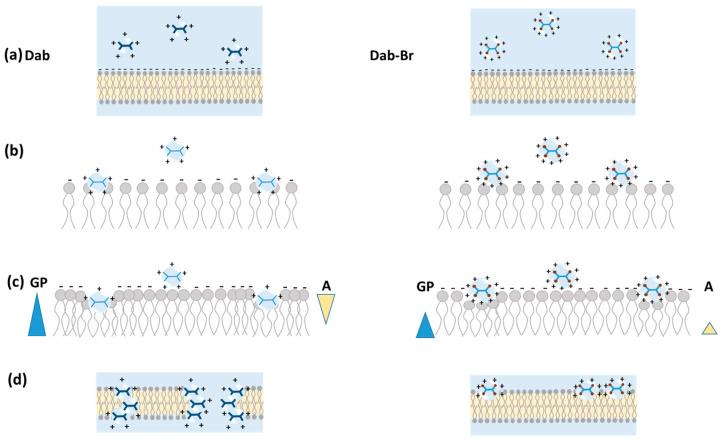
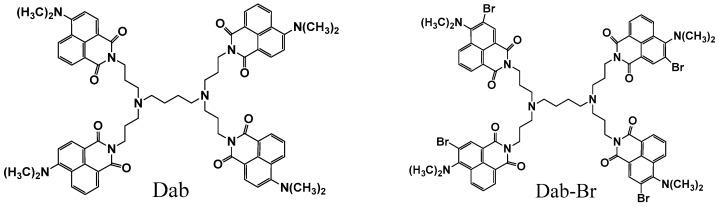
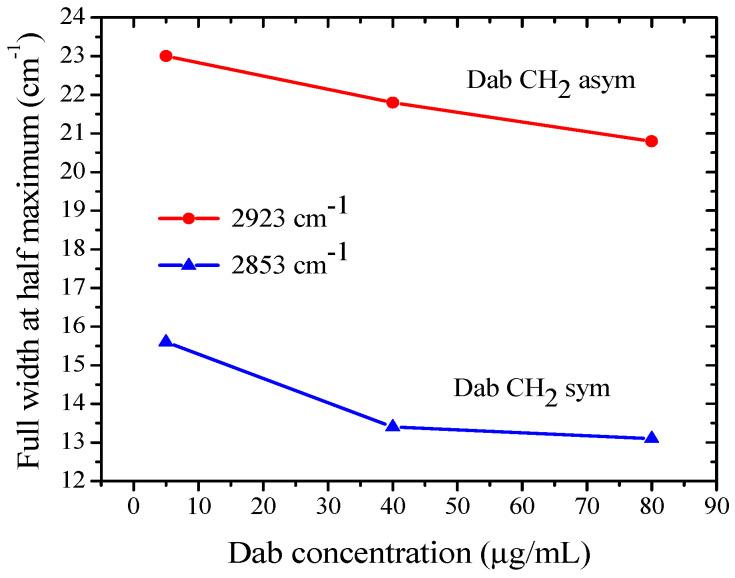
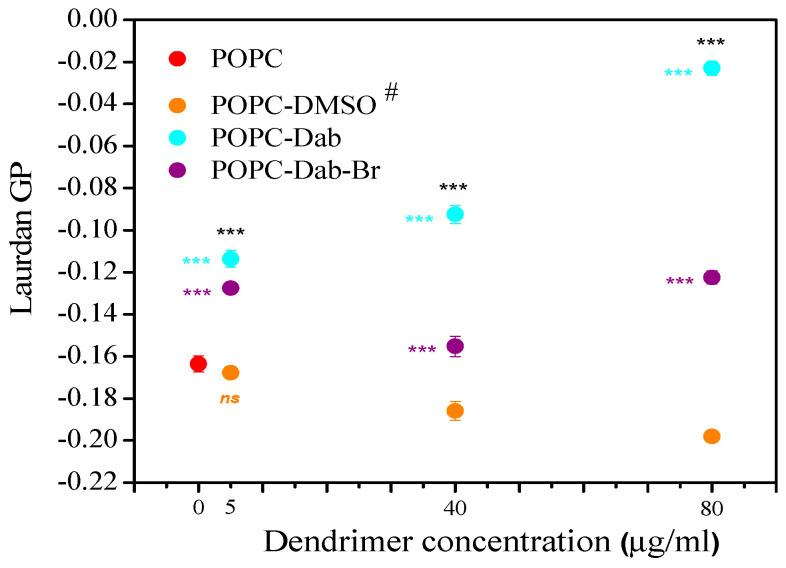
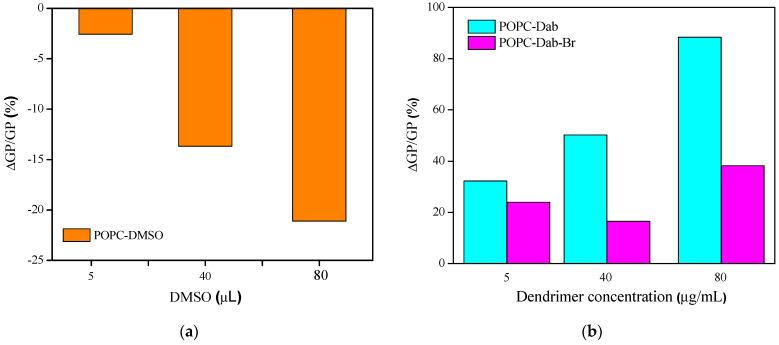
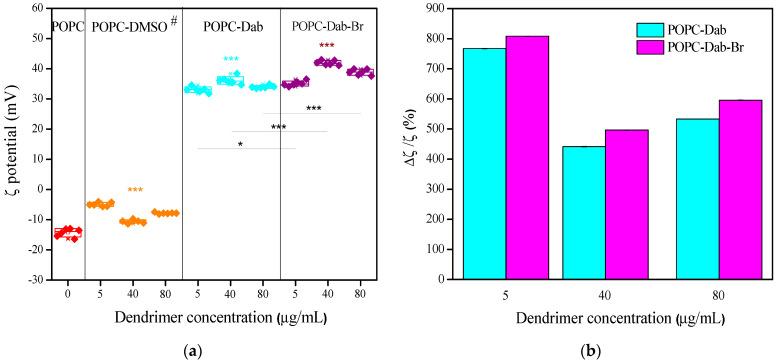
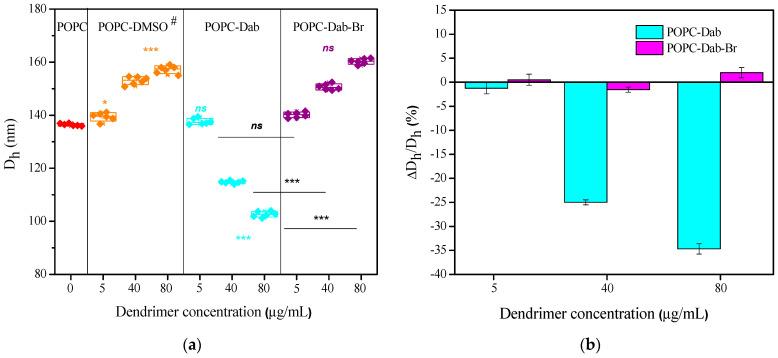
In the last decades, numerous dendrimers with a variety of potential biomedical applications have been developed and investigated. The aim of the present study was to evaluate the molecular mechanisms of interaction between two dendrimers with proven antibacterial activity (4-,-dimethylamino-1,8-naphthalimide (Dab) and 3-bromo-Dab (Dab-Br)) and POPC (1-palmitoyl-2-oleoylphosphatidylcholine) model membranes (monolayers and liposomes). The pressure-area isotherms and the compressional modulus of the monolayers revealed that Dab is likely to penetrate the hydrophobic region of POPC, whereas Dab-Br inserts mainly into the lipid headgroup area. This assumption was confirmed by FTIR-ATR of POPC liposomes containing Dab and Dab-Br dendrimers. In addition, Dab induced a higher lipid order in POPC large unilamellar vesicles (LUVs) compared to Dab-Br. Moreover, both dendrimers changed the negative zeta potential of POPC vesicles to positive values, with slightly higher effect of Dab-Br, indicating electrostatic interactions between the lipid headgroups and dendrimers. Furthermore, Dab was able to reduce the average POPC LUVs' size, unlike Dab-Br. The visualization of giant unilamellar vesicles revealed that the increasing dendrimer concentration induced model membrane shrinking and complete disintegration, which was more prominent for Dab. Based on the experimental results, new fundamental knowledge about the destabilizing effect of dendrimers on model lipid membranes will be acquired with a focus on their application in pharmacology and clinical practice.
在过去几十年中,人们已经开发并研究了许多具有各种潜在生物医学应用的树枝状大分子。本研究的目的是评估两种具有已证实抗菌活性的树枝状大分子(4-,-二甲基氨基-1,8-萘二甲酰亚胺(Dab)和3-溴-Dab(Dab-Br))与POPC(1-棕榈酰-2-油酰磷脂酰胆碱)模型膜(单层膜和脂质体)之间相互作用的分子机制。单层膜的压力-面积等温线和压缩模量表明,Dab可能穿透POPC的疏水区域,而Dab-Br主要插入脂质头基区域。这一假设通过含有Dab和Dab-Br树枝状大分子的POPC脂质体的傅里叶变换红外衰减全反射光谱(FTIR-ATR)得到了证实。此外,与Dab-Br相比,Dab在POPC大单层囊泡(LUVs)中诱导了更高的脂质有序度。而且,两种树枝状大分子都将POPC囊泡的负zeta电位变为正值,Dab-Br的影响略高,表明脂质头基与树枝状大分子之间存在静电相互作用。此外,与Dab-Br不同,Dab能够减小POPC LUVs的平均尺寸。巨型单层囊泡的可视化显示,树枝状大分子浓度的增加会导致模型膜收缩和完全解体,这在Dab中更为明显。基于实验结果,将获得关于树枝状大分子对模型脂质膜破坏作用的新的基础知识,重点关注其在药理学和临床实践中的应用。




 Zotero 插件