
异常姿势、屏幕使用时间、身体活动与疑似脊柱侧弯之间的相关性:一项横断面研究。
Correlation between abnormal posture, screen time, physical activity, and suspected scoliosis: a cross-sectional study.
作者信息
Chen Hongxin, Wu Liyang, Zhang Yi, Liu Jinyi, Huang Rui, Xie Jinyang, Guo Zhenfeng, Huang Tao, Chen Cuiling, Yang Kaimin, Bai Yuying, Huang Xuanxuan, Zhang Zhuopeng, Zhang Ruike
机构信息
Department of Rehabilitation Medicine, Key Laboratory of Biological Targeting Diagnosis, Therapy and Rehabilitation of Guangdong Higher Education Institutes, The Fifth Affiliated Hospital, Guangzhou Medical University, Guangzhou, 510700, China.
The Fifth Clinical College, Guangzhou Medical University, Guangzhou, 511436, China.
出版信息
J Orthop Surg Res. 2025 Apr 13;20(1):372. doi: 10.1186/s13018-025-05760-w.
BACKGROUND
Scoliosis considerably affects adolescents' physical well-being and quality of life. Current research offers scant data concerning the correlation between abnormal posture, screen time, physical activity, and adolescent scoliosis. This study aimed to investigate their potential correlations with suspected scoliosis in teenagers aged 10-13 years.
METHODS
This is a cross-sectional study. School scoliosis screening was conducted on adolescents aged 10-13 years from nine schools in Guangzhou, China. The survey encompassed demographic attributes, postural traits, and daily lifestyles. Logistic regression analysis was performed to analyze the correlations between various variables and the occurrence of suspected scoliosis.
RESULTS
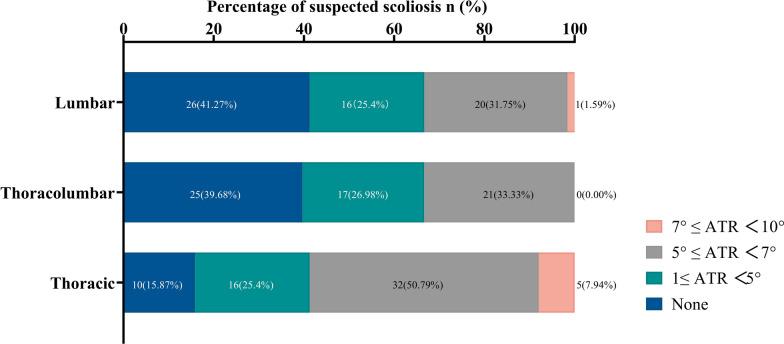
A total of 1297 questionnaires were distributed, and 1231 (94.9%) valid responses were received. All participants with valid responses underwent scoliosis screening. The overall prevalence of suspected scoliosis was 5.1%, with the highest prevalence observed in 11-year-old students, primarily affecting the thoracic spine. Significant correlations were found between suspected scoliosis and right-sided flatfoot, flat upper back, positive forward bend test (FBT), After-school screen time, weekend outdoor time, and weekend TV time.
CONCLUSIONS
The results show a substantial correlation between the incidence of suspected scoliosis and abnormal posture. Moreover, a marked correlation exists between distinct activity patterns, particularly extended usage of electronic devices and television, and the incidence of suspected scoliosis. Screening for abnormal posture and performing the FBT can help detect suspected scoliosis, which requires further clinical assessment to differentiate between postural deviations and scoliosis. We advise middle and primary school kids to modify their daily routines by decreasing sedentary behavior and enhancing physical activity to mitigate the potential occurrence of trunk asymmetries.
背景
脊柱侧弯严重影响青少年的身体健康和生活质量。目前的研究提供了关于异常姿势、屏幕使用时间、身体活动与青少年脊柱侧弯之间相关性的数据很少。本研究旨在调查10至13岁青少年中这些因素与疑似脊柱侧弯的潜在相关性。
方法
这是一项横断面研究。对来自中国广州9所学校的10至13岁青少年进行了学校脊柱侧弯筛查。调查涵盖了人口统计学特征、姿势特征和日常生活方式。进行逻辑回归分析以分析各种变量与疑似脊柱侧弯发生之间的相关性。
结果
共发放问卷1297份,回收有效问卷1231份(94.9%)。所有有有效回复的参与者都接受了脊柱侧弯筛查。疑似脊柱侧弯的总体患病率为5.1%,在11岁学生中患病率最高,主要影响胸椎。发现疑似脊柱侧弯与右侧扁平足、上背部扁平、前屈试验(FBT)阳性、课后屏幕使用时间、周末户外时间和周末看电视时间之间存在显著相关性。
结论
结果表明疑似脊柱侧弯的发生率与异常姿势之间存在显著相关性。此外,不同的活动模式,特别是电子设备和电视的长时间使用,与疑似脊柱侧弯的发生率之间存在明显相关性。筛查异常姿势并进行FBT有助于检测疑似脊柱侧弯,这需要进一步的临床评估以区分姿势偏差和脊柱侧弯。我们建议中小学生通过减少久坐行为和增加身体活动来改变日常生活习惯,以减轻躯干不对称的潜在发生。
 Zotero 插件