
埃及鼠尾草不同分离提取物的抗氧化潜力、蛋白酶抑制及细胞毒活性
Antioxidant Potentials, Protease Inhibitory, and Cytotoxic Activities of Various Isolated Extracts from Salvia aegyptiaca.
作者信息
Hosseini Ali, Moein Mahmoodreza, Sabahi Zahra, Moein Soheila, Hafez Ghoran Salar, Naderian Moslem, Zebarjad Zahra
机构信息
Department of Pharmacognosy, School of Pharmacy, Shiraz University of Medical Sciences, Shiraz, Iran.
Medicinal Plants Processing Research Center, Shiraz University of Medical Sciences, Shiraz, Iran.
出版信息
Iran Biomed J. 2025 Jan 1;29(1 & 2):57-67. doi: 10.61186/ibj.4567.
BACKGROUND
Natural compounds can regulate the growth and progression of cancer cells with low toxicity to normal cell; therefore, these compounds are unique targets for cancer treatment. Recently, extracts from Salvia species have shown promising antiproliferative potential. This study aimed to isolate and characterize bioactive compounds from Salvia aegyptiaca and evaluate their antioxidant, cytotoxic, and protease-inhibitory activities.
METHODS
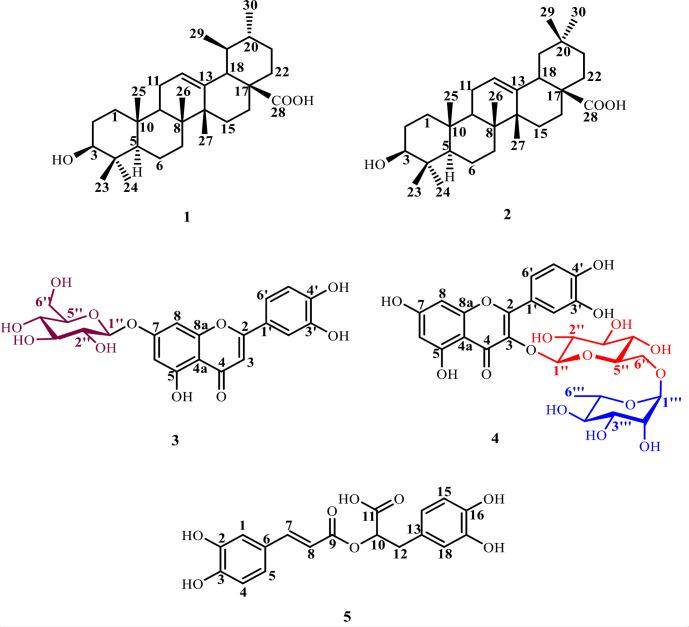
In this study, various extracts of S. aegyptiaca were prepared, and several compounds, including ursolic acid, oleanolic acid, luteolin-7-O-glucoside, quercetin-3-O-rutoside, and rosmarinic acid, were isolated and characterized using different spectroscopic methods. Finally, the antioxidant activity, protease inhibitory activity, and cytotoxicity of the crude extract, multiple fractions, and isolated compounds were examined.
RESULTS
According to the results obtained, rosmarinic acid demonstrated the highest antioxidant performance, as indicated by the following assays: DPPH (IC50: 28.39 ± 0.75 µg/mL), ABTS (39.52 ± 0.72 µg/mL), FRAP (31.87 ± 0.67 µg/mL), NO scavenging (71.44 ± 1.04 µg/mL), and ORAC values (0.6 TE/mg). Furthermore, both cynaroside and rosmarinic acid exhibited the most potent antiproliferative effects against the Hep G2 cell line, with IC50 value of 34.4 ± 2.34 and 47.84 ± 5.87 µg/mL, respectively. The EtOAc fraction and rosmarinic acid also showed higher protease inhibitory activity, with IC50 of 17.6 ± 0.10 and 17.0 ± 0.30 µg/mL, respectively, as compared to other compounds.
CONCLUSION
Our findings suggest that the identified compounds may be responsible for the antiproliferative effects of S. aegyptiaca. Overall, S. aegyptiaca could serve as a valuable natural antioxidant and anticancer agent in both pharmaceutical and food industries
背景
天然化合物能够调节癌细胞的生长和进展,同时对正常细胞毒性较低;因此,这些化合物是癌症治疗的独特靶点。最近,鼠尾草属植物的提取物显示出有前景的抗增殖潜力。本研究旨在从埃及鼠尾草中分离和鉴定生物活性化合物,并评估它们的抗氧化、细胞毒性和蛋白酶抑制活性。
方法
在本研究中,制备了埃及鼠尾草的各种提取物,并使用不同的光谱方法分离和鉴定了几种化合物,包括熊果酸、齐墩果酸、木犀草素-7-O-葡萄糖苷、槲皮素-3-O-芸香苷和迷迭香酸。最后,检测了粗提取物、多个馏分和分离化合物的抗氧化活性、蛋白酶抑制活性和细胞毒性。
结果
根据所得结果,迷迭香酸表现出最高的抗氧化性能,如下列测定所示:DPPH(IC50:28.39±0.75μg/mL)、ABTS(39.52±0.72μg/mL)、FRAP(31.87±0.67μg/mL)、NO清除(71.44±1.04μg/mL)和ORAC值(0.6 TE/mg)。此外,洋蓟苷和迷迭香酸对Hep G2细胞系均表现出最有效的抗增殖作用,IC50值分别为34.4±2.34和47.84±5.87μg/mL。与其他化合物相比,乙酸乙酯馏分和迷迭香酸也显示出更高的蛋白酶抑制活性,IC50分别为17.6±0.10和17.0±0.30μg/mL。
结论
我们的研究结果表明,所鉴定的化合物可能是埃及鼠尾草抗增殖作用的原因。总体而言,埃及鼠尾草在制药和食品工业中都可作为有价值的天然抗氧化剂和抗癌剂。

 Zotero 插件