
童年期忽视与抑郁症状之间的关联:回避型应对的中介作用。
Associations Between Childhood Neglect and Depressive Symptoms: The Mediating Effect of Avoidant Coping.
作者信息
Eggert Laura, Kenntemich Laura, von Hülsen Leonie, Gallinat Jürgen, Schäfer Ingo, Lotzin Annett
机构信息
Department of Psychiatry and Psychotherapy, University Medical Center Hamburg Eppendorf, Hamburg, Germany.
Department of Psychology, MSH Medical School Hamburg, Institute of Clinical Psychology and Psychotherapy, Hamburg, Germany.
出版信息
Depress Anxiety. 2024 Nov 30;2024:9959689. doi: 10.1155/da/9959689. eCollection 2024.
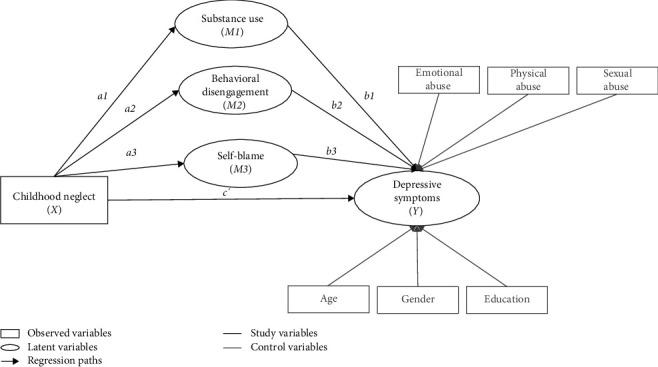
Individuals with a history of childhood neglect may be vulnerable to develop depression, as they may more often use avoidant strategies to cope with the stressors. This study examined (1) whether a history of childhood neglect was associated with higher levels of depressive symptoms and (2) whether avoidant coping behaviors mediated this association. In total, = 2245 German adults (mean age = 41.1 years, age range = 18-82 years, 70.2% female) were recruited from the general population between June and September 2020 during the COVID-19 pandemic. Childhood neglect (Adverse Childhood Experience Questionnaire [ACE]), depressive symptoms (Patient Health Questionnaire [PHQ-9]), and three avoidant coping behaviors (substance use, behavioral disengagement, and self-blame; Brief Coping Orientation to Problems Experienced [COPE]) were assessed. Using structural equation modeling (SEM), we examined the direct pathway from childhood neglect to depressive symptoms in a simultaneous parallel multiple mediation model and the possible mediating paths of avoidant coping behaviors. Childhood neglect was positively and significantly associated with depressive symptoms ( = 0.24, < 0.01) while controlling for the presence of childhood abuse. The three avoidant coping behaviors significantly mediated this association (substance use: bias-corrected 95% confidence intervals [BC 95% CI], 0.02, 0.05; behavioral disengagement: BC 95% CI, 0.04, 0.12; and self-blame: BC 95% CI, 0.16, 0.19). Post hoc contrasts between the mediators showed that self-blame had a significantly stronger indirect effect than substance use (BC 95% CI, -0.12, -0.01). This study provides evidence that avoidant coping behaviors mediate the association between childhood neglect and depressive symptoms in adults. Avoidance coping behaviors may be a promising target for psychological interventions to reduce depressive symptoms.
有童年期忽视经历的个体可能更容易患上抑郁症,因为他们可能更频繁地使用回避策略来应对压力源。本研究考察了:(1)童年期忽视经历是否与更高水平的抑郁症状相关;(2)回避应对行为是否介导了这种关联。在2020年6月至9月新冠疫情期间,从德国普通人群中招募了总计2245名成年人(平均年龄41.1岁,年龄范围18 - 82岁,女性占70.2%)。评估了童年期忽视(儿童期不良经历问卷[ACE])、抑郁症状(患者健康问卷[PHQ - 9])以及三种回避应对行为(物质使用、行为脱离和自责;经历问题的简要应对取向[COPE])。使用结构方程模型(SEM),我们在一个同时并行的多重中介模型中考察了从童年期忽视到抑郁症状的直接路径以及回避应对行为可能的中介路径。在控制童年期虐待存在的情况下,童年期忽视与抑郁症状呈显著正相关(β = 0.24,p < 0.01)。三种回避应对行为显著介导了这种关联(物质使用:偏差校正95%置信区间[BC 95% CI],0.02,0.05;行为脱离:BC 95% CI,0.04,0.12;自责:BC 95% CI,0.16,0.19)。中介变量之间的事后对比表明,自责的间接效应比物质使用显著更强(BC 95% CI,-0.12,-0.01)。本研究提供了证据,表明回避应对行为介导了成年人童年期忽视与抑郁症状之间的关联。回避应对行为可能是减轻抑郁症状的心理干预的一个有前景的目标。


 Zotero 插件