
双链纤维蛋白寡聚体强制解折叠的结构机制
Structural Mechanisms of Forced Unfolding of Double-Stranded Fibrin Oligomers.
作者信息
Maksudov Farkhad, Protopopova Anna D, Litvinov Rustem I, Marx Kenneth A, Weisel John W, Barsegov Valeri
机构信息
Department of Chemistry, University of Massachusetts, Lowell, Massachusetts 01854, United States.
Department of Cell and Developmental Biology, University of Pennsylvania School of Medicine, Philadelphia, Pennsylvania 19104, United States.
出版信息
J Phys Chem B. 2025 Apr 24;129(16):3963-3977. doi: 10.1021/acs.jpcb.5c00755. Epub 2025 Apr 14.
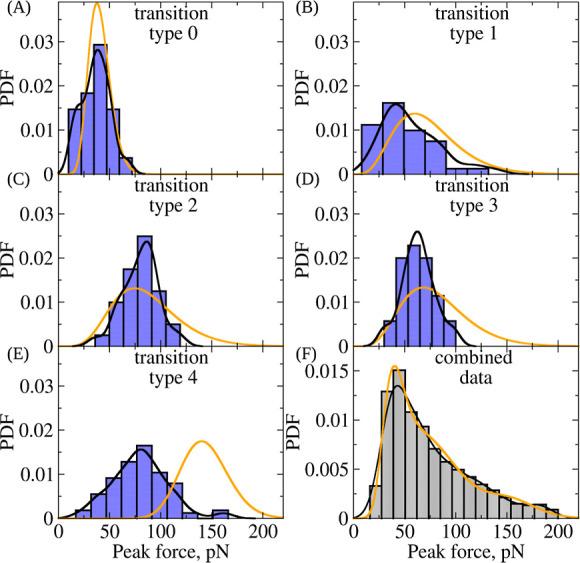
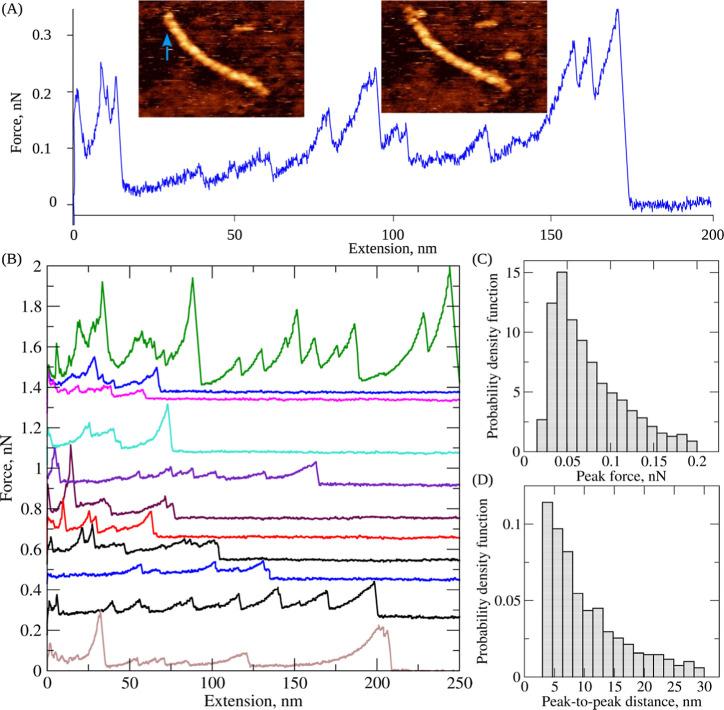
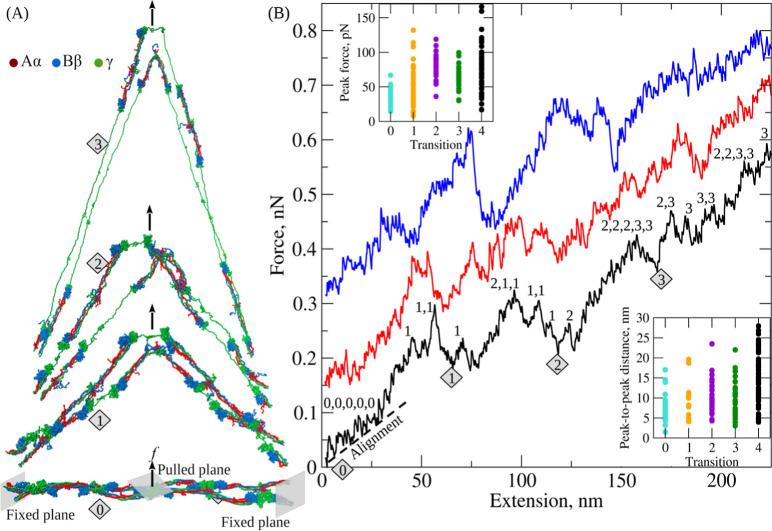
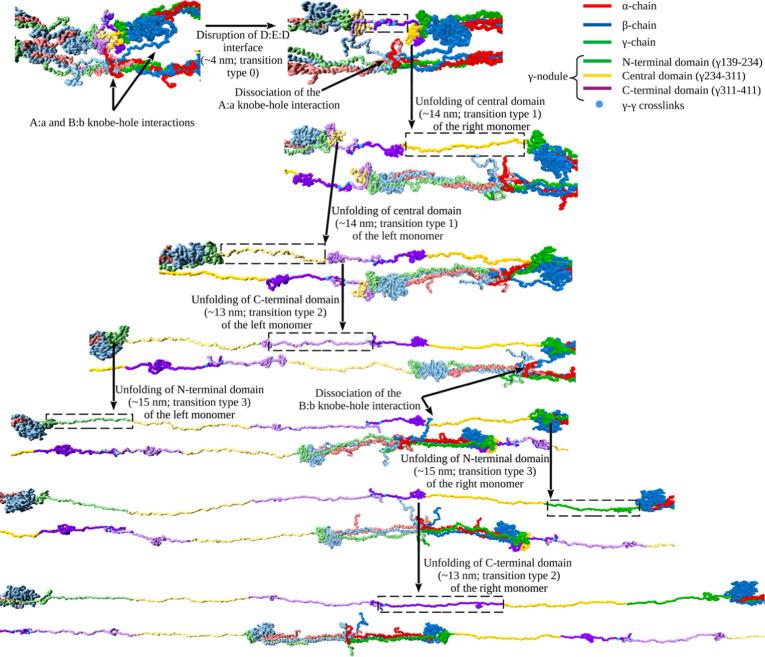
Fibrin forms a polymeric scaffold of blood clots, which are subjected to deformation in their dynamic environment. The extensible fibrin network allows fibers to stretch without breaking, but the mechanisms of their forced elongation are not understood. We combined atomic force microscopy, computer simulations, and Machine Learning to explore the nanomechanics of double-stranded cross-linked fibrin oligomers (FO). From the experimental force-extension profiles, the median 63 pN unfolding force and median 8.1 nm peak-to-peak distance with corresponding 56 pN and 11.4 nm interquartile ranges indicate substantial scatter due to ∼3-5 nm extension fluctuation of the triple α-helical coiled-coils. From simulations, unraveling of FO is determined by coupled dissociation of the D:D interface, γ-nodules unfolding, and reversible unfolding-refolding of the coiled-coils. These can occur as single structural transitions (60% of the time) or mixed transitions (40% of the time), with an alternating order of strands in which unfolding transitions occur, i.e., if the previous transition takes place in one strand, the next transition occurs in the other strand. The double-stranded FO are less extensible but stiffer and more stable compared with the single-stranded oligomers. These findings provide important insights into the biomechanics and dynamic structural properties of fibrin necessary to understand the (sub)molecular origin of fibrin extensibility.
纤维蛋白形成血凝块的聚合物支架,在动态环境中会发生变形。可延展的纤维蛋白网络使纤维能够拉伸而不断裂,但其强制伸长的机制尚不清楚。我们结合原子力显微镜、计算机模拟和机器学习来探索双链交联纤维蛋白寡聚体(FO)的纳米力学。从实验力-伸长曲线来看,63 pN的中位展开力和8.1 nm的中位峰峰距离以及相应的56 pN和11.4 nm四分位间距表明,由于三股α-螺旋卷曲螺旋约3-5 nm的伸长波动,存在大量散射。从模拟结果可知,FO的解链由D:D界面的耦合解离、γ-结节解链以及卷曲螺旋的可逆解链-再折叠决定。这些可以作为单一结构转变(60%的情况)或混合转变(40%的情况)发生,链的解链转变顺序交替,即如果前一个转变发生在一条链上,下一个转变则发生在另一条链上。与单链寡聚体相比,双链FO的可延展性较差,但更硬且更稳定。这些发现为理解纤维蛋白可延展性的(亚)分子起源所必需的纤维蛋白生物力学和动态结构特性提供了重要见解。
 Zotero 插件