
阻断肿瘤血管生成VEGF/VEGFR通路:贝伐单抗——20年的治疗成功与争议
Blocking Tumoral Angiogenesis VEGF/VEGFR Pathway: Bevacizumab-20 Years of Therapeutic Success and Controversy.
作者信息
Chitoran Elena, Rotaru Vlad, Stefan Daniela-Cristina, Gullo Giuseppe, Simion Laurentiu
机构信息
Medicine School, "Carol Davila" University of Medicine and Pharmacy, 050474 Bucharest, Romania.
General Surgery and Surgical Oncology Department I, Bucharest Institute of Oncology "Prof. Dr. Al. Trestioreanu", 022328 Bucharest, Romania.
出版信息
Cancers (Basel). 2025 Mar 27;17(7):1126. doi: 10.3390/cancers17071126.
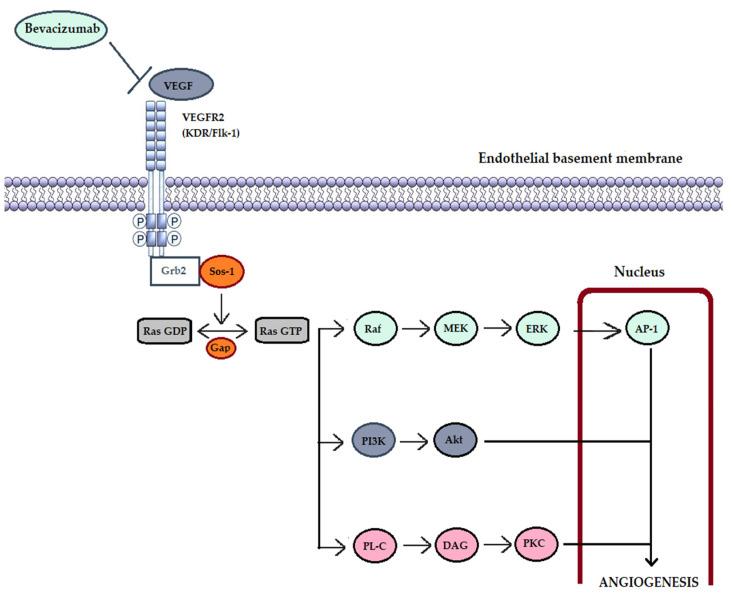
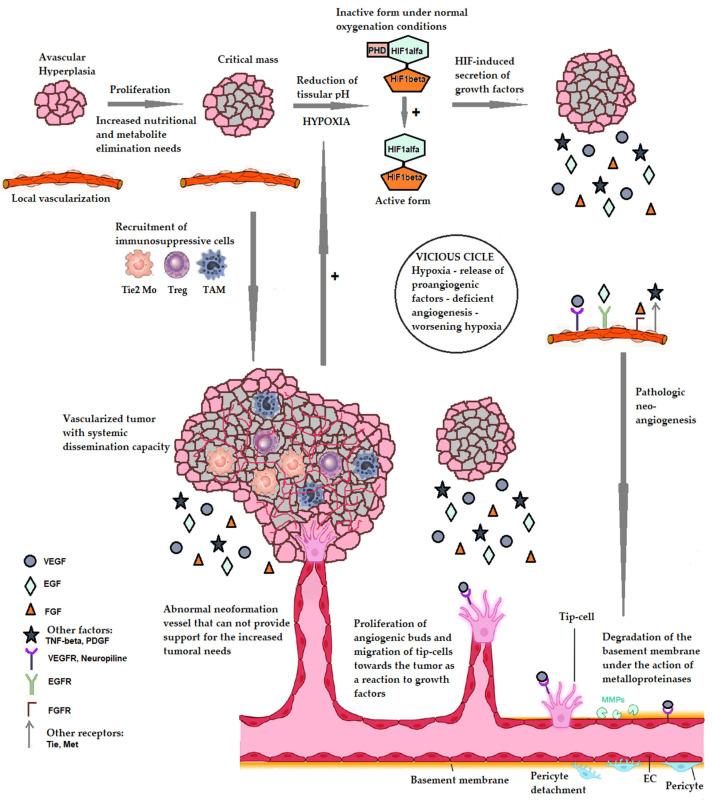
The "angiogenesis switch"-defined as the active process by which solid tumors develop their own circulation-plays an important role in both tumoral growth and propagation. As the malignant tumor grows and reaches a critical size, the metabolic needs as a function of an ever-increasing distance to the nearest emergent blood vessel, can no longer be covered by the microenvironment of the peritumoral tissue. Although a relatively discrete process, the "angiogenic switch" acts as a limiting stage of tumoral development present from the avascular hyperplasia phase to the vascularized neoplastic phase, providing support for tumor expansion and metastasis. Over time, research has focused on blocking the angiogenetic pathways (such as VEGF/VEGFR signaling axis) leading to the development of targeted therapeutic agents such as Bevacizumab. Objectives: We conducted a review of the molecular principles of tumoral angiogenesis and we tried to follow the history of Bevacizumab from its first approval for human usage 20 years ago to current days, focusing on the impact this agent had in solid tumor therapy. A comprehensive review of clinical trials pertaining to Bevacizumab (from the era of the preclinic trials leading to approval for human usage, to the more recent randomized trial focusing on combination targeted therapy) further details the role of this drug. We aimed to establish if this ancient drug continues to have a place in modern oncology. Conclusions: Bevacizumab, one of the first drugs targeting tumoral microenvironment, remains one of the most important oncologic agents blocking the VEGF/VEGFR angiogenic pathway. otherwise, history of 20 years marked by numerous controversies (ranging from methodological errors of clinical trials to withdrawal of approval for human usage in breast cancer patients, from discussions about severe side effects to resistance to therapy and limited efficacity), Bevacizumab continues to provide an optimal therapeutic option for many solid tumors that previously had little to no means of treatment, improving otherwise bleak outcomes. Even in the era of personalized precision oncology, Bevacizumab continues to be a key element in many therapeutic regimens both as monotherapy and in combination with newer targeted agents.
“血管生成开关”——被定义为实体瘤形成自身循环的活跃过程——在肿瘤生长和扩散中都起着重要作用。随着恶性肿瘤生长并达到临界大小,由于与最近的新生血管距离不断增加,其代谢需求无法再由肿瘤周围组织的微环境满足。尽管“血管生成开关”是一个相对离散的过程,但它是肿瘤发展从无血管增生阶段到血管化肿瘤阶段的一个限制阶段,为肿瘤扩展和转移提供支持。随着时间推移,研究集中在阻断导致如贝伐单抗等靶向治疗药物研发的血管生成途径(如VEGF/VEGFR信号轴)。目的:我们对肿瘤血管生成的分子原理进行了综述,并试图追溯贝伐单抗从20年前首次获批用于人体至今的历史,重点关注该药物在实体瘤治疗中的影响。对与贝伐单抗相关的临床试验(从导致获批用于人体的临床前试验时代到最近聚焦联合靶向治疗的随机试验)进行全面综述,进一步详述了该药物的作用。我们旨在确定这种老牌药物在现代肿瘤学中是否仍有一席之地。结论:贝伐单抗作为首批靶向肿瘤微环境的药物之一,仍然是阻断VEGF/VEGFR血管生成途径的最重要肿瘤药物之一。尽管20年的历史充满了诸多争议(从临床试验的方法错误到乳腺癌患者获批用于人体的许可被撤销,从关于严重副作用的讨论到治疗耐药性和疗效有限),贝伐单抗继续为许多以前几乎没有治疗手段的实体瘤提供了最佳治疗选择,改善了原本暗淡的预后。即使在个性化精准肿瘤学时代,贝伐单抗无论是作为单一疗法还是与更新的靶向药物联合使用时,仍然是许多治疗方案中的关键要素。
 Zotero 插件