
膀胱癌中膀胱、肠道和阴道的微生物群景观:一项系统综述。
Microbiome landscapes of the bladder, intestine, and vagina in bladder cancer: a systematic review.
作者信息
Surber Jonathan, Semmler Marie, Enderlin Dominik, Affentranger Andres, Scherer Thomas, Sigg Silvan, Kaufmann Ernest, Gadient Jana, Truscello Luca, Scharl Michael, Morsy Yasser, Eberli Daniel, Poyet Cédric, Bieri Uwe
机构信息
Department of Urology, University Hospital Zurich, Frauenklinikstrasse 10, 8091, Zurich, Switzerland.
Department of Urology, LMU Klinikum, Ludwigs-Maximilians University Munich, Munich, Germany.
出版信息
Discov Oncol. 2025 Apr 14;16(1):525. doi: 10.1007/s12672-025-02165-3.
BACKGROUND
Microbiomes have been linked to oncogenesis, e.g. the intestinal microbiome and colon cancer or HPV-associated cervical cancer. A connection between microbiomes of different body cavities and tumor oncogenesis was shown. The gut microbiome's influence on bladder cancer was established, raising the question whether nearby microbiomes (rectum, vagina) also influence bladder cancer due to their proximity.
OBJECTIVE
Considering the influence of various body cavities and the broader microbial components, this systematic review aims to investigate differences in the bladder, vaginal, and intestinal microbiota-including bacterial, viral, fungal and archaea-between patients with bladder cancer and healthy controls.
METHODS
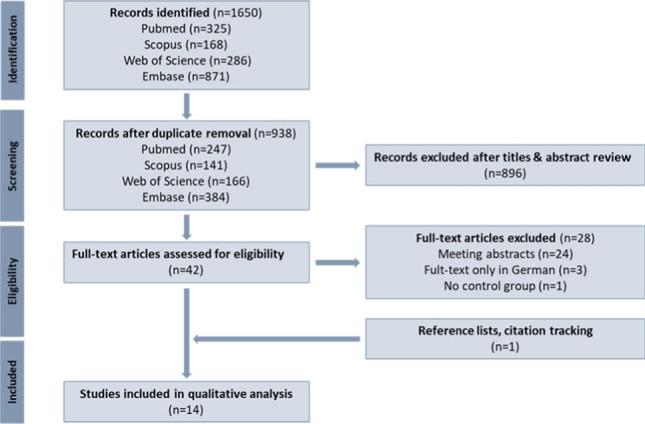
Databases (PubMed, Scopus, Embase) were searched until April 2022. Three types of studies were included: "(1) studies using bladder cancer and control groups (case-controlled studies) (2) studies that provided information on the presence or abundance of microbial taxa (3) studies that provided information on increased or decreased taxa in bladder cancer and/or control groups.". Risk of bias was assessed using the Newcastle Ottawa Scale.
RESULTS
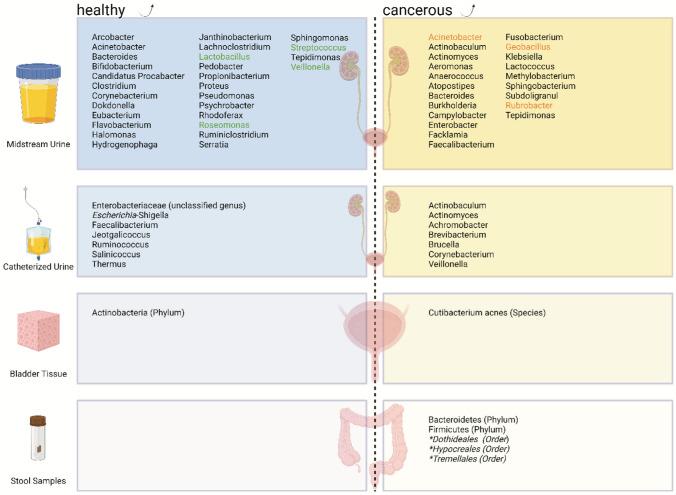
Fourteen studies (695 samples: 403 bladder cancer, 292 controls) were analyzed. Bacterial taxa that have been detected in at least two studies, the genera Geobacillus and Rubrobacter were more frequently in bladder cancer patients; while Streptococcus and Roseomonas were more prevalent in controls. No consistent taxa were identified across stool or bladder tissue samples.
CONCLUSION
The microbiota in bladder cancer patients show significant variation across studies. Standardized methods and expanded investigations into viral and fungal components are needed to clarify the role of microbiota in bladder cancer.
背景
微生物群与肿瘤发生有关,例如肠道微生物群与结肠癌或人乳头瘤病毒相关的宫颈癌。不同体腔的微生物群与肿瘤发生之间的联系已被证实。肠道微生物群对膀胱癌的影响已得到证实,这就引发了一个问题,即附近的微生物群(直肠、阴道)由于距离较近是否也会影响膀胱癌。
目的
考虑到各种体腔的影响和更广泛的微生物组成部分,本系统评价旨在研究膀胱癌患者和健康对照者之间膀胱、阴道和肠道微生物群(包括细菌、病毒、真菌和古细菌)的差异。
方法
检索数据库(PubMed、Scopus、Embase)直至2022年4月。纳入三种类型的研究:“(1)使用膀胱癌和对照组的研究(病例对照研究)(2)提供微生物分类群存在或丰度信息的研究(3)提供膀胱癌和/或对照组中分类群增加或减少信息的研究。”。使用纽卡斯尔渥太华量表评估偏倚风险。
结果
分析了14项研究(695个样本:403例膀胱癌患者,292例对照)。在至少两项研究中检测到的细菌分类群,嗜热栖热菌属和红球菌属在膀胱癌患者中更常见;而链球菌属和玫瑰单胞菌属在对照中更普遍。在粪便或膀胱组织样本中未发现一致的分类群。
结论
膀胱癌患者的微生物群在不同研究中表现出显著差异。需要标准化方法并扩大对病毒和真菌成分的研究,以阐明微生物群在膀胱癌中的作用。
 Zotero 插件