
蛋白质组学分析筛选出用于肺癌诊断的新型外泌体蛋白质生物标志物。
Proteomic profiles screening identified novel exosomal protein biomarkers for diagnosis of lung cancer.
作者信息
Feng Weiyan, Lin Ying, Zhang Ling, Hu Weiming
机构信息
Department of Pancreas Surgery, West China Hospital, Sichuan University, Chengdu, 610051, People's Republic of China.
Division III of General Surgery, West China Hospital-Chengdu Shangjin Nanfu, West China Hospital, Sichuan University, Chengdu, 611730, Sichuan, China.
出版信息
Clin Proteomics. 2025 Apr 15;22(1):12. doi: 10.1186/s12014-025-09535-7.
BACKGROUND
Exosomes play important role in biological functions, including both normal and disease process. Multiple cell types can secret exosomes, which act as message carriers. Increased evidences reveal that exosomes are promising diagnosis biomarkers in malignant tumors.
METHODS
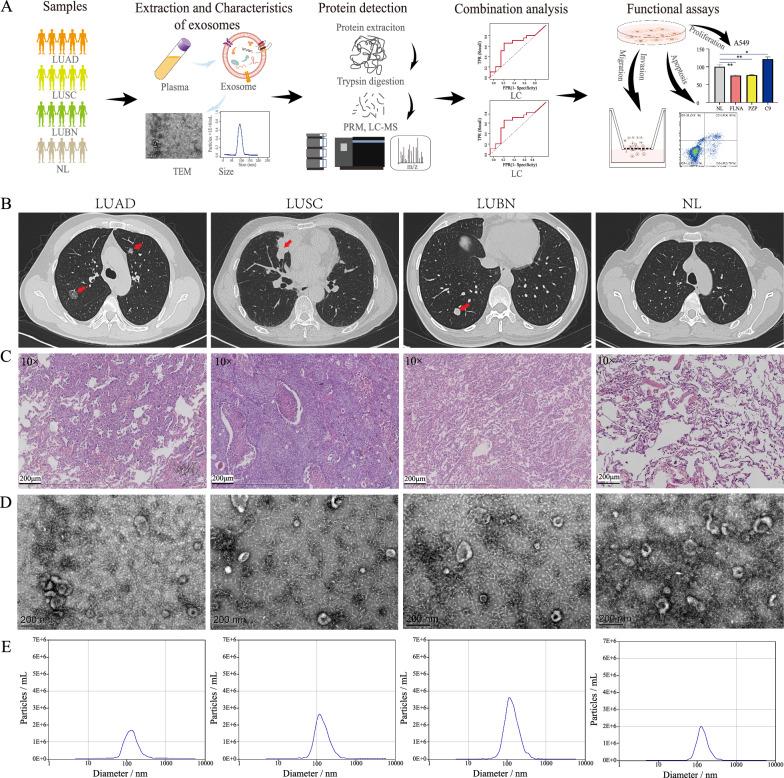
In this study, we enrolled 78 participants, including 20 lung adenocarcinoma (LUAD), 18 lung squamous carcinoma (LUSC), 20 lung benign diseases (LUBN) and 20 healthy controls (NL) and we performed parallel reaction-monitoring (PRM)-mass spectrometry to screening the proteomic variation by label free analysis in exosomes from all groups, which has been widely used to quantify and detect target proteins.
RESULTS
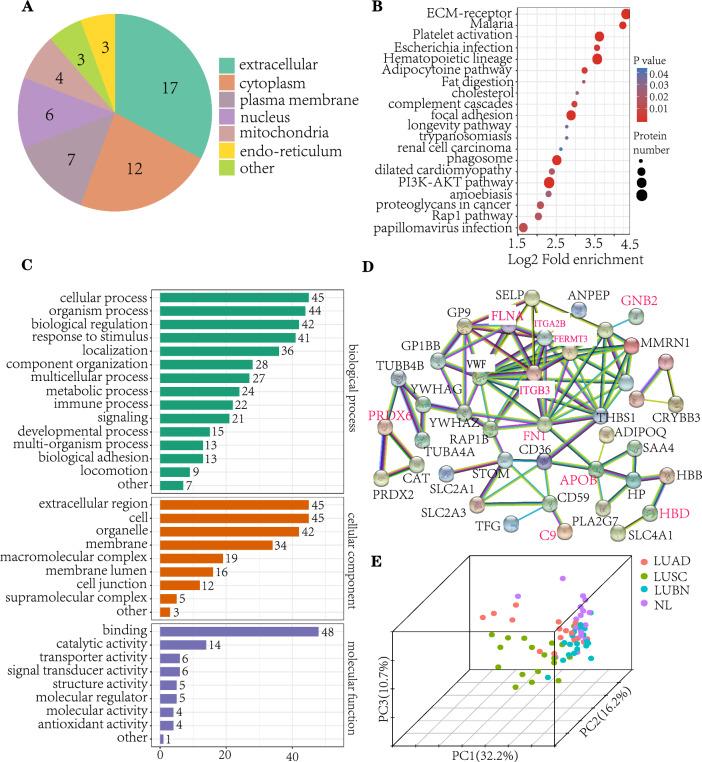
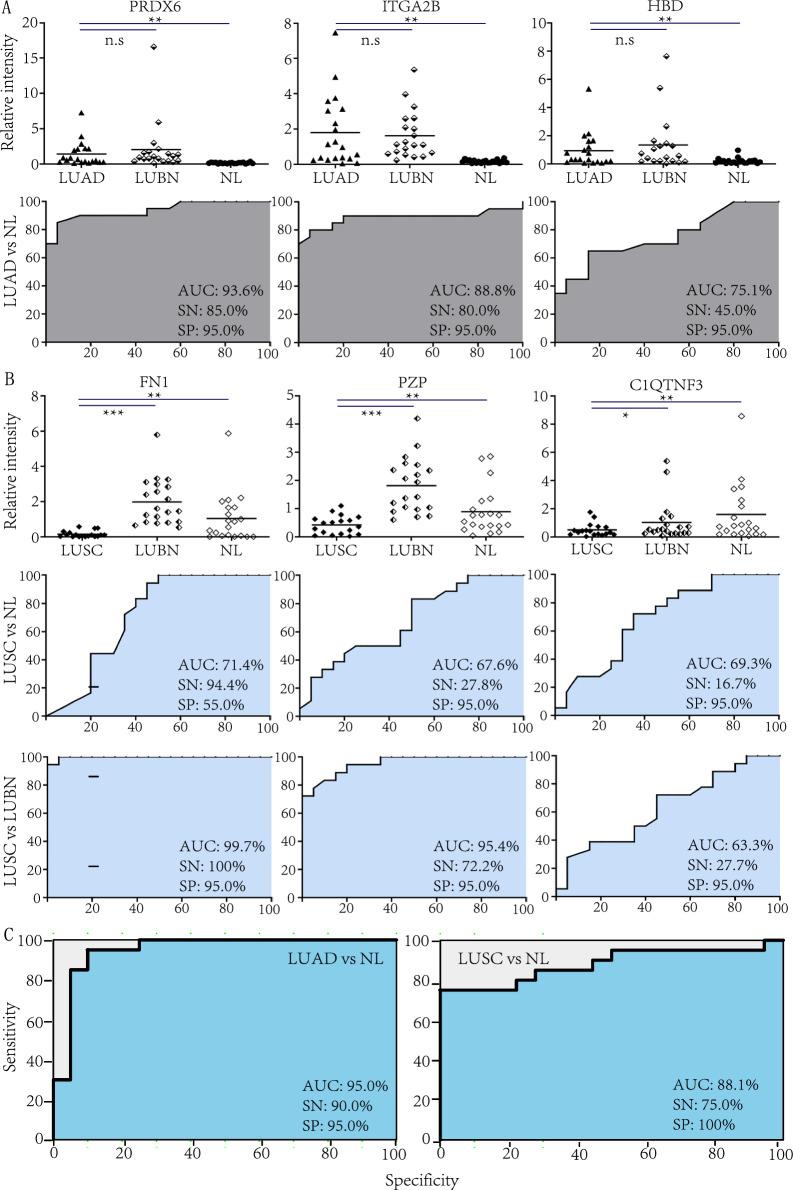
Total 14 protein were identified as candidate biomarkers, complement components C9, apolipoprotein B (APOB), filamin A (FLNA), guanine nucleotide binding protein G subunit 2 (GNB2), fermitin family homolog 3 (FERMT3) showed significantly differentiation in total lung cancer (LUAD and LUSC together), we then obtained combination analysis of 5 proteins and the area under the curve (AUC), sensitivity (SN) and specificity (SP) were 63.0%, 65.0%, and 75.0%, respectively, in comparison to NL group. And the LUAD combination panel, peroxiredoxin 6 (PRDX6), integrin alpha-IIb (ITGA2B) and hemoglobin subunit delta (HBD) revealed AUC was 95.0%, SN was 90.0% and SP was 95.0% in comparison to NL controls. In LUSC analysis, combination analysis of fibronectin 1 (FN1), pregnancy zone protein (PZP) and complement C1q tumor necrosis factor related protein 3 (C1QTNF3) showed that AUC was 88.1%, SN was 75.0%, SP was 100% in paralleled with NL group. Finally C9, FLNA, PZP were overexpressed in lung cancer H1299 and A549 cell lines and the results indicated that C9 acted as oncogenic role by increasing proliferation, migration and invasion of lung cancer cells, while FLNA and PZP played tumor-suppression by inhibition biological functions of lung cancer cells.
CONCLUSION
Taken together, our study revealed multiple exosomal proteins which could be applied as candidate biomarkers in diagnosis of lung cancer.
背景
外泌体在生物学功能中发挥重要作用,包括正常和疾病过程。多种细胞类型可分泌外泌体,其作为信息载体。越来越多的证据表明,外泌体是恶性肿瘤中有前景的诊断生物标志物。
方法
在本研究中,我们招募了78名参与者,包括20例肺腺癌(LUAD)、18例肺鳞癌(LUSC)、20例肺良性疾病(LUBN)和20例健康对照(NL),并进行平行反应监测(PRM)-质谱分析,通过无标记分析筛选所有组外泌体中的蛋白质组变异,该方法已被广泛用于定量和检测目标蛋白。
结果
共鉴定出14种蛋白质作为候选生物标志物,补体成分C9、载脂蛋白B(APOB)、细丝蛋白A(FLNA)、鸟嘌呤核苷酸结合蛋白G亚基2(GNB2)、fermitin家族同源物3(FERMT3)在总肺癌(LUAD和LUSC一起)中显示出显著差异,然后我们对5种蛋白质进行联合分析,与NL组相比,曲线下面积(AUC)、敏感性(SN)和特异性(SP)分别为63.0%、65.0%和75.0%。在LUAD联合检测组中,过氧化物酶体增殖物激活受体6(PRDX6)、整合素α-IIb(ITGA2B)和血红蛋白亚基δ(HBD)与NL对照组相比,AUC为95.0%,SN为90.0%,SP为95.0%。在LUSC分析中,纤连蛋白1(FN1)、妊娠区蛋白(PZP)和补体C1q肿瘤坏死因子相关蛋白3(C1QTNF3)的联合分析显示,与NL组平行时,AUC为88.1%,SN为75.0%,SP为100%。最后,C9、FLNA、PZP在肺癌H1299和A549细胞系中过表达,结果表明C9通过增加肺癌细胞的增殖、迁移和侵袭发挥致癌作用,而FLNA和PZP通过抑制肺癌细胞的生物学功能发挥肿瘤抑制作用。
结论
综上所述,我们的研究揭示了多种外泌体蛋白可作为肺癌诊断的候选生物标志物。


 Zotero 插件