
切割后靶点停留决定了Cas12a诱导的DNA双链断裂非同源末端连接中的不对称性。
Post-cleavage target residence determines asymmetry in non-homologous end joining of Cas12a-induced DNA double strand breaks.
作者信息
Chen Ruo-Dan, Yang Yi, Liu Kun-Ming, Hu Jing-Zhen, Feng Yi-Li, Yang Chun-Yi, Jiang Rui-Rui, Liu Si-Cheng, Wang Yue, Han Ping-An, Tian Ru-Gang, Wang Yu-Long, Xu Shi-Ming, Xie An-Yong
机构信息
Key Laboratory of Laparoscopic Technology of Zhejiang Province, Department of General Surgery, Sir Run-Run Shaw Hospital, Zhejiang University School of Medicine, Hangzhou, Zhejiang, 310016, People's Republic of China.
Hangzhou Qiantang Hospital, Hangzhou, Zhejiang, 310018, People's Republic of China.
出版信息
Genome Biol. 2025 Apr 14;26(1):96. doi: 10.1186/s13059-025-03567-w.
BACKGROUND
After Cas12a cleaves its DNA target, it generates a DNA double strand break (DSB) with two compatible 5'-staggered ends. The Cas12a-gRNA complex remains at the protospacer adjacent motif (PAM)-proximal end (PPE) while releasing the PAM-distal end (PDE). The effects of this asymmetric retention on DSB repair are currently unknown.
RESULTS
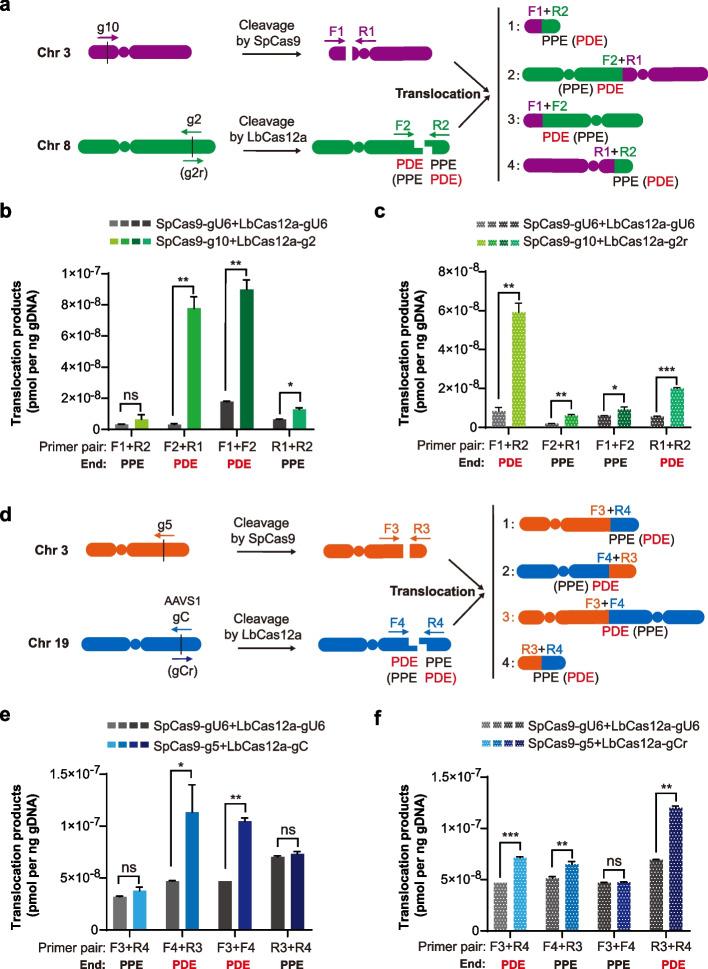
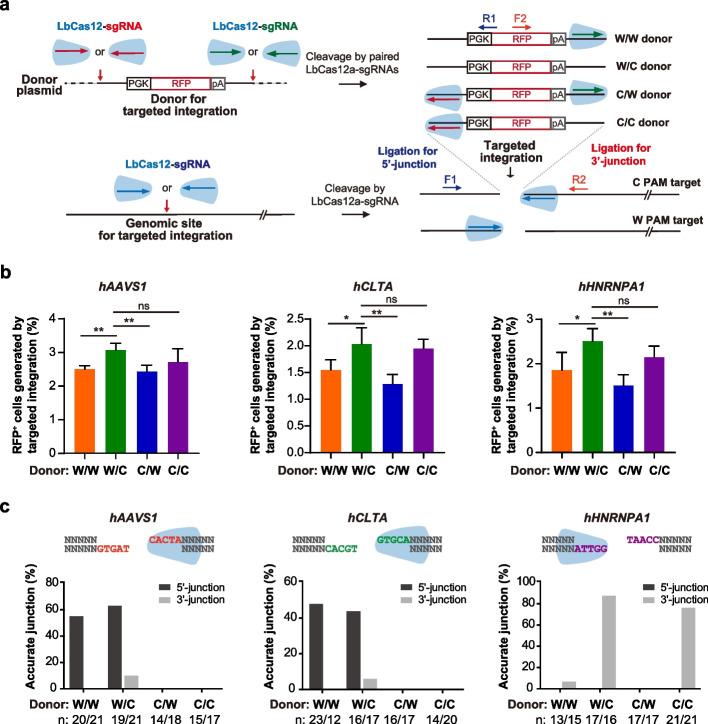
Post-cleavage retention of LbCas12a at PPEs suppresses the recruitment of classical non-homologous end joining (c-NHEJ) core factors, leading to longer deletions at PPEs compared to PDEs. This asymmetry in c-NHEJ engagement results in approximately tenfold more accurate ligation between two compatible PDEs induced by paired LbCas12a than ligation involving a compatible PPE. Moreover, ligation to a given end of SpCas9-induced DSBs demonstrates more efficient ligation with a PDE from Cas12a-induced DSBs than with a PPE. In LbCas12a-induced NHEJ-mediated targeted integration, only two compatible PDEs from LbCas12a-induced DSBs-one from donor templates and the other from target sites-promote accurate and directional ligation. Based on these findings, we developed a strategy called Cas12a-induced PDE ligation (CIPDEL) for NHEJ-mediated efficient and precise gene correction and insertion.
CONCLUSIONS
The asymmetric retention of CRISPR-LbCas12a at DSB ends suppresses c-NHEJ at PPEs, not at PDEs. This unique repair mechanism can be utilized in the CIPDEL strategy, offering a potentially better alternative for homology-directed targeted integration.
背景
Cas12a切割其DNA靶标后,会产生具有两个兼容的5' 交错末端的DNA双链断裂(DSB)。Cas12a-gRNA复合物保留在原间隔相邻基序(PAM)近端末端(PPE),同时释放PAM远端末端(PDE)。这种不对称保留对DSB修复的影响目前尚不清楚。
结果
切割后LbCas12a在PPE处的保留抑制了经典非同源末端连接(c-NHEJ)核心因子的募集,导致与PDE相比,PPE处的缺失更长。c-NHEJ参与的这种不对称性导致配对的LbCas12a诱导的两个兼容PDE之间的连接比涉及兼容PPE的连接精确约十倍。此外,与SpCas9诱导的DSB的给定末端连接显示,与Cas12a诱导的DSB的PDE连接比与PPE连接更有效。在LbCas12a诱导的NHEJ介导的靶向整合中,只有来自LbCas12a诱导的DSB的两个兼容PDE——一个来自供体模板,另一个来自靶位点——促进精确和定向连接。基于这些发现,我们开发了一种称为Cas12a诱导的PDE连接(CIPDEL)的策略,用于NHEJ介导的高效和精确的基因校正和插入。
结论
CRISPR-LbCas12a在DSB末端的不对称保留抑制了PPE处的c-NHEJ,而不是PDE处的。这种独特的修复机制可用于CIPDEL策略,为同源定向靶向整合提供了一种潜在的更好选择。


 Zotero 插件