
气道装置对小儿斜视手术中苏醒期谵妄的影响。
Effect of Airway Devices on Emergence Delirium in Pediatric Strabismus Surgery.
作者信息
Park Eun Ji, Hwang Boo-Young, Kwon Jae-Young, Jung Young-Hoon, Lee Hyeon Jeong, Jeon Soeun
机构信息
Department of Anesthesia and Pain Medicine, Biomedical Research Institute, Pusan National University Hospital, Pusan, South Korea.
Department of Anesthesia and Pain Medicine, School of Medicine, Pusan National University, Yangsan, South Korea.
出版信息
Med Sci Monit. 2025 Apr 15;31:e948351. doi: 10.12659/MSM.948351.
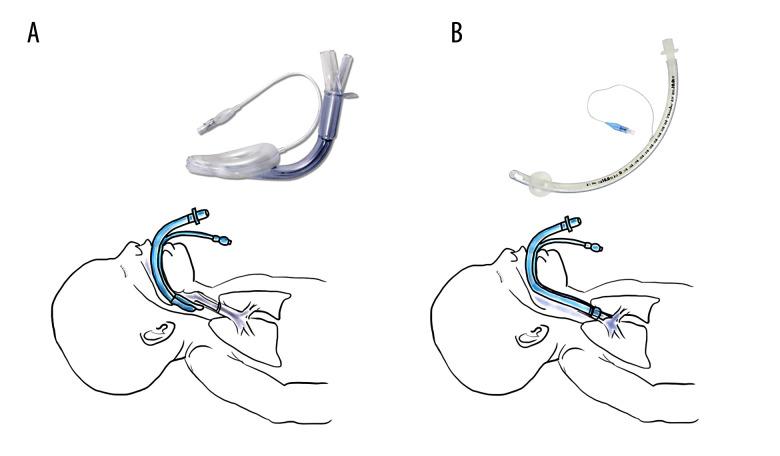
BACKGROUND Pediatric anesthesia emergence delirium (PAED), with symptoms including agitation, hyperactivity, and confusion, is common in children undergoing general anesthesia. This study aimed to compare the effect of an endotracheal tube (ETT) and a laryngeal mask airway (LMA) on emergence delirium (ED) in 73 children undergoing strabismus surgery. MATERIAL AND METHODS Seventy-three children aged 3 to 9 years were enrolled and randomly assigned to 2 groups: 36 patients in the LMA group (group L) and 37 patients in the ETT group (group E). The primary endpoint was the existence of ED, defined as a PAED scale score exceeding 10. Secondary endpoints were PAED scale scores, the Face, Legs, Activity, Cry, Consolability (FLACC) scale scores, measured every 5 min, intubation and extubation times, complications, airway responses following intubation, and post-anesthesia care unit (PACU) stay duration. RESULTS Seventy-three patients were included in the final analysis. Intubation time and PACU stay were significantly shorter in group L than in group E (P=0.02). Group E demonstrated higher PAED scale scores at 0, 5, 10, 20, and 25 min after surgery (P=0.062, 0.029, 0.019, 0.007, and 0.028, respectively). FLACC scores were also higher in group E, at 20, 25, and 30 min after surgery (P=0.016, 0.029, and 0.026, respectively). The presence of ED was lower in group L than in group E, at 5, 10, and 15 min (P=0.024, 0.008, and 0.025, respectively). CONCLUSIONS LMA is better than ETT in pediatric strabismus surgery, as it reduces postoperative pain and PACU stay.
背景 小儿麻醉苏醒期谵妄(PAED),症状包括躁动、多动和意识模糊,在接受全身麻醉的儿童中很常见。本研究旨在比较气管内插管(ETT)和喉罩气道(LMA)对73例斜视手术患儿苏醒期谵妄(ED)的影响。
材料与方法 纳入73例3至9岁儿童,随机分为2组:LMA组(L组)36例患者和ETT组(E组)37例患者。主要终点是ED的存在,定义为PAED量表评分超过10分。次要终点是PAED量表评分、面部、腿部、活动、哭闹、安慰度(FLACC)量表评分(每5分钟测量一次)、插管和拔管时间、并发症、插管后的气道反应以及麻醉后恢复室(PACU)停留时间。
结果 73例患者纳入最终分析。L组的插管时间和PACU停留时间明显短于E组(P = 0.02)。E组在术后0、5、10、20和25分钟时PAED量表评分更高(分别为P = 0.062、0.029、0.019、0.007和0.028)。E组在术后20、25和30分钟时FLACC评分也更高(分别为P = 0.016、0.029和0.026)。L组在5、10和15分钟时ED的发生率低于E组(分别为P = 0.024、0.008和0.025)。
结论 在小儿斜视手术中,LMA优于ETT,因为它可减轻术后疼痛并缩短PACU停留时间。

 Zotero 插件