
废塑料制氢的现状与展望
State-of-the-art and perspectives of hydrogen generation from waste plastics.
作者信息
Niu Feng, Wu Zeqi, Chen Da, Huang Yuexiang, Ordomsky Vitaly V, Khodakov Andrei Y, Van Geem Kevin M
机构信息
College of Materials and Chemistry, China Jiliang University, Hangzhou 310018, Zhejiang, P. R. China.
University of Lille, CNRS, Centrale Lille, University of Artois, UMR 8181 - UCCS - Unité de Catalyse et Chimie du Solide, Lille, France.
出版信息
Chem Soc Rev. 2025 May 19;54(10):4948-4972. doi: 10.1039/d4cs00604f.
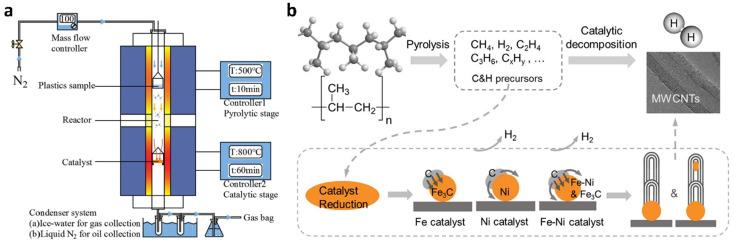
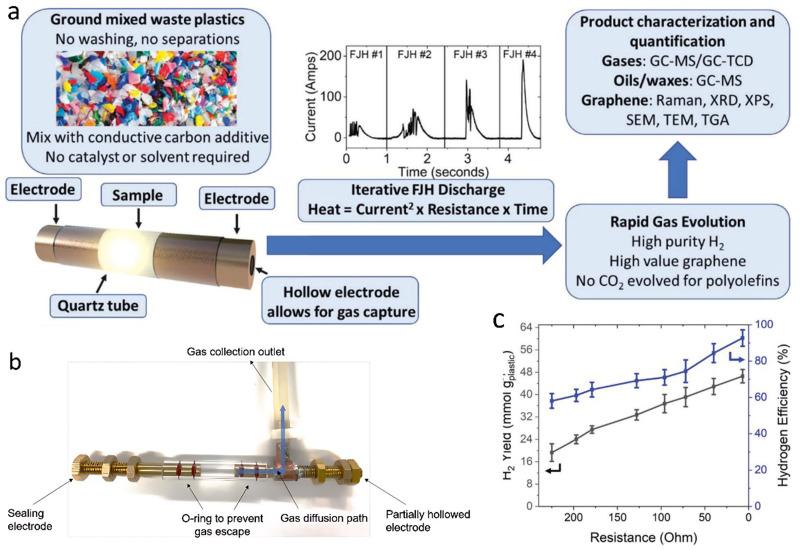
Waste plastic utilization and hydrogen production present significant economic and social challenges but also offer opportunities for research and innovation. This review provides a comprehensive analysis of the latest advancements and innovations in hydrogen generation coupled with waste plastic recycling. It explores various strategies, including pyrolysis, gasification, aqueous phase reforming, photoreforming, and electrocatalysis. Pyrolysis and gasification in combination with catalytic reforming or water gas-shift are currently the most feasible and scalable technologies for hydrogen generation from waste plastics, with pyrolysis operating in an oxygen-free environment and gasification in the presence of steam, though both require high energy inputs. Aqueous phase reforming operates at moderate temperatures and pressures, making it suitable for oxygenated plastics, but it faces challenges related to feedstock limitations, catalyst costs and deactivation. Photoreforming and electrocatalytic reforming are emerging, sustainable methods that use sunlight and electricity, respectively, to convert plastics into hydrogen. Still, they suffer from low efficiency, scalability issues, and limitations to specific plastic types like oxygenated polymers. The challenges and solutions to commercializing plastic-to-hydrogen technologies, drawing on global industrial case studies have been outlined. Maximizing hydrogen productivity and selectivity, minimizing energy consumption, and ensuring stable operation and scaleup of plastic recycling are crucial parameters for achieving commercial viability.
废塑料利用和制氢既带来了重大的经济和社会挑战,也提供了研究和创新的机会。本综述全面分析了与废塑料回收相结合的制氢最新进展和创新。它探讨了各种策略,包括热解、气化、水相重整、光重整和电催化。热解和气化与催化重整或水煤气变换相结合,目前是从废塑料制氢最可行和可扩展的技术,热解在无氧环境中进行,气化在蒸汽存在下进行,不过两者都需要高能量输入。水相重整在中等温度和压力下运行,适用于含氧塑料,但面临原料限制、催化剂成本和失活等挑战。光重整和电催化重整是新兴的可持续方法,分别利用阳光和电力将塑料转化为氢气。然而,它们存在效率低、可扩展性问题以及对含氧聚合物等特定塑料类型的局限性。借鉴全球工业案例研究,概述了塑料制氢技术商业化的挑战和解决方案。最大限度地提高氢气生产率和选择性、最小化能源消耗以及确保塑料回收的稳定运行和扩大规模是实现商业可行性的关键参数。










 Zotero 插件