
基于双ABC-X理论框架的肺癌患者家庭复原力及其影响因素
Family Resilience and Its Influencing Factors Among Patients With Lung Cancer Based on Double ABC-X Theoretical Framework.
作者信息
Shen Ziyi, Fang Yan, Li Chengcheng, Luo Xin, Cui Junling, Liu Yanchang, Hong Jingfang
机构信息
School of Nursing, Anhui Medical University, Hefei, Anhui, China.
Anhui International Joint Research Center of Nursing Science, Hefei, Anhui, China.
出版信息
Cancer Med. 2025 Apr;14(8):e70868. doi: 10.1002/cam4.70868.
OBJECTIVE
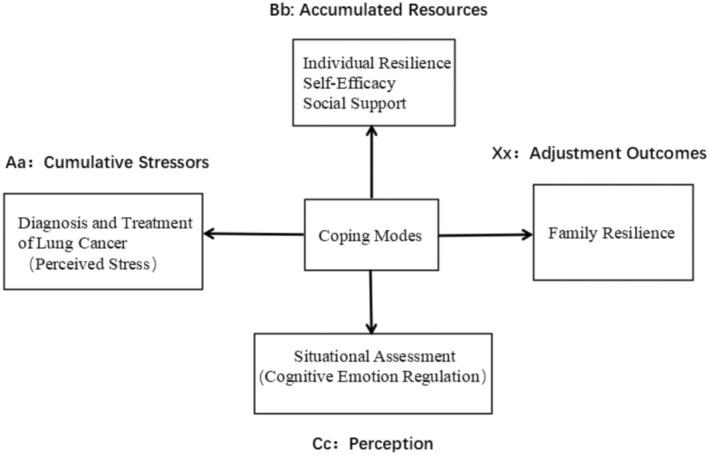
The aim of this study was to evaluate the family resilience and its psychosocial influencing factors of patients with lung cancer. Relationships between variables and pathways were also explored based on the Double ABC-X as the theoretical framework.
METHODS
A cross-sectional survey of 318 lung cancer patients was conducted in a tertiary hospital in Anhui, China. The questionnaires included a general information survey, the Chinese perceived stress scale, the Connor-Davidson Resilience Scale, the social support scale, the cognitive emotion regulation scale, the self-efficacy scale, the medical coping modes questionnaire, and the family resilience scale. Data entry was performed using EpiData3.1 software, while data processing and analysis were conducted with SPSS 26.0. The structural equation modeling was fitted and validated using AMOS 26.0 software.
RESULTS
Family resilience levels were found to be moderately above average. Linear regression analysis indicated payment method, employment status, time since diagnosis, confrontative coping style, Positive Cognitive Emotion Regulation (PCER), perceived stress, social support, and personal resilience as the main influencing factors, which could explain 71.1% of the variation of family resilience in individuals with lung cancer. The final model comprises nine significant pathways. Cognitive emotion regulation, self-efficacy, and social support all have direct positive effects on family resilience (β = 0.202, β = 0.272, β = 0.298). Personal resilience, social support, and self-efficacy significantly positively influence confrontive coping modes (β = 0.293, β = 0.175, β = 0.121). Individual resilience has a significant positive effect on self-efficacy, with a path coefficient of β = 0.377. Submissive coping modes are notably enhanced by perceived stress, as indicated by a path coefficient of β = 0.516, while personal resilience negatively affects submissive coping styles, as indicated by a path coefficient of β = -0.188.
CONCLUSIONS
This study highlights the importance of psychosocial factors, such as cognitive emotion regulation, self-efficacy, and social support, in enhancing family resilience in lung cancer patients. Clinically, interventions targeting these factors might significantly improve family functioning and coping mechanisms, contributing to better patient and family outcomes during cancer treatment and care.
目的
本研究旨在评估肺癌患者的家庭复原力及其心理社会影响因素。并基于双重ABC-X理论框架探讨各变量之间的关系及路径。
方法
在中国安徽一家三级医院对318例肺癌患者进行了横断面调查。问卷包括一般信息调查、中文版感知压力量表、康纳-戴维森复原力量表、社会支持量表、认知情绪调节量表、自我效能量表、医学应对方式问卷和家庭复原力量表。使用EpiData3.1软件进行数据录入,采用SPSS 26.0进行数据处理与分析。使用AMOS 26.0软件拟合和验证结构方程模型。
结果
发现家庭复原力水平略高于平均水平。线性回归分析表明,支付方式、就业状况、确诊时间、对抗性应对方式、积极认知情绪调节(PCER)、感知压力、社会支持和个人复原力是主要影响因素,它们可以解释肺癌患者家庭复原力个体差异的71.1%。最终模型包含九条显著路径。认知情绪调节、自我效能和社会支持均对家庭复原力有直接正向影响(β = 0.202,β = 0.272,β = 0.298)。个人复原力、社会支持和自我效能对对抗性应对方式有显著正向影响(β = 0.293,β = 0.175,β = 0.121)。个体复原力对自我效能有显著正向影响,路径系数β = 0.377。如路径系数β = 0.516所示,感知压力显著增强了顺从性应对方式,而如路径系数β = -0.188所示,个人复原力对顺从性应对方式有负面影响。
结论
本研究强调了认知情绪调节、自我效能和社会支持等心理社会因素在增强肺癌患者家庭复原力方面的重要性。临床上,针对这些因素的干预措施可能会显著改善家庭功能和应对机制,有助于在癌症治疗和护理期间取得更好的患者和家庭结局。

 Zotero 插件