
壳聚糖-乳铁蛋白包衣系统对β-胡萝卜素脂质体的稳定作用:囊泡性质及体外抗炎研究
Stabilization of β-Carotene Liposomes with Chitosan-Lactoferrin Coating System: Vesicle Properties and Anti-Inflammatory In Vitro Studies.
作者信息
Gao Shuxin, Yi Xiangzhou, Gao Xia, Long Zhengsen, Guo Jingfeng, Xia Guanghua, Shen Xuanri
机构信息
Hainan Engineering Research Center of Aquatic Resources Efficient Utilization in South China Sea, Key Laboratory of Seafood Processing of Haikou, School of Food Science and Engineering, Hainan University, Haikou 570228, China.
School of Food Science and Engineering, Hainan Tropic Ocean University, Sanya 572022, China.
出版信息
Foods. 2025 Mar 12;14(6):968. doi: 10.3390/foods14060968.
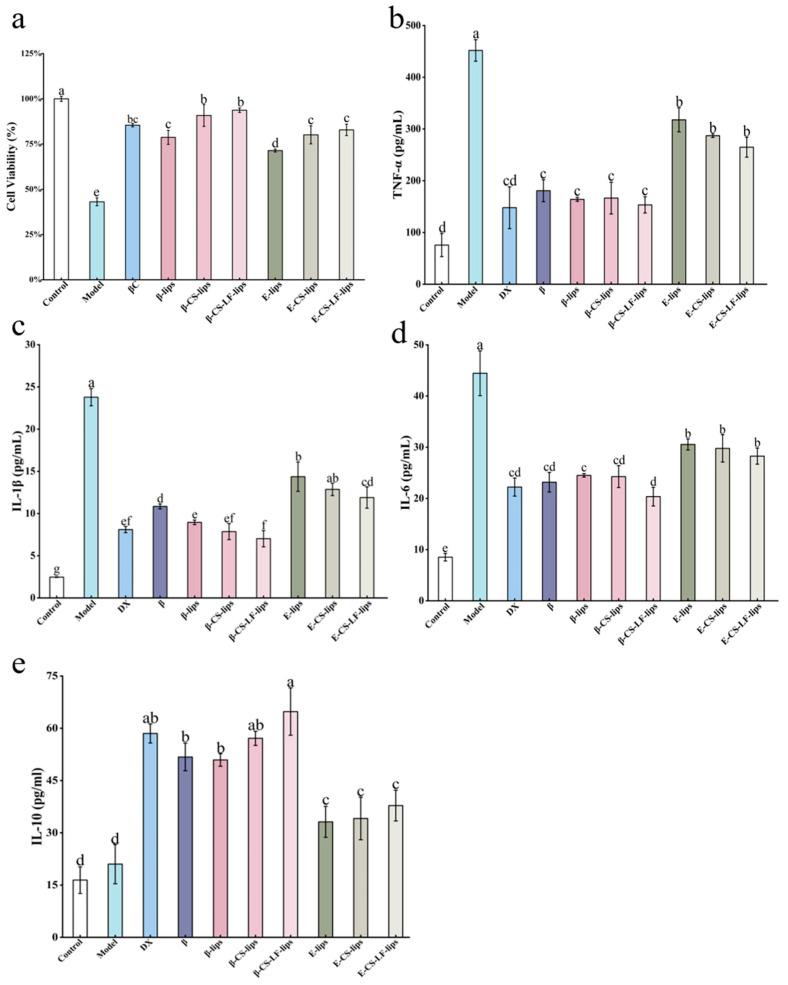
Liposomes serve as an effective delivery system capable of encapsulating a variety of bioactive substances. However, their structural integrity is susceptible to damage from various environmental factors, which can result in the leakage of the encapsulated bioactive agents. Consequently, identifying effective strategies to enhance the stability of liposomes has become a central focus of contemporary liposome research. Surface modification, achieved by introducing a protective layer on the liposome surface, effectively reduces liposome aggregation and enhances their stability. To this end, we designed a surface modification and constructed liposomes loaded with β-carotene through co-modification with chitosan and lactoferrin, resulting in enhanced stability. This improvement was evident in terms of storage stability, light stability, and in vitro digestion stability. The study investigated the morphology, structure, and physicochemical properties of liposomes with varying degrees of modification. CS-LF co-modified liposomes exhibited significant structural changes, with particle size increasing from 257.9 ± 6.2 nm to 580.5 ± 21.5 nm, and zeta potential shifting from negative to +48.9 ± 1.3 mV. Chitosan and lactoferrin were modified on the liposome surface through electrostatic interactions and hydrogen bonding, forming a dense protective barrier on the lipid membrane. Physicochemical analysis indicated that chitosan-lactoferrin co-modification led to a more ordered arrangement of the phospholipid bilayer, reduced membrane fluidity, and increased membrane rigidity. The interactions between chitosan, lactoferrin, and phospholipids were enhanced through hydrogen bonding, resulting in a denser surface membrane structure. This structural integrity reduced membrane permeability and improved the stability of liposomes under storage conditions, UV irradiation, and in vitro digestion. Additionally, co-modified chitosan-lactoferrin liposomes effectively alleviated lipopolysaccharide-induced inflammatory damage in mouse microglial cells by increasing cellular uptake capacity, thereby enhancing the bioavailability of β-carotene. The results of this study demonstrate that chitosan-lactoferrin co-modification significantly enhances the stability of liposomes and the bioavailability of β-carotene. These findings may contribute to the development of multi-substance co-modified liposome systems, providing a more stable transport mechanism for various compounds.
脂质体是一种有效的递送系统,能够包裹多种生物活性物质。然而,其结构完整性易受各种环境因素的破坏,这可能导致包裹的生物活性剂泄漏。因此,确定提高脂质体稳定性的有效策略已成为当代脂质体研究的核心焦点。通过在脂质体表面引入保护层实现的表面修饰,有效地减少了脂质体聚集并提高了其稳定性。为此,我们设计了一种表面修饰方法,并通过壳聚糖和乳铁蛋白的共修饰构建了负载β-胡萝卜素的脂质体,从而提高了稳定性。这种改进在储存稳定性、光稳定性和体外消化稳定性方面都很明显。该研究调查了不同修饰程度的脂质体的形态、结构和理化性质。壳聚糖-乳铁蛋白共修饰的脂质体表现出显著的结构变化,粒径从257.9±6.2nm增加到580.5±21.5nm,zeta电位从负值变为+48.9±1.3mV。壳聚糖和乳铁蛋白通过静电相互作用和氢键在脂质体表面进行修饰,在脂质膜上形成了致密的保护屏障。理化分析表明,壳聚糖-乳铁蛋白共修饰导致磷脂双层排列更有序,膜流动性降低,膜刚性增加。壳聚糖、乳铁蛋白和磷脂之间的相互作用通过氢键增强,形成了更致密的表面膜结构。这种结构完整性降低了膜通透性,提高了脂质体在储存条件、紫外线照射和体外消化下的稳定性。此外,共修饰的壳聚糖-乳铁蛋白脂质体通过增加细胞摄取能力,有效减轻了脂多糖诱导的小鼠小胶质细胞炎症损伤,从而提高了β-胡萝卜素的生物利用度。本研究结果表明,壳聚糖-乳铁蛋白共修饰显著提高了脂质体的稳定性和β-胡萝卜素的生物利用度。这些发现可能有助于多物质共修饰脂质体系统的开发,为各种化合物提供更稳定的运输机制。


 Zotero 插件