
2型固有淋巴细胞在哮喘合并特应性皮炎中的作用:弥合从研究到临床实践的差距
The role of ILC2s in asthma combined with atopic dermatitis: bridging the gap from research to clinical practice.
作者信息
Luo Yan-Fang, Deng Yu, Yang Feng, Xiong Xia, Yuan Yu-Lai, Ao Su-Hua
机构信息
Department of Respirology, The Affiliated Traditional Chinese Medicine Hospital, Southwest Medical University, Luzhou, Sichuan, China.
College of Integrated Chinese and Western Medicine, Southwest Medical University, Luzhou, Sichuan, China.
出版信息
Front Immunol. 2025 Apr 1;16:1567817. doi: 10.3389/fimmu.2025.1567817. eCollection 2025.
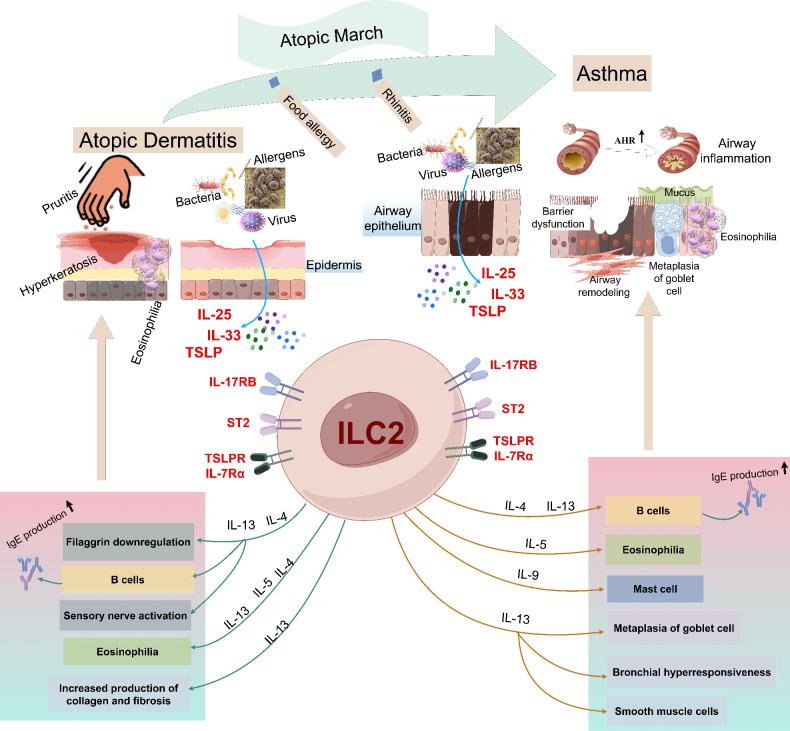
Asthma, a complex and heterogeneous respiratory disease, is often accompanied by various comorbidities, notably atopic dermatitis (AD). AD characterized by recurrent eczematous lesions and severe itching, can trigger or exacerbate asthma. Individuals with AD are 2.16 times more likely to develop asthma compared to the reference population. Furthermore, asthmatics with AD experience more severe and frequent emergency department visits and hospital admissions compared to patients with asthma alone. The close connection between asthma and AD indicates there are overlap pathophysiologic mechanisms. It is well-known that dysregulated type 2 (T2) immune inflammation is pivotal in the development of both AD and asthma, traditionally attributed to CD4 type 2 helper T (Th2) cells. Over the past decade, group 2 innate lymphoid cells (ILC2s), as potent innate immune cells, have been demonstrated to be the key drivers of T2 inflammation, playing a crucial role in the pathogenesis of both asthma and AD. ILC2s not only trigger T2 immune-inflammation but also coordinate the recruitment and activation of innate and adaptive immune cells, thereby intensifying the inflammatory response. They are rapidly activated by epithelium alarmins producing copious amounts of T2 cytokines such as interleukin (IL) -5 and IL-13 that mediate the airway inflammation, hyperresponsiveness, and cutaneous inflammation in asthma and AD, respectively. The promising efficiency of targeted ILC2s in asthma and AD has further proven their essential roles in the pathogenesis of both conditions. However, to the best of our knowledge, there is currently no review article specifically exploring the role of ILC2s in asthma combined with AD and their potential as future therapeutic targets. Hence, we hypothesize that ILC2s may play a role in the pathogenesis of asthma combined with AD, and targeting ILC2s could be a promising therapeutic approach for this complex condition in the future. In this review, we discuss recent insights in ILC2s biology, focus on the current knowledge of ILC2s in asthma, AD, particularly in asthma combined with AD, and suggest how this knowledge might be used for improved treatments of asthma combined with AD.
哮喘是一种复杂的异质性呼吸系统疾病,常伴有多种合并症,尤其是特应性皮炎(AD)。AD以反复出现的湿疹样皮损和严重瘙痒为特征,可引发或加重哮喘。与参照人群相比,AD患者患哮喘的可能性高2.16倍。此外,与单纯哮喘患者相比,合并AD的哮喘患者急诊就诊和住院的情况更严重且更频繁。哮喘与AD之间的密切联系表明存在重叠的病理生理机制。众所周知,2型(T2)免疫炎症失调在AD和哮喘的发病过程中都起着关键作用,传统上认为这归因于CD4 2型辅助性T(Th2)细胞。在过去十年中,2型固有淋巴细胞(ILC2s)作为强大的固有免疫细胞,已被证明是T2炎症的关键驱动因素,在哮喘和AD的发病机制中都起着至关重要的作用。ILC2s不仅触发T2免疫炎症,还协调固有免疫细胞和适应性免疫细胞的募集和激活,从而加剧炎症反应。它们被上皮警报素迅速激活,产生大量T2细胞因子,如白细胞介素(IL)-5和IL-13,分别介导哮喘和AD中的气道炎症、高反应性和皮肤炎症。靶向ILC2s在哮喘和AD中的显著疗效进一步证明了它们在这两种疾病发病机制中的重要作用。然而,据我们所知,目前尚无专门探讨ILC2s在合并AD的哮喘中的作用及其作为未来治疗靶点潜力的综述文章。因此,我们推测ILC2s可能在合并AD的哮喘发病机制中起作用,靶向ILC2s可能是未来治疗这种复杂疾病的一种有前景的治疗方法。在本综述中,我们讨论了ILC2s生物学的最新见解,重点关注目前关于ILC2s在哮喘、AD,特别是合并AD的哮喘中的知识,并提出如何利用这些知识改善合并AD的哮喘的治疗。
 Zotero 插件