
美国镰状细胞病患者频繁接受红细胞输血治疗的临床及经济负担
Clinical and Economic Burden of Managing Patients with Sickle Cell Disease Receiving Frequent Red Blood Cell Transfusions in the United States.
作者信息
Udeze Chuka, Jerry Michelle, Evans Kristin A, Li Nanxin, Jain Siddharth, Andemariam Biree
机构信息
Health Economics and Outcomes Research, Vertex Pharmaceuticals Incorporated, Boston, MA, USA.
Research and Analytic Services, Merative, Ann Arbor, MI, USA.
出版信息
Clinicoecon Outcomes Res. 2025 Apr 11;17:303-313. doi: 10.2147/CEOR.S511996. eCollection 2025.
PURPOSE
Standard of care for patients with sickle cell disease (SCD) includes red blood cell transfusions (RBCTs). Data on clinical and economic outcomes of patients with SCD receiving frequent RBCTs are limited.
MATERIALS AND METHODS
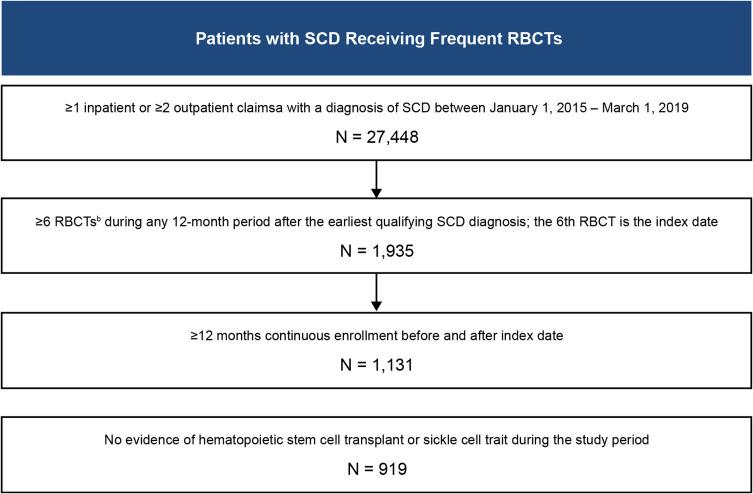
This longitudinal, retrospective, claims-based analysis used the Merative™ MarketScan Commercial, Medicare, and Multi-State Medicaid databases. Patients with SCD (identified using ICD-9/10 codes) receiving frequent RBCTs (≥6 RBCTs during any 12-month period) between January 1, 2015, and March 1, 2019, were included. The index date was the date of the sixth RBCT. Eligible patients were required to have ≥12 months of continuous enrollment pre- and post-index. Patients were followed from index to end of enrollment, death, or end of the study period (February 29, 2020), whichever came first. Clinical complications, all-cause healthcare resource utilization (HCRU), and healthcare costs were descriptively summarized during follow-up.
RESULTS
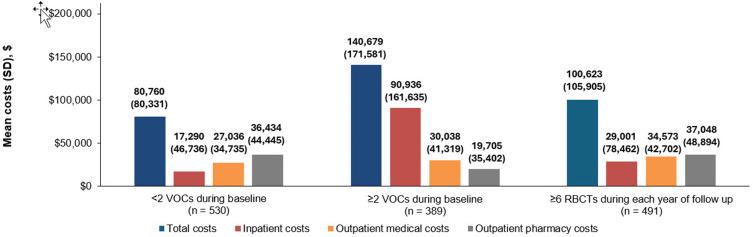
A total of 919 patients with SCD receiving frequent RBCTs met the eligibility criteria for inclusion. Patients experienced a mean of 4.0 vaso-occlusive crises (VOCs) per patient per year (PPPY) and received a mean of 8.3 RBCTs PPPY during follow-up. The most common clinical complications were iron overload (77%), infections (66%), and cerebrovascular disease (48%). Patients had a mean of 2.3 inpatient admissions, 83.5 outpatient visits, and 37.4 outpatient prescriptions PPPY during follow-up. Mean total annual healthcare costs were $106,123 PPPY, including mean inpatient, outpatient medical, and outpatient pharmacy costs of $48,463, $28,307, and $29,353, respectively. Compared to those with <2 baseline VOCs, patients with ≥2 baseline VOCs had more HCRU and higher annual healthcare costs.
CONCLUSION
Despite utilizing available care with frequent RBCTs, patients with SCD experienced a variety of disease and transfusion-related complications, including frequent VOCs and iron overload, which led to substantial HCRU and costs. These findings highlight the need for novel therapies for this patient group.
目的
镰状细胞病(SCD)患者的标准治疗包括红细胞输血(RBCT)。关于接受频繁RBCT的SCD患者的临床和经济结局的数据有限。
材料与方法
这项基于索赔的纵向回顾性分析使用了Merative™ MarketScan商业、医疗保险和多州医疗补助数据库。纳入了在2015年1月1日至2019年3月1日期间接受频繁RBCT(在任何12个月期间≥6次RBCT)的SCD患者(使用ICD-9/10编码识别)。索引日期为第六次RBCT的日期。符合条件的患者在索引前后需要有≥12个月的连续参保期。从索引日期开始对患者进行随访,直至参保结束、死亡或研究期结束(2020年2月29日),以先到者为准。在随访期间对临床并发症、全因医疗资源利用(HCRU)和医疗费用进行描述性总结。
结果
共有919例接受频繁RBCT的SCD患者符合纳入标准。患者在随访期间平均每人每年经历4.0次血管闭塞性危机(VOC),平均每人每年接受8.3次RBCT。最常见的临床并发症是铁过载(77%)、感染(66%)和脑血管疾病(48%)。患者在随访期间平均每人每年有2.3次住院、83.5次门诊就诊和37.4次门诊处方。平均每年总医疗费用为每人每年106,123美元,其中住院、门诊医疗和门诊药房的平均费用分别为48,463美元、28,307美元和29,353美元。与基线VOC<2次的患者相比,基线VOC≥2次的患者有更多的HCRU和更高的年度医疗费用。
结论
尽管对SCD患者频繁使用RBCT进行现有治疗,但他们仍经历了各种与疾病和输血相关的并发症,包括频繁的VOC和铁过载,这导致了大量的HCRU和费用。这些发现凸显了针对该患者群体开发新疗法的必要性。

 Zotero 插件