
溃疡性结肠炎的疾病清除:一项叙述性综述
Disease Clearance in Ulcerative Colitis: A Narrative Review.
作者信息
Danese Silvio, Peyrin-Biroulet Laurent, Jairath Vipul, D'Amico Ferdinando, Adsul Shashi, Agboton Christian, Magro Fernando
机构信息
Department of Gastroenterology and Endoscopy, IRCCS San Raffaele Hospital and Vita-Salute, San Raffaele University, Milan, Italy.
Department of Gastroenterology, INFINY Institute, INSERM NGERE, Vandœuvre-lès-Nancy, France.
出版信息
United European Gastroenterol J. 2025 Jul;13(6):902-910. doi: 10.1002/ueg2.12714. Epub 2025 Apr 16.
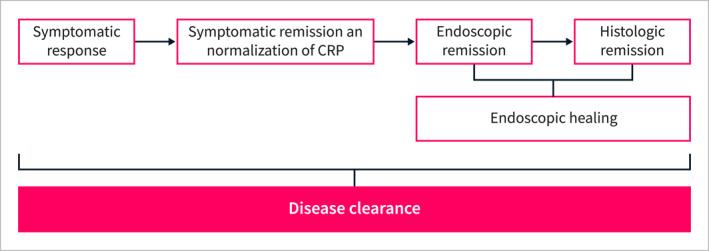
Ulcerative colitis (UC) is a chronic relapsing disease with significant associated risks such as colectomy, hospitalization, or colorectal cancer. A treat-to-target approach that mitigates disease activity and progression from an early stage is needed. The latest STRIDE II guidelines advocate for clinical and endoscopic remission as the main therapeutic targets in the management of UC; however, histological remission is increasingly being recognized as an important outcome. The concept of disease clearance, a composite outcome comprising clinical, endoscopic, and histological remission, has been proposed as a potential target for patients with UC and has been precisely defined by the International Organization for the Study of Inflammatory Bowel Disease, with the aim of standardizing its use in clinical practice and research. Despite challenges, including variable standardized definitions and uncertainties regarding the timing of reaching different definitions of remission, disease clearance corresponds to comprehensive disease control, and its use as an outcome could help clinicians to better evaluate the actual status of the disease. Furthermore, achieving disease clearance may be related to an improved disease course, positive long-term outcomes, and an improvement in health-related quality of life. Real-world evidence supports the feasibility of achieving disease clearance with various treatment modalities, including vedolizumab, the only gut-selective antilymphocyte trafficking drug. The aim of this narrative review is to explore the concept of disease clearance in patients with disease clearance, mainly focusing on trials evaluating vedolizumab but also other biologics.
溃疡性结肠炎(UC)是一种慢性复发性疾病,伴有诸如结肠切除术、住院治疗或结直肠癌等重大相关风险。需要一种从早期阶段就减轻疾病活动和进展的达标治疗方法。最新的STRIDE II指南提倡将临床和内镜缓解作为UC管理的主要治疗目标;然而,组织学缓解越来越被认为是一个重要的结果。疾病清除的概念,即一种包括临床、内镜和组织学缓解的综合结果,已被提议作为UC患者的一个潜在目标,并已由国际炎症性肠病研究组织进行了精确界定,目的是在临床实践和研究中规范其使用。尽管存在挑战,包括标准化定义的差异以及达到不同缓解定义的时间方面的不确定性,但疾病清除对应于全面的疾病控制,将其作为一个结果有助于临床医生更好地评估疾病的实际状况。此外,实现疾病清除可能与改善病程、良好的长期结局以及提高健康相关生活质量有关。真实世界的证据支持通过包括维多珠单抗(唯一的肠道选择性抗淋巴细胞转运药物)在内的各种治疗方式实现疾病清除的可行性。本叙述性综述的目的是探讨疾病清除在UC患者中的概念,主要关注评估维多珠单抗但也包括其他生物制剂的试验。
 Zotero 插件