
一种通过使用有机酸作为体外和体内抗菌剂来预防新出现感染的新策略。
A New Strategy to Prevent Emerging Infections by Using Organic Acids as Antimicrobials In Vitro and Ex Vivo.
作者信息
Balta Igori, Simiz Florin Dan, Stef Ducu, Pet Ioan, Dumitrescu Gabi, Iancu Tiberiu, Cretescu Iuliana, Corcionivoschi Nicolae, Stef Lavinia
机构信息
Faculty of Bioengineering of Animal Resources, University of Life Sciences King Mihai I of Romania from Timisoara, 300645 Timisoara, Romania.
Faculty of Veterinary Medicine, University of Life Sciences King Mihai I of Romania from Timisoara, 300645 Timisoara, Romania.
出版信息
Int J Mol Sci. 2025 Apr 5;26(7):3423. doi: 10.3390/ijms26073423.
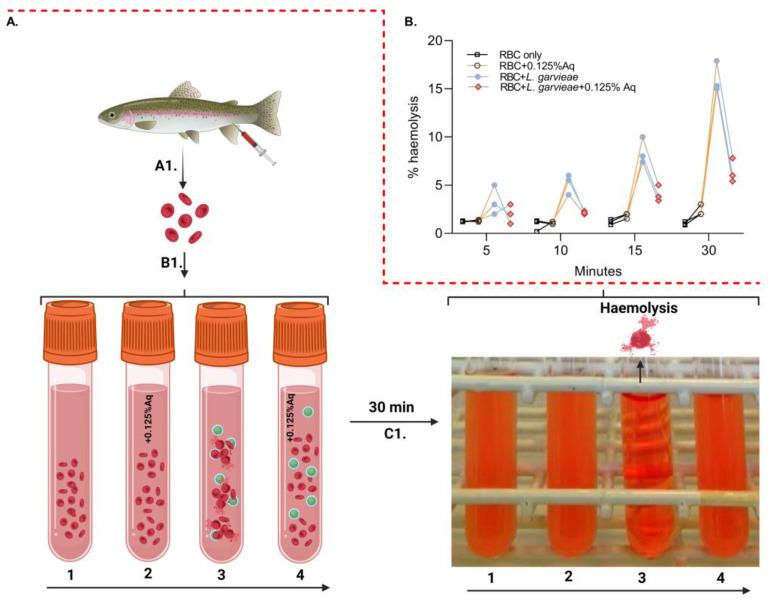
The ever-growing global demand for animal protein forces the aquaculture industry to expand at a pace which imposes significant challenges in maintaining sustainable practices. This study aimed to investigate the efficacy of an organic acid mixture (Aq) in mitigating () virulence through its effects on bacterial virulence (EPS production, biofilm, and haemolytic factors) and host pathogenicity, including its adherence to CHSE-214 cells, haemolysis, and proinflammatory responses. Our findings reveal that Aq significantly inhibits growth at a 0.125% concentration, suppresses EPS-related gene expression, reduces biofilm formation, and reduces cytotoxicity in fish epithelial cells (CHSE-214). Moreover, Aq decreased haemolysing gene expression (, and ) and attenuated red blood cell haemolysis, a hallmark of pathogenicity. Lastly, Aq was demonstrated to induce modulation in the host immune responses, lowering IL-1β and IL-8 expression, which are critical mediators of inflammation and pathogen recruitment. Therefore, we conclude that the main mechanism of action of Aq involves inhibiting adhesion to epithelial cells, reducing EPS production, and downregulating key virulence-associated genes (e.g., , , and ). After preventing adherence and suppressing proinflammatory cytokine expression (IL-1β and IL-8), Aq disrupts the pathogen's ability to breach epithelial barriers and induce red blood cell lysis, thereby mitigating its virulence and pathogenicity. Our results emphasised the potential of Aq as an alternative non-antibiotic intervention for controlling piscine lactococcosis, advancing our understanding of pathogenesis and providing the foundation for the future integration of environmentally friendly antimicrobials into aquaculture disease management.
全球对动物蛋白的需求不断增长,迫使水产养殖业以一定速度扩张,这给维持可持续养殖方式带来了重大挑战。本研究旨在调查一种有机酸混合物(Aq)通过对细菌毒力(胞外多糖产生、生物膜和溶血因子)及宿主致病性的影响来减轻(某病原体)毒力的效果,包括其对CHSE - 214细胞的黏附、溶血及促炎反应。我们的研究结果表明,Aq在浓度为0.125%时能显著抑制(某病原体)生长,抑制与胞外多糖相关的基因表达,减少生物膜形成,并降低鱼类上皮细胞(CHSE - 214)的细胞毒性。此外,Aq降低了溶血相关基因的表达(具体基因名称未给出),并减弱了红细胞溶血,这是(某病原体)致病性的一个标志。最后,Aq被证明能诱导宿主免疫反应的调节,降低IL - 1β和IL - 8的表达,而这两种物质是炎症和病原体募集的关键介质。因此,我们得出结论,Aq的主要作用机制包括抑制(某病原体)对上皮细胞的黏附、减少胞外多糖产生以及下调关键的毒力相关基因(如具体基因名称未给出)。在防止(某病原体)黏附并抑制促炎细胞因子表达(IL - 1β和IL - 8)后,Aq破坏了病原体突破上皮屏障并诱导红细胞裂解的能力,从而减轻其毒力和致病性。我们的结果强调了Aq作为控制鱼类乳球菌病的替代性非抗生素干预措施的潜力,增进了我们对(某病原体)发病机制的理解,并为未来将环境友好型抗菌剂纳入水产养殖疾病管理奠定了基础。



 Zotero 插件