
社会经济地位对早期胎盘蛋白质损伤与环境空气中PM化学成分暴露之间关联的效应修正
Effect Modification by Socioeconomic Status on the Associations between Early Placental Protein Damage and Exposure to Ambient Air PM Chemical Components.
作者信息
Yang Junnan, Li Xuesong, Chu Mengyu, Wang Mengyuan, Huo Yan, Han Bin, Bai Zhipeng, Wang Jianmei, Zhang Yujuan
机构信息
Department of Family Planning, The Second Hospital of Tianjin Medical University, Tianjin, China.
Department of Obstetrics, Xi'an International Medical Center Hospital, Xi'an, China.
出版信息
Environ Health Perspect. 2025 May;133(5):57017. doi: 10.1289/EHP15170. Epub 2025 May 23.
BACKGROUND
Ambient fine particulate matter with aerodynamic diameter () exposure is associated with systemic protein damage in pregnant women. However, its effect on protein damage in human placentas is unclear.
OBJECTIVES
We estimated the associations of and chemical component exposures with advanced oxidation protein products (AOPP) in placental villi tissues before 13 weeks of gestation.
METHODS
We enrolled 165 women with unintended normal early pregnancy (NEP) who requested induced abortion during the first trimester and 165 women with early pregnancy loss (EPL) who also requested induced abortion (2017-2022). Maternal daily , black carbon (BC), organic matter (OM), sulfate, nitrate, and ammonium exposures from the 12th week before ovulation to villi collection were estimated using data accessed from the Tracking Air Pollution in China platform. Associations of pollutant exposures during the 30 days before villi collection, during the post-conception period (from ovulation to villi collection), and during the periovulatory period (from the 12th week before to the third week after ovulation) with villi AOPP were estimated and compared between the NEP and EPL groups. Additionally, effect modifications by socioeconomic status expressed in family monthly income per capita were estimated using stratified distributed lag nonlinear models.
RESULTS
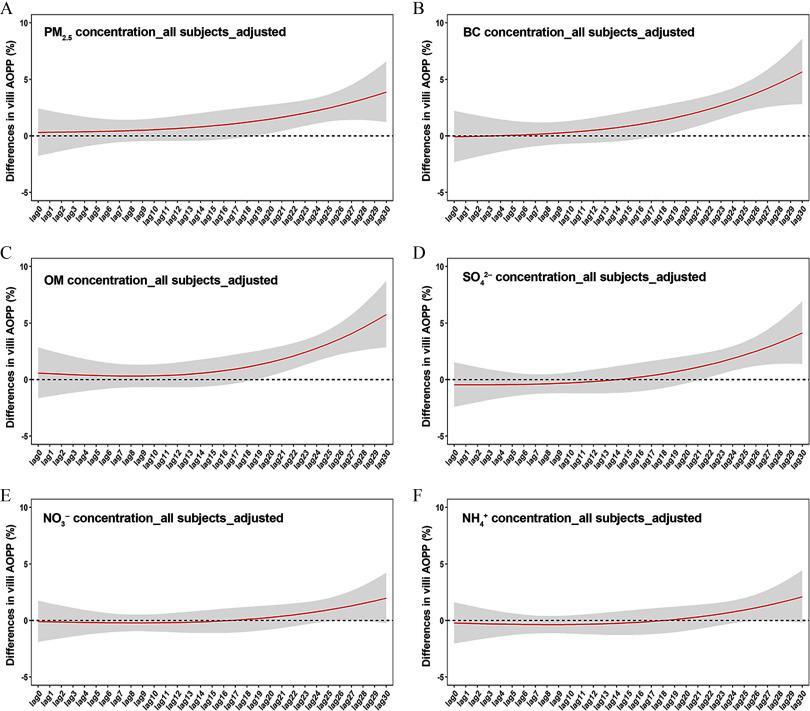
Thirty-day cumulative and average post-conception exposures to higher concentrations of , BC, and OM were associated with higher villi AOPP in all subjects and both groups. Thirty-day cumulative effects of per interquartile range increase in the residuals of BC and OM were robust in EPL [ values (95% confidence interval) of villi AOPP were 111.22% (17.96%, 278.24%) and 93.87% (20.63%, 211.56%)] but were not robust in NEP. The associations of per interquartile range increase in the concentrations of BC and OM at some lag days with higher villi AOPP were stronger in low-income stratification (the ranges of values of villi AOPP were 10.51-11.99% and 8.08-12.50%) than those in medium-income stratification (3.19-3.80% and 1.95-3.73%) and high-income stratification (2.57-2.78% and 2.51-2.72%). Periovulatory OM exposure was positively associated with villi AOPP in EPL but not in NEP, and the susceptible periods to and the other four components were 1-4 weeks earlier in EPL than in NEP.
DISCUSSION
Maternal , BC, and OM exposures were positively associated with oxidative protein damage in early placenta. The associations were stronger in women with EPL or low-income. https://doi.org/10.1289/EHP15170.
背景
暴露于空气动力学直径()的环境细颗粒物与孕妇的全身蛋白质损伤有关。然而,其对人胎盘蛋白质损伤的影响尚不清楚。
目的
我们估计了妊娠13周前胎盘绒毛组织中与化学组分暴露和晚期氧化蛋白产物(AOPP)之间的关联。
方法
我们招募了165名意外早期正常妊娠(NEP)且在孕早期要求人工流产的女性,以及165名早期妊娠丢失(EPL)且同样要求人工流产的女性(2017 - 2022年)。利用从中国空气污染追踪平台获取的数据,估算从排卵前第12周直至绒毛采集期间孕妇每日的、黑碳(BC)、有机物(OM)、硫酸盐、硝酸盐和铵的暴露量。估计并比较了绒毛采集前30天、受孕后时期(从排卵到绒毛采集)以及排卵期周围时期(从排卵前第12周到排卵后第三周)污染物暴露与绒毛AOPP之间的关联,NEP组和EPL组进行了对比。此外,使用分层分布滞后非线性模型估算了以人均家庭月收入表示的社会经济地位对效应的修饰作用。
结果
在所有受试者及两组中,受孕后30天累积暴露于较高浓度的、BC和OM以及平均暴露与较高的绒毛AOPP相关。BC和OM残差每增加一个四分位数间距的30天累积效应在EPL组中显著[绒毛AOPP的比值(95%置信区间)分别为111.22%(17.96%,278.24%)和93.87%(20.63%,211.56%)],但在NEP组中不显著。在低收入分层中,BC和OM浓度在某些滞后天数每增加一个四分位数间距与较高绒毛AOPP的关联更强(绒毛AOPP比值范围为10.51 - 11.99%和8.08 - 12.50%),高于中等收入分层(3.19 - 3.80%和1.95 - 3.73%)和高收入分层(2.57 - 2.78%和2.51 - 2.72%)。排卵期周围OM暴露与EPL组的绒毛AOPP呈正相关,但与NEP组无关,且EPL组对和其他四种组分的易感期比NEP组早1 - 4周。
讨论
孕妇暴露于、BC和OM与早期胎盘的氧化蛋白质损伤呈正相关。在EPL女性或低收入女性中这种关联更强。https://doi.org/10.1289/EHP15170



 Zotero 插件