
底物的存在保证了通向脂氧合酶催化位点的氧气通道。
The presence of substrate warrants oxygen access tunnels toward the catalytic site of lipoxygenases.
作者信息
Manivarma Thiliban, Nowak Wieslaw, Tyurina Yulia Y, Tyurin Vladimir A, Bayir Hülya, Kagan Valerian E, Mikulska-Ruminska Karolina
机构信息
Institute of Physics, Faculty of Physics, Astronomy and Informatics, Nicolaus Copernicus University in Torun, PL87100, Torun, Poland.
Department of Environmental and Occupational Health, Center for Free Radical and Antioxidant Health, School of Public Health, University of Pittsburgh, Pittsburgh, PA, 15261, USA.
出版信息
Redox Biol. 2025 Jun;83:103636. doi: 10.1016/j.redox.2025.103636. Epub 2025 Apr 11.
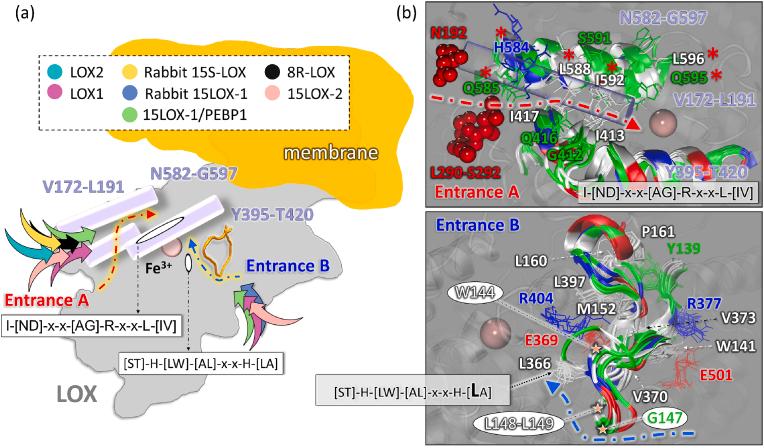
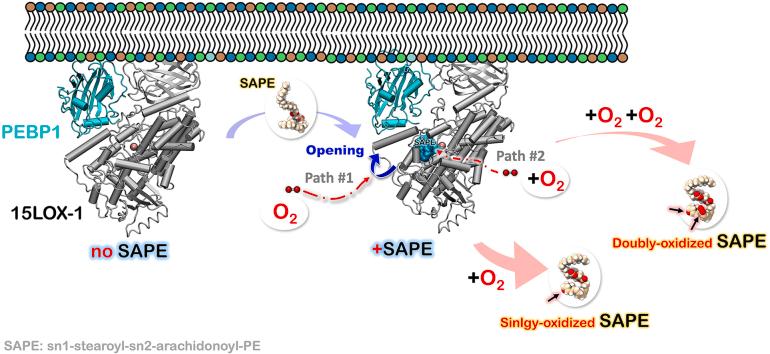
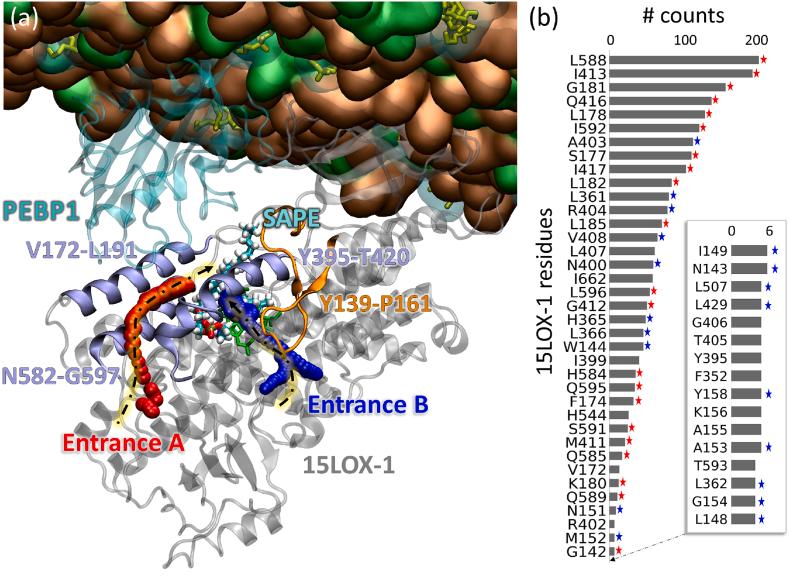
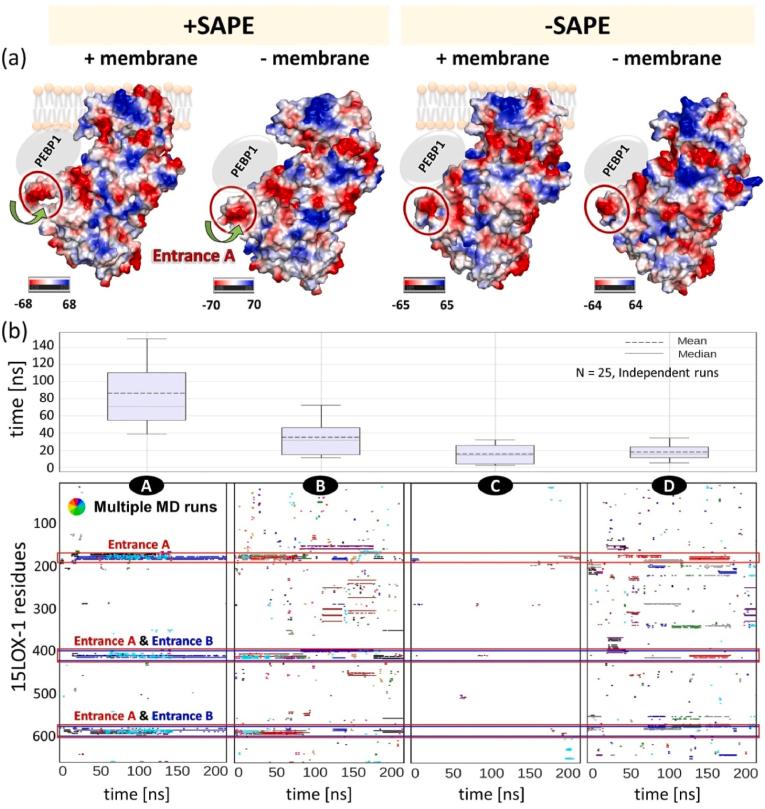
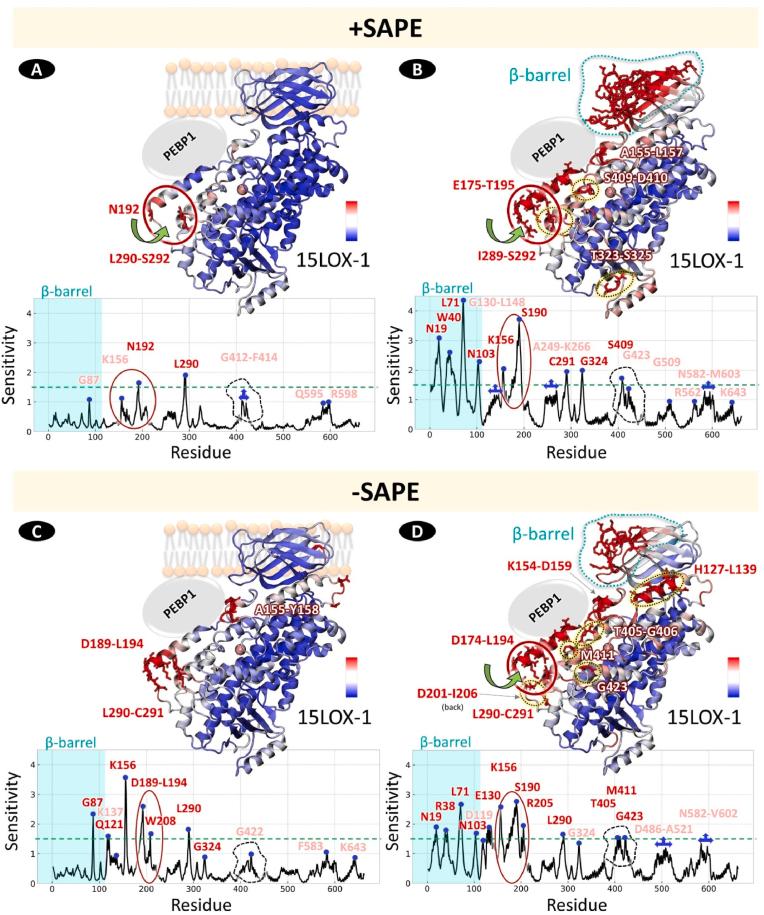
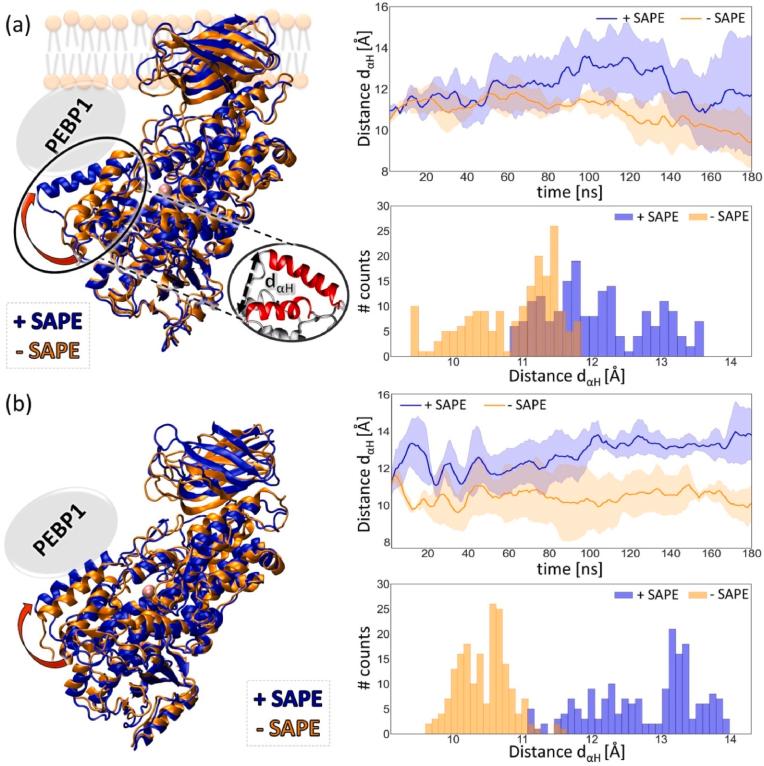
Ferroptosis is a regulated form of cell death driven by lipid peroxidation, with 15-lipoxygenase (15LOX) enzyme playing a critical role in catalyzing the oxygenation of polyunsaturated fatty acid-containing phospholipids, such as 1-stearoyl-2-arachidonoyl-sn-glycero-3-phosphoethanolamine (SAPE), to initiate this process. The molecular oxygen required for this catalytic reaction is subject to continuous competition among various oxygen-consuming enzymes, which influences the efficiency of lipid peroxidation. In this study, we utilized structure-based modeling and all-atom molecular dynamics simulations to explore the oxygen diffusion pathways in 15LOX-1 under varying oxygen concentrations and in the presence of key components, including a substrate, binding partner PE-binding protein 1 (PEBP1), and the membrane environment. Extensive computational experiments were performed on various system configurations, examining the role of substrate binding, membrane presence, and PEBP1 association in oxygen acquisition. Our computational results indicate that the substrate binding induces a conformational change in 15LOX-1, facilitating the simultaneous recruitment of one or two O molecules, which drive peroxidation, leading predominantly to monohydroperoxide products and, less frequently, to dihydroperoxide products. A similar trend was observed in our redox lipidomics analysis. Moreover, we noticed that the presence of the membrane significantly reduces irrelevant oxygen binding spots, directing oxygen molecules toward a primary tunnel essential for the catalytic activity. We identified two primary oxygen tunnels with sequentially and structurally conserved regions across the lipoxygenase family. These findings provide novel insights into the regulation of oxygen acquisition mechanism for LOX members, shedding light on the molecular basis of ferroptosis signaling.
铁死亡是一种由脂质过氧化驱动的程序性细胞死亡形式,15-脂氧合酶(15LOX)在催化含多不饱和脂肪酸的磷脂(如1-硬脂酰-2-花生四烯酰-sn-甘油-3-磷酸乙醇胺(SAPE))的氧化以启动这一过程中起关键作用。该催化反应所需的分子氧在各种耗氧酶之间持续竞争,这影响脂质过氧化的效率。在本研究中,我们利用基于结构的建模和全原子分子动力学模拟,探索了在不同氧浓度下以及在关键成分(包括底物、结合伴侣PE结合蛋白1(PEBP1)和膜环境)存在的情况下,15LOX-1中的氧扩散途径。对各种系统配置进行了广泛的计算实验,研究了底物结合、膜的存在以及PEBP1结合在氧获取中的作用。我们的计算结果表明,底物结合诱导15LOX-1发生构象变化,促进同时募集一个或两个O分子,这些分子驱动过氧化反应,主要产生单氢过氧化物产物,较少产生二氢过氧化物产物。在我们的氧化还原脂质组学分析中也观察到了类似的趋势。此外,我们注意到膜的存在显著减少了无关的氧结合位点,将氧分子导向催化活性所必需的主要通道。我们在脂氧合酶家族中鉴定出两个具有序列和结构保守区域的主要氧通道。这些发现为脂氧合酶成员的氧获取机制调控提供了新的见解,揭示了铁死亡信号传导的分子基础。

 Zotero 插件