
抑郁症部分通过对体重指数和高血压的影响降低认知功能:一项大型观察性研究和孟德尔随机化分析。
Depression reduces cognitive function partly through effects on BMI and hypertension: a large observational study and Mendelian randomization analysis.
作者信息
Gong Hongyang, Wang Zhao, Chen Yanyan, Mi Taotao, Wang Yanxin
机构信息
Department of Physiology, College of Medicine, Chosun University, Gwangju, Korea.
Department of Neurology, The First Affiliated Hospital of Anhui University of Traditional Chinese Medicine, No. 117, Meishan Road, Hefei, 230031, Anhui, China.
出版信息
BMC Psychiatry. 2025 Apr 17;25(1):393. doi: 10.1186/s12888-025-06846-9.
BACKGROUND
While abundant evidence suggests a correlation between depression and the risk of cognitive impairments, the causal relationship, as well as the mechanisms mediating this association, remain uncertain.
METHODS
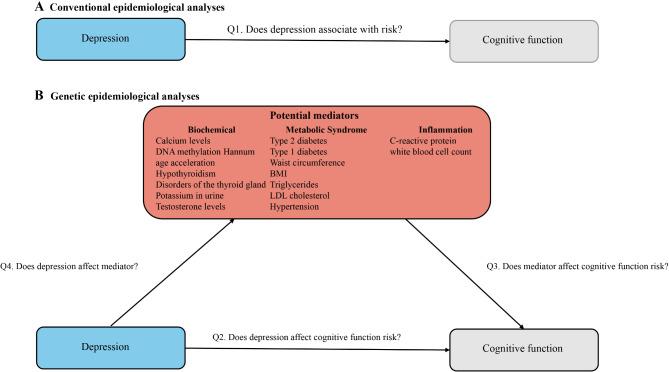
We conducted an observational study within the National Health and Nutrition Examination Survey (NHANES), simultaneously employing weighted multivariable-adjusted linear regression to explore the association between them. Subsequently, Mendelian randomization analysis was employed to investigate the causal relationship between them as well as the mediating effects.
RESULTS
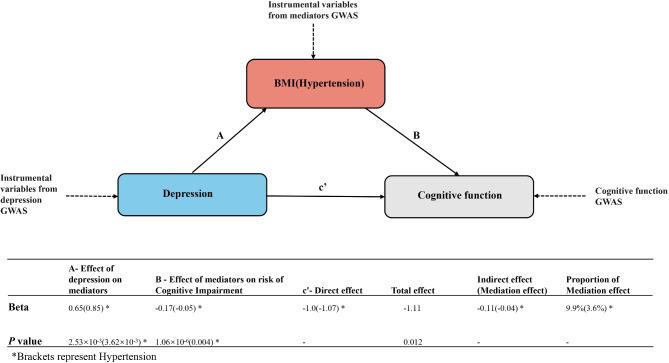
The observational analysis of NHANES data indicates that depression is independently associated with cognitive function. Regarding MR, genetically predicted depression is causally related to cognitive function in the IVW method (OR 0.33, 95% CI 0.14-0.78, P = 0.012). Furthermore, depression leads to obesity (OR = 1.91, P = 2.53 × 10 - 3) and elevated blood pressure (OR 2.34, P = 3.62 × 10 - 3). Waist circumference (OR = 0.85, P = 3.00 × 10 - 4), BMI (OR = 0.84, P = 1.06 × 10 - 6), and hypertension (OR = 0.95, P = 4.00 × 10 - 3) all contribute to cognitive function. Additionally, there is no causal association between cognitive function and depression (OR 1.00, 95% CI 0.99-1.01, P = 0.559) in reverse Mendelian randomization. Mediation analysis indicates that BMI and hypertension mediate 9.9% and 3.6% of the cognitive function under depression conditions, respectively.
CONCLUSIONS
Our study indicates that depression can lead to obesity and hypertension, which can reduce cognitive function. These findings underscore the importance of timely identification and management of depression in patients with cognitive impairments and suggest that treatments aimed at reducing weight and lowering blood pressure may help prevent cognitive impairment.
背景
尽管大量证据表明抑郁症与认知障碍风险之间存在关联,但因果关系以及介导这种关联的机制仍不确定。
方法
我们在美国国家健康与营养检查调查(NHANES)中进行了一项观察性研究,同时采用加权多变量调整线性回归来探讨它们之间的关联。随后,采用孟德尔随机化分析来研究它们之间的因果关系以及中介效应。
结果
对NHANES数据的观察性分析表明,抑郁症与认知功能独立相关。关于孟德尔随机化,在逆方差加权法(IVW)中,基因预测的抑郁症与认知功能存在因果关系(比值比0.33,95%置信区间0.14 - 0.78,P = 0.012)。此外,抑郁症会导致肥胖(比值比 = 1.91,P = 2.53×10⁻³)和血压升高(比值比2.34,P = 3.62×10⁻³)。腰围(比值比 = 0.85,P = 3.00×10⁻⁴)、体重指数(比值比 = 0.84,P = 1.06×10⁻⁶)和高血压(比值比 = 0.95,P = 4.00×10⁻³)均对认知功能有影响。此外,在反向孟德尔随机化中,认知功能与抑郁症之间无因果关联(比值比1.00,95%置信区间0.99 - 1.01,P = 0.559)。中介分析表明,在抑郁症情况下,体重指数和高血压分别介导了9.9%和3.6%的认知功能。
结论
我们的研究表明,抑郁症可导致肥胖和高血压,进而降低认知功能。这些发现强调了及时识别和管理认知障碍患者抑郁症的重要性,并表明旨在减轻体重和降低血压的治疗可能有助于预防认知障碍。
 Zotero 插件