
使用健康应用程序的心血管疾病患者的健康行为和疾病自我管理指标:一项随机对照试验的结果
Health behavior and disease self-management indicators in patients with cardiovascular diseases using a health app: Findings from an RCT.
作者信息
Lippke Sonia, Korte Luisa, Kumar Vinayak Anand, Fach Andreas, Ratz Tiara
机构信息
Health Promotion and Prevention Unit, Department of Health Sciences, Hamburg University of Applied Sciences/Hochschule für Angewandte Wissenschaften Hamburg (HAW Hamburg), Hamburg, Germany.
Health Psychology & Behavioral Medicine Lab, School of Business, Social and Decision Sciences, Constructor University, Bremen, Germany.
出版信息
AIMS Public Health. 2025 Feb 26;12(1):233-258. doi: 10.3934/publichealth.2025015. eCollection 2025.
BACKGROUND
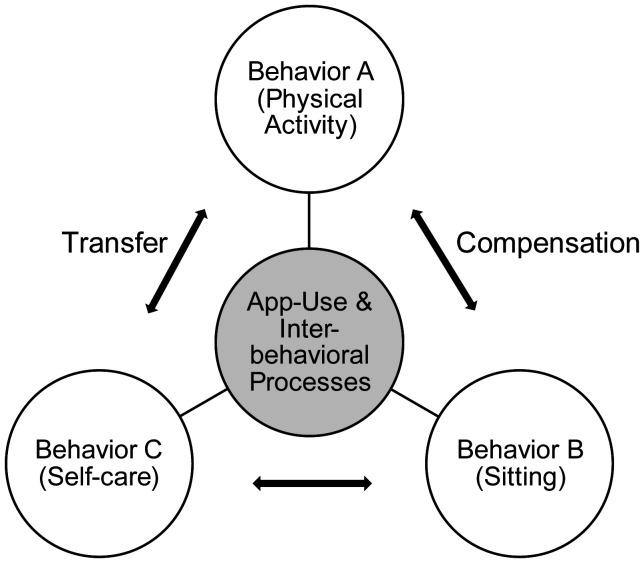
Prevention of acute cardiovascular events in patients with cardiovascular disease (CVD) requires promoting health-protective behaviors (e.g., physical activity) and reducing health-compromising behaviors (e.g., sitting). Digital interventions addressing health behavior offer great potential. Based on a multiple behavior change theory, an intervention in the form of a digital health application (app) was evaluated in a pilot trial, testing the following hypotheses (H): H1: Health behaviors (physical activity, sitting) and disease self-management (self-care maintenance, self-care confidence) are closely related; H2: changes in health behaviors and disease self-management indicators over time (T0 to T1) are more pronounced in the intervention group (IG, app users) than in the control group (CG); H3: within the IG, changes in systolic and diastolic blood pressure indicate a positive trajectory.
METHODS
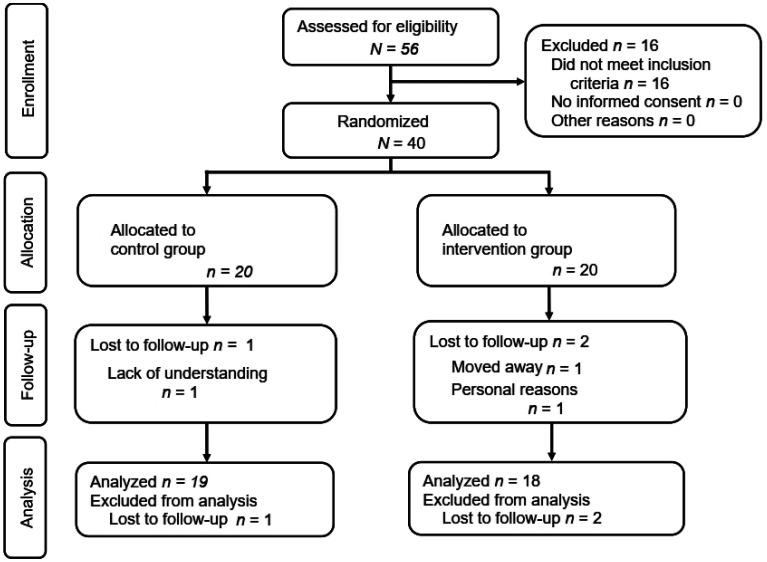
A 12-week randomized controlled trial (RCT) was conducted with two measurement points. The IG received an app addressing self-management and health behavior change. A total of = 40 CVD patients were randomized equally to the CG (45% women; mean age = 60.6 years) and the IG (35% women; mean age = 61.5 years).
RESULTS
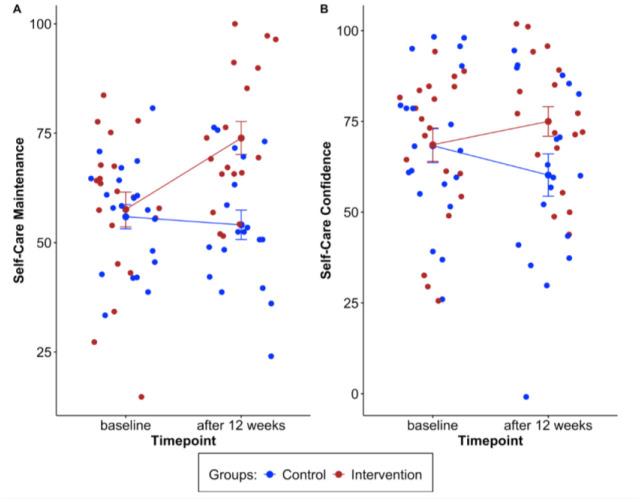
Findings support H1 with correlations between behaviors ( = -0.66-0.79) and disease self-management ( = -0.06-0.70). H2 was also partially supported, with significant improvements over time in self-management indicators, especially self-care maintenance, in the IG (Eta² = 0.35; < 0.001). H3 could not be confirmed as no significant changes were found.
CONCLUSIONS
This study provides evidence that an app addressing different behavior change techniques (BCTs) can help to manage CVD by promoting health-protective behaviors and preventing health-compromising behaviors. Taking different behaviors into account may increase the effectiveness of behavioral intervention, thereby improving individual and public health. Replications with larger samples and more objective measures are needed.
背景
预防心血管疾病(CVD)患者的急性心血管事件需要促进健康保护行为(如体育活动)并减少危害健康的行为(如久坐)。针对健康行为的数字干预具有巨大潜力。基于多行为改变理论,在一项试点试验中评估了以数字健康应用程序(应用)形式进行的干预,检验以下假设(H):H1:健康行为(体育活动、久坐)与疾病自我管理(自我护理维持、自我护理信心)密切相关;H2:随着时间推移(从T0到T1),干预组(IG,应用程序用户)的健康行为和疾病自我管理指标变化比对照组(CG)更明显;H3:在IG组内,收缩压和舒张压的变化表明呈积极轨迹。
方法
进行了一项为期12周的随机对照试验(RCT),有两个测量点。IG组使用一款针对自我管理和健康行为改变的应用程序。总共40名CVD患者被平均随机分配到CG组(45%为女性;平均年龄 = 60.6岁)和IG组(35%为女性;平均年龄 = 61.5岁)。
结果
研究结果支持H1,行为(r = -0.66 - 0.79)与疾病自我管理(r = -0.06 - 0.70)之间存在相关性。H2也得到部分支持,IG组自我管理指标随时间有显著改善,尤其是自我护理维持方面(Eta² = 0.35;p < 0.001)。H3未得到证实,因为未发现显著变化。
结论
本研究提供了证据,表明一款涉及不同行为改变技术(BCTs)的应用程序可通过促进健康保护行为和预防危害健康的行为来帮助管理CVD。考虑不同行为可能会提高行为干预的有效性,从而改善个人和公众健康。需要用更大样本和更客观的测量方法进行重复研究。
 Zotero 插件