
脉冲激光与Janus粒子相互作用的动力学
Dynamics of Pulsed-Laser Interaction with Janus Particles.
作者信息
Khoshzaban Alireza, Magazzú Alessandro, Donato Maria Grazia, Maragò Onofrio M, Unlu Mehmet Burcin, Cizmeciyan M Natali, Elahi Parviz
机构信息
Institute of Biomedical Engineering, Boğaziçi University, 34684 Istanbul, Turkey.
CNR-IPCF, Istituto per i Processi Chimico-Fisici, I-98158 Messina, Italy.
出版信息
ACS Photonics. 2025 Mar 12;12(4):1936-1943. doi: 10.1021/acsphotonics.4c02388. eCollection 2025 Apr 16.
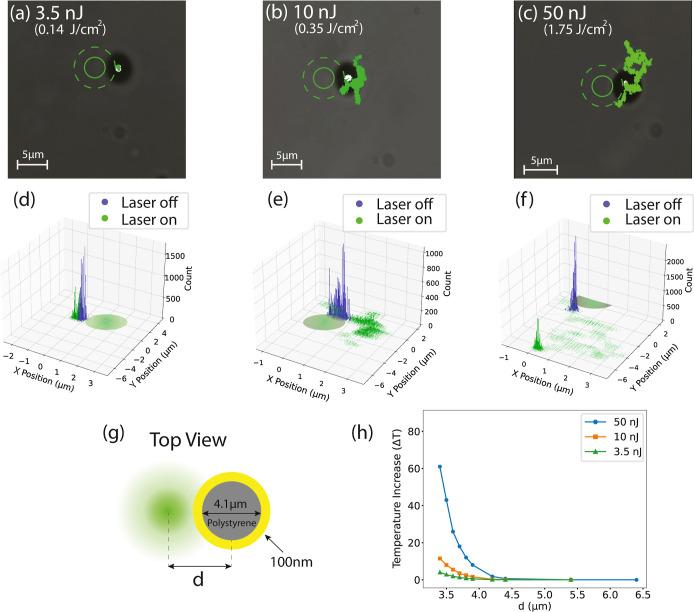
Janus particles, with their flexible chemistry and multifunctionality, have broadened the scope of the optical manipulation field as an emerging class of materials. Laser-based manipulation is particularly promising for half-metal-coated particles, offering a platform to study optical and thermal effects. However, the role of the laser's operation regime in particle behavior needs to be understood better. Hence, in this work, we studied the interaction of nanosecond-pulsed lasers on 4.1 μm Au-Janus particles with a 100 nm gold cap. We focused on the interaction in three sections: (1) We observed three pulse energy influence regimes: In the low-influence regime (less than ∼10 nJ), the particle maintains its intrinsic Brownian motion. In the medium-influence regime (less than ∼40 nJ), the particle exhibits an extended range of motion. In the high-influence regime (higher than ∼40 nJ), the particle undergoes superdiffusion and establishes a new equilibrium position. (2) During optical manipulation trials, a threshold pulse energy of 4 nJ (average power of 40 μW) was sufficient to move Au-Janus particles against the laser spot. We achieved translation velocities of 0.9-5.1 μm/s at 4-50 nJ. (3) The gold cap is damaged at 20 nJ (fluence of 0.7 J/cm) when the laser is focused on the particle, consistent with theoretical predictions, and the ablation process generates micro- and submicrometer gold particles. These findings reveal the potential of pulsed lasers for precise, power-efficient manipulation of Janus particles, advancing our understanding of laser-particle interactions and opening new pathways for optical manipulation applications.
双面粒子因其灵活的化学性质和多功能性,作为一类新兴材料拓宽了光操纵领域的范围。基于激光的操纵对于半金属包覆粒子尤其具有前景,为研究光学和热效应提供了一个平台。然而,激光的运行模式在粒子行为中的作用尚需更深入了解。因此,在这项工作中,我们研究了纳秒脉冲激光与带有100纳米金帽的4.1微米金 - 双面粒子之间的相互作用。我们重点研究了三个方面的相互作用:(1)我们观察到三种脉冲能量影响模式:在低影响模式(小于约10纳焦)下,粒子保持其固有的布朗运动。在中等影响模式(小于约40纳焦)下,粒子表现出更广泛的运动范围。在高影响模式(高于约40纳焦)下,粒子经历超扩散并建立新的平衡位置。(2)在光操纵试验中,4纳焦(平均功率40微瓦)的阈值脉冲能量足以使金 - 双面粒子逆着激光光斑移动。在4 - 50纳焦时,我们实现了0.9 - 5.1微米/秒的平移速度。(3)当激光聚焦在粒子上时,金帽在20纳焦(通量为0.7焦/平方厘米)时受损,这与理论预测一致,并且烧蚀过程产生微米级和亚微米级的金粒子。这些发现揭示了脉冲激光在精确、高效操纵双面粒子方面的潜力,增进了我们对激光 - 粒子相互作用的理解,并为光操纵应用开辟了新途径。



 Zotero 插件