
甲状腺功能减退犬血清生物标志物的氧化还原状态及其左甲状腺素钠治疗
Redox status of biomarkers in serum of dogs with hypothyroidism and its treatment with levothyroxine sodium.
作者信息
Zhu Ling, Han Jinge, Bahetijiang Halihaxi, Liu Gang, Kastelic John P, Zhou Xueying, Han Bo
机构信息
College of Veterinary Medicine, China Agricultural University, Beijing, China.
College of Animal Science and Veterinary Medicine, Tianjin Agricultural University, Tianjin, China.
出版信息
Front Vet Sci. 2025 Apr 4;12:1490369. doi: 10.3389/fvets.2025.1490369. eCollection 2025.
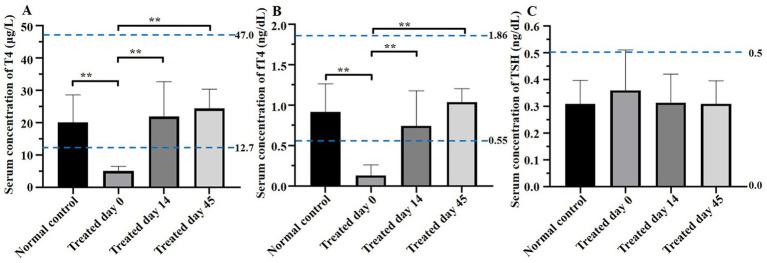
Information regarding canine hypothyroidism in China remains limited, particularly regarding the redox status of affected dogs. Therefore, the objective of this study was to evaluate the redox status of dogs with hypothyroidism and observe how it changed after levothyroxine replacement therapy. A total of 10 healthy dogs (control group) and 10 dogs with hypothyroidism (treatment group) from China Agricultural University Veterinary Teaching Hospital were included in the study. The redox status was assessed in all 20 dogs. Thyroid profiles such as thyroxine (T4), free thyroxine (fT4), and thyroid-stimulating hormone (TSH) and biomarkers of oxidative stress, including superoxide dismutase (SOD), catalase (CAT), glutathione peroxidase (GSH-px), and malondialdehyde (MDA), were assessed on day 0 in all dogs and on days 14 and 45 post-levothyroxine sodium treatment in dogs with hypothyroidism. Dogs with hypothyroidism had decreased levels of serum T4 and fT4 and increased levels of serum TSH. Based on SOD, CAT, GSH-px, and MDA, dogs with hypothyroidism had oxidative stress. Following 45-day treatment with levothyroxine sodium (0.02 mg/kg orally twice daily), antioxidant parameters improved progressively: SOD increased from 60.2 to 76.7 U/mL (Day 0-14) and further to 83.3 U/mL (Day 45); CAT from 105.9 to 115.5 mU/mL (Day 0-14) reaching 132.9 mU/mL (Day 45); GSH-Px from 10.2 to 8.4 U/mL (Day 0-14) then 9.7 U/mL (Day 45), while MDA decreased from 8.2→6.8→4.4 μmol/L correspondingly. In conclusion, increased serum TSH and MDA concentrations, in addition to decreased serum T4 and fT4 concentrations and decreased SOD and CAT activities, indicated that there was oxidative stress in dogs with hypothyroidism. However, there were significant improvements in the redox status of biomarkers in the serum of dogs with hypothyroidism after treatment with levothyroxine sodium (0.02 mg/kg twice daily) for 45 days.
在中国,关于犬甲状腺功能减退症的信息仍然有限,尤其是关于患病犬的氧化还原状态。因此,本研究的目的是评估甲状腺功能减退症犬的氧化还原状态,并观察左甲状腺素替代治疗后其如何变化。本研究纳入了来自中国农业大学动物医院的10只健康犬(对照组)和10只甲状腺功能减退症犬(治疗组)。对所有20只犬的氧化还原状态进行了评估。在第0天对所有犬以及在甲状腺功能减退症犬左甲状腺素钠治疗后的第14天和第45天,评估了甲状腺指标,如甲状腺素(T4)、游离甲状腺素(fT4)和促甲状腺激素(TSH),以及氧化应激生物标志物,包括超氧化物歧化酶(SOD)、过氧化氢酶(CAT)、谷胱甘肽过氧化物酶(GSH-px)和丙二醛(MDA)。甲状腺功能减退症犬的血清T4和fT4水平降低,血清TSH水平升高。基于SOD、CAT、GSH-px和MDA,甲状腺功能减退症犬存在氧化应激。左甲状腺素钠(0.02mg/kg口服,每日两次)治疗45天后,抗氧化参数逐渐改善:SOD从60.2升至76.7U/mL(第0天至第14天),并进一步升至83.3U/mL(第45天);CAT从105.9升至115.5mU/mL(第0天至第14天),达到132.9mU/mL(第45天);GSH-Px从10.2降至8.4U/mL(第0天至第14天),然后为9.7U/mL(第45天),而MDA相应地从8.2→6.8→4.4μmol/L下降。总之,血清TSH和MDA浓度升高,以及血清T4和fT4浓度降低以及SOD和CAT活性降低,表明甲状腺功能减退症犬存在氧化应激。然而,左甲状腺素钠(0.02mg/kg,每日两次)治疗45天后,甲状腺功能减退症犬血清中生物标志物的氧化还原状态有显著改善。

 Zotero 插件