
mdciao:分子动力学模拟数据的可访问分析与可视化
mdciao: Accessible Analysis and Visualization of Molecular Dynamics Simulation Data.
作者信息
Pérez-Hernández Guillermo, Hildebrand Peter W
机构信息
Charité - Universitätsmedizin Berlin, corporate member of Freie Universität Berlin and Humboldt-Universität zu Berlin, Institute of Medical Physics and Biophysics, Berlin, Germany.
Universität Leipzig, Medizinische Fakultät, Institut für Medizinische Physik und Biophysik, Leipzig, Germany.
出版信息
PLoS Comput Biol. 2025 Apr 21;21(4):e1012837. doi: 10.1371/journal.pcbi.1012837. eCollection 2025 Apr.
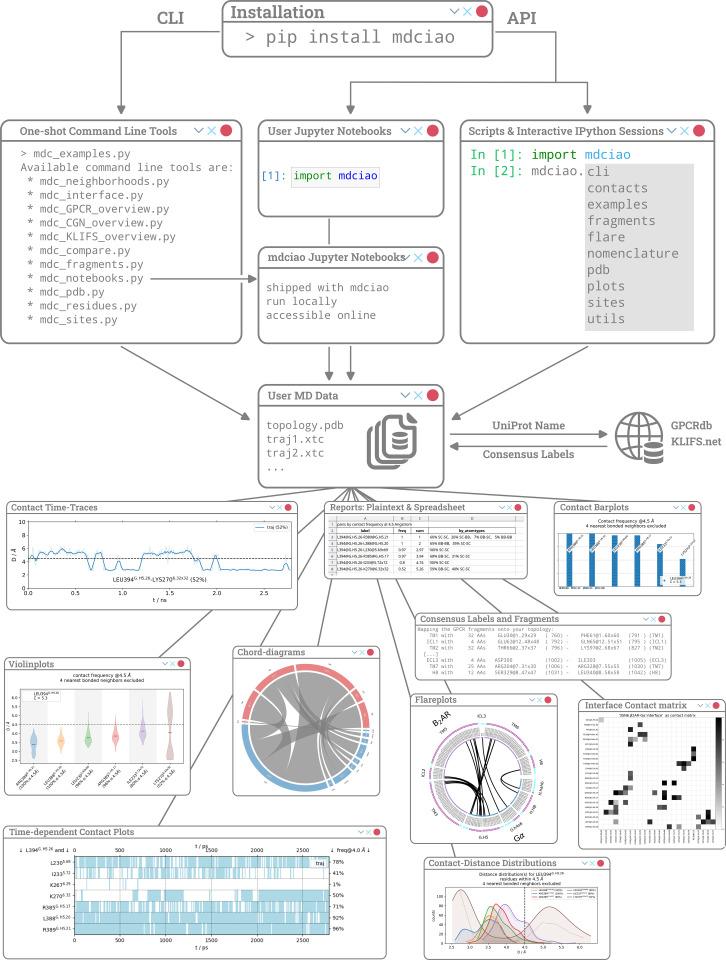
We present mdciao, an open-source command line tool and Python Application-Programming-Interface (API) for easy, one-shot analysis and representation of molecular dynamics (MD) simulation data. Building upon the widely used concept of residue-residue contact-frequencies, mdciao offers a wide spectrum of further analysis and representations, enriched with available domain specific annotations. The user-friendly interface offers pre-packaged solutions for non-expert users, while keeping customizability for expert ones. Emphasis has been put into automatically producing annotated, production-ready figures and tables. Furthermore, seamless on-the-fly query and inclusion of domain-specific generic residue numbering for GPCRs, GAIN-domains, G-proteins, and kinases is made possible through online lookups. This allows for easy selection and comparison across different systems, regardless of sequence identity, target residues or domains. Finally, the fully documented Python API allows users to include the basic or advanced mdciao functions in their analysis workflows, and provides numerous examples and Jupyter Notebook Tutorials. The source code is published under the GNU Lesser General Public License v3.0 or later and hosted on https://github.com/gph82/mdciao, and the documentation, including guides and examples, can be found at https://www.mdciao.org.
我们展示了mdciao,这是一个开源的命令行工具和Python应用程序编程接口(API),用于轻松、一次性地分析和呈现分子动力学(MD)模拟数据。基于广泛使用的残基-残基接触频率概念,mdciao提供了广泛的进一步分析和表示方法,并丰富了可用的特定领域注释。用户友好的界面为非专业用户提供了预包装的解决方案,同时为专业用户保留了可定制性。重点在于自动生成带注释的、可用于生产的图表和表格。此外,通过在线查找,可以无缝实时查询并纳入GPCR、GAIN结构域、G蛋白和激酶的特定领域通用残基编号。这使得无论序列同一性、目标残基或结构域如何,都能轻松地在不同系统之间进行选择和比较。最后,文档齐全的Python API允许用户在其分析工作流程中包含基本或高级的mdciao功能,并提供了大量示例和Jupyter Notebook教程。源代码根据GNU Lesser General Public License v3.0或更高版本发布,并托管在https://github.com/gph82/mdciao上,文档(包括指南和示例)可在https://www.mdciao.org上找到。

 Zotero 插件