
靶向NRF2的表观遗传和翻译后修饰:疾病治疗中的关键调控因子
Targeting epigenetic and post-translational modifications of NRF2: key regulatory factors in disease treatment.
作者信息
Yang Xinyi, Liu Yingchao, Cao Jinghao, Wu Cuiyun, Tang Lusheng, Bian Wenxia, Chen Yuhan, Yu Lingyan, Wu Yunyi, Li Sainan, Shen Yuhuan, Xia Jun, Du Jing
机构信息
Laboratory Medicine Center, Department of Clinical Laboratory, Zhejiang Provincial People's Hospital (Affiliated People's Hospital), Hangzhou Medical College, Hangzhou, Zhejiang, 310014, China.
Cancer Center, Department of Radiology, Zhejiang Provincial People's Hospital (Affiliated People's Hospital), Hangzhou Medical College, Hangzhou, Zhejiang, China.
出版信息
Cell Death Discov. 2025 Apr 21;11(1):189. doi: 10.1038/s41420-025-02491-z.
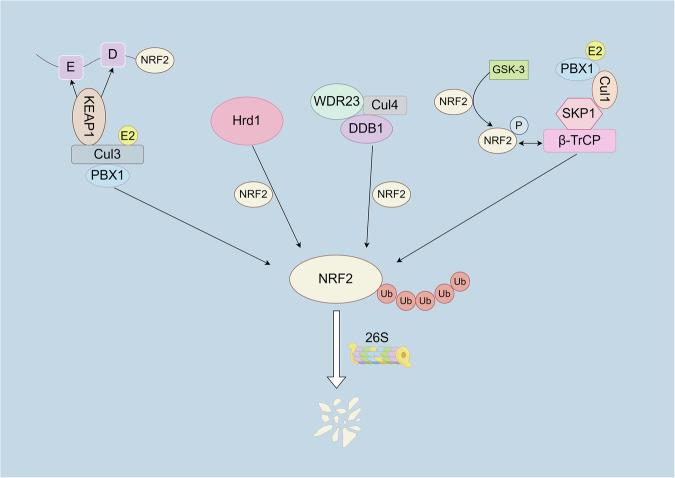
Nuclear factor erythroid 2-related factor 2 (NRF2) is a key transcription factor involved in regulating cellular antioxidant defense and detoxification mechanisms. It mitigates oxidative stress and xenobiotic-induced damage by inducing the expression of cytoprotective enzymes, including HO-1 and NQO1. NRF2 also modulates inflammatory responses by inhibiting pro-inflammatory genes and mediates cell death pathways, including apoptosis and ferroptosis. Targeting NRF2 offers potential therapeutic avenues for treating various diseases. NRF2 is regulated through two principal mechanisms: post-translational modifications (PTMs) and epigenetic alterations. PTMs, including phosphorylation, ubiquitination, and acetylation, play a pivotal role in modulating NRF2's stability, activity, and subcellular localization, thereby precisely controlling its function in the antioxidant response. For instance, ubiquitination can lead to NRF2 degradation and reduced antioxidant activity, while deubiquitination enhances its stability and function. Epigenetic modifications, such as DNA methylation, histone modifications, and interactions with non-coding RNAs (e.g., MALAT1, PVT1, MIR4435-2HG, and TUG1), are essential for regulating NRF2 expression by modulating chromatin architecture and gene accessibility. This paper systematically summarizes the molecular mechanisms by which PTMs and epigenetic alterations regulate NRF2, and elucidates its critical role in cellular defense and disease. By analyzing the impact of PTMs, such as phosphorylation, ubiquitination, and acetylation, as well as DNA methylation, histone modifications, and non-coding RNA interactions on NRF2 stability, activity, and expression, the study reveals the complex cellular protection network mediated by NRF2. Furthermore, the paper explores how these regulatory mechanisms affect NRF2's roles in oxidative stress, inflammation, and cell death, identifying novel therapeutic targets and strategies. This provides new insights into the treatment of NRF2-related diseases, such as cancer, neurodegenerative disorders, and metabolic syndrome. This research deepens our understanding of NRF2's role in cellular homeostasis and lays the foundation for the development of NRF2-targeted therapies.
核因子红细胞2相关因子2(NRF2)是一种关键的转录因子,参与调节细胞抗氧化防御和解毒机制。它通过诱导包括HO-1和NQO1在内的细胞保护酶的表达来减轻氧化应激和外源性物质诱导的损伤。NRF2还通过抑制促炎基因来调节炎症反应,并介导细胞死亡途径,包括细胞凋亡和铁死亡。靶向NRF2为治疗各种疾病提供了潜在的治疗途径。NRF2通过两种主要机制进行调节:翻译后修饰(PTM)和表观遗传改变。PTM,包括磷酸化、泛素化和乙酰化,在调节NRF2的稳定性、活性和亚细胞定位方面起着关键作用,从而精确控制其在抗氧化反应中的功能。例如,泛素化可导致NRF2降解并降低抗氧化活性,而去泛素化则增强其稳定性和功能。表观遗传修饰,如DNA甲基化、组蛋白修饰以及与非编码RNA(如MALAT1、PVT1、MIR4435-2HG和TUG1)的相互作用,对于通过调节染色质结构和基因可及性来调节NRF2表达至关重要。本文系统地总结了PTM和表观遗传改变调节NRF2的分子机制,并阐明了其在细胞防御和疾病中的关键作用。通过分析磷酸化、泛素化和乙酰化等PTM以及DNA甲基化、组蛋白修饰和非编码RNA相互作用对NRF2稳定性、活性和表达的影响,该研究揭示了由NRF2介导的复杂细胞保护网络。此外,本文探讨了这些调节机制如何影响NRF2在氧化应激、炎症和细胞死亡中的作用,确定了新的治疗靶点和策略。这为治疗与NRF2相关的疾病,如癌症、神经退行性疾病和代谢综合征提供了新的见解。这项研究加深了我们对NRF2在细胞稳态中作用的理解,并为开发靶向NRF2的疗法奠定了基础。


 Zotero 插件