
适合手术的转移性胃癌——巴西胃肠肿瘤组(GTG)的治疗顺序实用算法
Metastatic gastric cancer in fit patients-a practical algorithm of treatment sequencing from the Brazilian Group of Gastrointestinal Tumours (GTG).
作者信息
Peixoto Renata D'Alpino, Prolla Gabriel, Coutinho Anelisa Kruschewsky, de Oliveira Julia Andrade, E Silva Virgilio Souza, Riechelmann Rachel, de Mendonça Rego Juliana Florinda, de Jesus Victor Hugo Fonseca, Weschenfelder Rui Fernando
机构信息
BC Cancer Agency, Vancouver, BC V5Z 4E6, Canada.
Oncoclínicas, Porto Alegre 90570-020, Brazil.
出版信息
Ecancermedicalscience. 2025 Feb 13;19:1848. doi: 10.3332/ecancer.2025.1848. eCollection 2025.
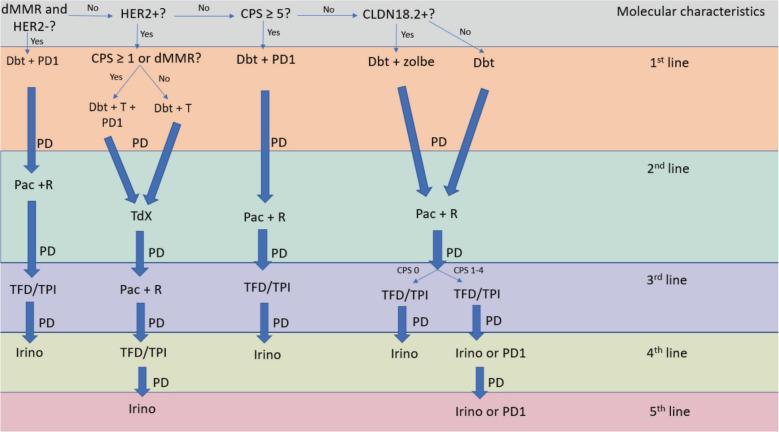
Recent advancements in biomarker-driven therapies have significantly transformed the treatment paradigm for unresectable metastatic gastric cancer (mGC). These innovations, however, have introduced not only issues related to accessibility but also complexities for treating physicians, particularly general oncologists, in selecting the most appropriate treatment for each patient and deciding on the best sequencing strategy. This manuscript presents an algorithm developed by the Brazilian Group of Gastrointestinal Tumours, designed to provide straightforward guidance in the management of unresectable mGC. This algorithm, grounded in evidence for fit patients, aims to streamline therapeutic decision-making in clinical practice, assuming the absence of access and resource constraints.
生物标志物驱动疗法的最新进展显著改变了不可切除转移性胃癌(mGC)的治疗模式。然而,这些创新不仅带来了可及性相关问题,也给治疗医生,尤其是普通肿瘤内科医生,在为每位患者选择最合适的治疗方法以及决定最佳的治疗顺序策略方面带来了复杂性。本文介绍了巴西胃肠肿瘤研究组开发的一种算法,旨在为不可切除mGC的管理提供直接指导。该算法基于适合患者的证据,旨在在临床实践中简化治疗决策,假定不存在获取和资源限制。
 Zotero 插件