
肿瘤治疗中妇科患者的复原力与脆弱性:耻辱感和健康素养的链式中介作用
Resilience and frailty among gynecological patients in oncological treatment: the chain mediating role of stigma and health literacy.
作者信息
Man Shuo, Wu Xiaofang, Huang HaoWen, Yu Jinjin, Xia Ling
机构信息
Obstetrics and Gynecology Department, Affiliated Hospital of Jiangnan University, Wuxi, Jiangsu, China.
Jiangnan University Wuxi Medical College, Wuxi, Jiangsu, China.
出版信息
Front Psychiatry. 2025 Apr 2;16:1497074. doi: 10.3389/fpsyt.2025.1497074. eCollection 2025.
BACKGROUND
Frailty poses a significant threat to the health status among gynecological patients in oncological treatment. Previous studies have shown that resilience, stigma, and health literacy are associated with frailty. However, their effects and potential relationship with frailty among gynecological patients in oncological treatment have not been fully studied.
OBJECTIVE
The study aimed to explore the mediation role of stigma and health literacy between resilience and frailty among gynecological patients in oncological treatment.
METHODS
A total of 202 gynecological patients in oncological treatment in three gynecological wards of a tertiary hospital in Wuxi from March 2024 to May 2024 were selected for the study using a cross-sectional research method. A convenience sampling method was used. Information was collected on demographic characteristics, resilience, stigma, health literacy, and frailty. The PROCESS macro program was used to explore the mediating role of stigma and health literacy in the relationship between resilience and frailty.
RESULTS
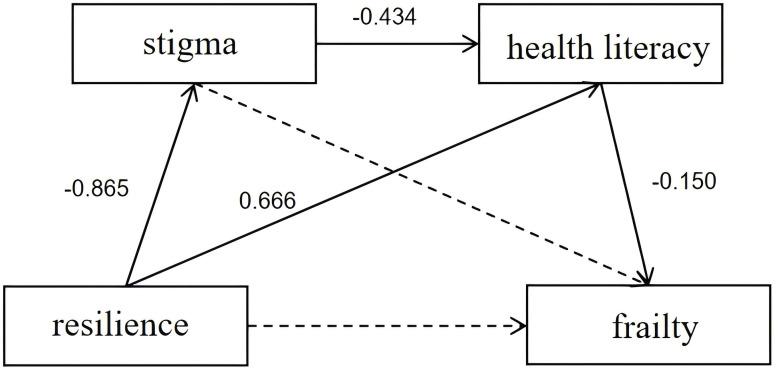
The prevalence of frailty among gynecological patients in oncological treatment was 27.2%. The mediation effect results demonstrated that resilience was not a direct predictor of frailty (β = -0.010, 95%CI: -0.084 ~0.065) but indirectly predicted frailty through health literacy (β = -0.100, 95%CI: -0.155 ~ -0.053) and stigma-health literacy (β = -0.056, 95%CI: -0.091 ~ -0.029). However, no significant mediating effect of stigma alone was found (β = -0.038, 95%CI: -0.085 ~ 0.005).
CONCLUSIONS
The findings reveal the impact and potential relationship of resilience and frailty among gynecological patients in oncological treatment in patients with gynecologic oncology. Health literacy mediated the effect between resilience and frailty. Stigma and health literacy were chain mediators in the link between resilience and frailty. Healthcare professionals should pay timely attention to the psychological and mental status of gynecological patients in oncological treatment patients with gynecologic oncology and take measures to improve health literacy.
背景
虚弱对肿瘤治疗中的妇科患者健康状况构成重大威胁。以往研究表明,心理韧性、耻辱感和健康素养与虚弱有关。然而,它们在肿瘤治疗中的妇科患者中对虚弱的影响及潜在关系尚未得到充分研究。
目的
本研究旨在探讨耻辱感和健康素养在肿瘤治疗中的妇科患者心理韧性与虚弱之间的中介作用。
方法
采用横断面研究方法,选取2024年3月至2024年5月无锡市某三级医院三个妇科病房的202例肿瘤治疗中的妇科患者进行研究。采用便利抽样法。收集患者的人口学特征、心理韧性、耻辱感、健康素养和虚弱情况等信息。使用PROCESS宏程序探讨耻辱感和健康素养在心理韧性与虚弱关系中的中介作用。
结果
肿瘤治疗中的妇科患者虚弱患病率为27.2%。中介效应结果显示,心理韧性不是虚弱的直接预测因素(β = -0.010,95%CI:-0.0840.065),而是通过健康素养(β = -0.100,95%CI:-0.155 -0.053)和耻辱感-健康素养(β = -0.056,95%CI:-0.091~ -0.029)间接预测虚弱。然而,未发现单独耻辱感的显著中介效应(β = -0.038,95%CI:-0.085~0.005)。
结论
研究结果揭示了肿瘤治疗中的妇科患者心理韧性与虚弱之间的影响及潜在关系。健康素养介导了心理韧性与虚弱之间的效应。耻辱感和健康素养是心理韧性与虚弱之间联系的链式中介。医护人员应及时关注肿瘤治疗中的妇科患者的心理和精神状态,并采取措施提高其健康素养。

 Zotero 插件